Introduction
Industrial crushers and lump breakers combine four serious hazard categories in a single piece of equipment: rotating machinery, hazardous energy, airborne dust, and sustained noise. Managing all four at once demands more than a posted sign or a one-time operator orientation.
OSHA estimates that proper lockout/tagout compliance prevents approximately 120 fatalities and 50,000 injuries every year, with injured workers losing an average of 24 workdays per incident.
BLS data shows food manufacturing — one of the most common environments for lump breakers and crushers — carries a total recordable case rate of 3.3 per 100 full-time workers, well above the broader manufacturing average of 2.7.
Lost production, regulatory penalties, workers' compensation costs, and equipment damage compound quickly in high-throughput operations — consequences that show up on the balance sheet long after an incident closes.
This guide covers the safety standards that plant managers, operators, and maintenance teams must follow — from pre-operation checks through installation, daily operation, and environmental controls.
Key Takeaways
- Industrial crushers carry mechanical, dust, noise, and entrapment hazards that require formal, layered safety protocols
- Lockout/tagout (LOTO) is mandatory every time a crusher is serviced, adjusted, or cleared of a blockage
- PPE includes hard hats, safety glasses, steel-toed boots, hearing protection, and respirators where dust is present
- Equipment must match the application — mismatched construction materials introduce both safety and contamination risks
- Pre-shift inspections, hazard reporting, and documented maintenance are required daily — no exceptions
Safety Guidelines for Crusher Operation
Crushers and lump breakers generate hazards across multiple categories at once. Understanding each one is the starting point for managing them.
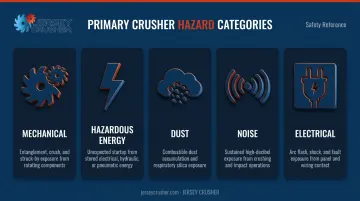
Primary hazard categories:
- Mechanical — rotating rotors, breaker bars, and discharge points; entrapment risk in feed and discharge zones; ejected material from overloaded or oversized feed
- Hazardous energy — stored electrical and mechanical energy during jam clearing, blade access, and maintenance; this is where LOTO failures occur
- Dust — inhalation hazard in virtually all bulk-solids processing; explosion hazard in grain, sugar, spice, chemical, and pharmaceutical environments
- Noise — sustained operation above OSHA's 85 dBA action level is common; long-latency hearing damage accumulates without obvious early symptoms
- Electrical — motor and control panel exposure during servicing and installation
No single control eliminates these risks. Safe crusher operation depends on equipment designed for the application, operators trained on that specific machine, and consistent daily discipline around inspections and housekeeping.
General Safety Precautions
All personnel working near operating crushers must wear appropriate PPE matched to the actual hazards present. Under OSHA 1910.132, employers must assess the workplace, select appropriate PPE, and train workers before they operate or maintain equipment.
Minimum PPE for crusher environments:
- ANSI/ISEA Z89.1-rated hard hat for overhead and impact hazards
- ANSI Z87.1-rated safety glasses for eye and face protection
- ASTM F2413-rated steel-toed boots for foot protection
- High-visibility clothing in shared or multi-equipment environments
- Hearing protection rated for sustained exposure at or above 85 dBA
- N95 respirator or better (selected under OSHA 1910.134 based on material type) in enclosed powder processing environments
Beyond PPE, baseline workspace requirements include:
- All guards confirmed in place and functional before startup — no exceptions
- Walkways, platforms, and discharge areas kept clear between every shift
- Pre-operation hazard assessment covering site conditions, nearby equipment activity, and shift-change status — not just a one-time initial setup review
Safety During Installation
Installation creates a distinct set of risks separate from normal operation. A crusher being positioned, wired, and commissioned is heavy, electrically active, and surrounded by people working in close proximity.
Stop-work conditions during installation include:
- Power supply not confirmed isolated
- Mounting surface not rated for equipment load
- Guards not yet fitted
- Personnel not cleared from the immediate work zone
Lifting and positioning require rated rigging equipment, a documented lift plan per ASME B30 standards, and a strict rule: no personnel under suspended loads at any point. Equipment must be fully secured and settled before rigging is released.
Electrical isolation must follow 29 CFR 1910.147 before any wiring is connected. LOTO applies during commissioning, not only during ongoing maintenance — the hazard is identical.
Safety While Operating a Crusher
Know the Specific Machine
Experience on one crusher type doesn't transfer automatically. A technician comfortable with one rotor configuration may be unfamiliar with the feed size limits, interlock logic, or clearing procedure on a different model. Operators must be trained on the exact unit they're running — including its rated capacity, maximum feed size, and manufacturer-specified clearing procedures.
Oversized or overloaded feed is a leading cause of both mechanical failure and injury. For Jersey Crusher's Lump Busters® and Particle-izers, the correct operating parameters vary by model (from the compact Model 1515 through the larger 3648 and 6464 configurations) and depend on the material being processed. When in doubt, contact the manufacturer before running outside of evaluated parameters.
Monitor Continuously During Operation
Running a crusher and walking away is not acceptable practice. Active monitoring should cover:
- Lubrication levels and bearing temperature
- Vibration patterns — changes from baseline indicate developing mechanical problems
- Pressure readings where applicable
- Abnormal sounds (grinding, knocking, or irregular rhythm)
- Output particle size consistency — irregular discharge often means a rotor or screen issue
Any anomaly warrants investigation before continuing operation. Stopping to investigate takes minutes; a mechanical failure or injury takes far longer to recover from.
Behavioral Risks That Cause Injuries
The most preventable crusher injuries involve specific behaviors that operators and supervisors must actively eliminate:
- Bypassing interlocks or safety guards — removes the only automated barrier between the operator and rotating parts
- Manually clearing blockages on powered equipment — the leading cause of crush and entrapment fatalities
- Reaching into feed openings — the feed zone is an active hazard zone during any powered state
- Running beyond rated capacity — accelerates wear, increases ejection risk, and creates unpredictable failure modes
Correct Blockage Clearance Procedure
Jam clearing is where production pressure and safety discipline collide most directly. That pressure is exactly why the correct procedure must be non-negotiable.
The correct sequence:
- Shut down completely — do not attempt clearing under power
- Apply lockout/tagout per 29 CFR 1910.147
- Use only manufacturer-approved clearing methods (wedge on line, overhead hoist, or equivalent per the equipment manual)
- Verify safe conditions before restart
- Document the blockage event for maintenance review
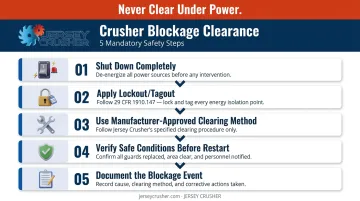
Skipping any step in this sequence — even under time pressure — is what turns a routine blockage into a recordable injury or fatality.
Environmental and System Safety Considerations
Combustible Dust
Enclosed processing environments handling grain, sugar, spice, pharmaceutical powders, or chemical intermediates face a dual hazard: inhalation risk and explosion risk. OSHA's combustible dust data identifies 281 incidents between 1980 and 2005, resulting in 119 worker deaths and 718 injuries.
OSHA's revised Combustible Dust National Emphasis Program (CPL 03-00-008, issued January 2023) actively targets facilities that generate or handle combustible particulate solids. Two standards govern dust hazard analysis and explosion prevention at these facilities: NFPA 652 (general combustible dust) and NFPA 654 (manufacturing, processing, and handling of combustible particulate solids).
Facilities must determine whether their specific materials are combustible — not all dusts behave the same. Where risk exists, controls include:
- Dust collection venting integrated at the crusher discharge or feed point
- Enclosure design that limits airborne escape
- Regular housekeeping to prevent surface accumulation
- Explosion-proof motor specifications for Class II, Div 1/2 classified zones
Jersey Crusher offers dust collection venting integration as an option on its lump breakers and explicitly recommends it for powder applications. Air purge shaft seals — standard on all Jersey Crusher units — prevent material from migrating into bearing assemblies, reducing friction-based ignition risk in dust-classified environments.
Noise and Vibration
OSHA 1910.95 requires a hearing conservation program when exposure reaches 85 dBA as an 8-hour time-weighted average, and feasible engineering or administrative controls when exposure exceeds 90 dBA. NIOSH sets its recommended limit at the same 85 dBA threshold.
Actual noise levels depend on the material, enclosure, room acoustics, and equipment configuration — a universal crusher dBA figure is not meaningful without site-specific measurement. Administrative controls that complement PPE include operator rotation schedules, timed breaks in low-noise areas, and regular noise monitoring.
Material Compatibility
The construction material of the crusher itself is a safety consideration, not just a quality one. Processing corrosive or sanitary materials through inappropriately rated equipment creates contamination risk and accelerates component failure.
For food, pharmaceutical, and sanitary applications, stainless steel (commonly 304 or 316 grade) is specified for cleanability and corrosion resistance. 316 SS is preferred where corrosive intermediates or strict contamination control is required. The applicable standard — 3-A, USDA, or a customer-specific sanitary requirement — should govern actual grade selection.
For mineral processing, recycling, and abrasive chemical applications, abrasion-resistant construction is the appropriate choice.
Jersey Crusher manufactures lump breakers in carbon steel, 304 stainless steel, 316 stainless steel, and abrasion-resistant variants across its product line, specifically to match equipment construction to the process environment.
Common Safety Mistakes to Avoid
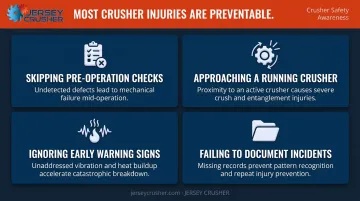
Most crusher injuries are preventable. These four patterns show up repeatedly across incident investigations.
- Skipping pre-operation checks because the previous shift ran fine. Mechanical conditions change between cycles — lubrication loss, guard displacement, and component wear don't announce themselves. A pre-shift check is the only reliable way to catch changes before they become incidents.
- Treating a running crusher as approachable. The feed zone, rotating components, and discharge point are all active hazard zones during powered operation. Full shutdown and confirmed LOTO are required before anyone enters a danger zone — no exceptions.
- Ignoring early warning signs. Abnormal vibration, unusual sounds, irregular particle size output, or unexpected heat are indicators of developing failures, not nuisances to defer until the next scheduled maintenance. Operators trained to recognize and report these symptoms prevent escalation into equipment damage and injury.
- Failing to document maintenance, checks, and incidents. Without written records, recurring hazards can't be identified or corrected. Documentation supports OSHA recordkeeping compliance and gives maintenance teams the data to spot systemic problems early. Near-misses — jams, overheating, abnormal vibration — should be recorded and reviewed, not dismissed because no one was hurt.
Conclusion
Crusher safety isn't a documentation exercise. It depends on three interconnected factors working together: equipment correctly specified for the application, operators thoroughly trained on the specific machine they're running, and a site culture that treats pre-shift checks and housekeeping as non-negotiable.
If any of those three elements is weak, the others can't compensate. Plant managers and safety teams should review their current protocols against the guidelines covered here — and treat any gap as an active personnel risk that warrants immediate action.
Getting equipment specification right is where safety and productivity intersect. For guidance on material compatibility, crusher selection, or dust collection integration for your specific application, contact Jersey Crusher at 973-686-5999 or sales@jerseycrusher.com.
Frequently Asked Questions
What are the 7 basic general industry safety rules?
OSHA's general industry safety rules cover: wearing appropriate PPE, following lockout/tagout during maintenance, keeping work areas clean, reporting hazards promptly, following established operating procedures, never bypassing safety devices or guards, and receiving proper machine-specific training before operating equipment.
What are the hazards of jaw crushers?
Primary hazards include entrapment in the crushing chamber, ejected material from the feed opening, dust inhalation from fine particulate generation, sustained noise exposure above safe thresholds, and mechanical failure from oversized feed or bypassed guards.
What PPE is required when operating an industrial crusher or lump breaker?
Standard required PPE includes:
- Hard hat (ANSI/ISEA Z89.1), safety glasses (ANSI Z87.1), steel-toed boots (ASTM F2413)
- High-visibility clothing and hearing protection
- For powder or chemical processing: NIOSH-certified respirator (OSHA 1910.134) and cut-resistant gloves
What is lockout/tagout (LOTO) and why is it critical for crusher maintenance?
LOTO is the process of isolating and de-energizing all equipment energy sources before any maintenance, adjustment, or blockage clearance. Bypassing it is one of the leading causes of fatal crushing injuries; OSHA estimates proper LOTO compliance prevents 120 fatalities and 50,000 injuries annually.
How often should industrial crusher safety inspections be conducted?
Pre-shift checks should occur before every operation cycle. More detailed formal inspections follow intervals defined by the manufacturer and your site safety plan. Any abnormal operating condition — unusual vibration, unexpected heat, irregular output — triggers an immediate unscheduled inspection.
What are the warning signs that a crusher should be shut down immediately?
Shut down and investigate immediately if you observe: unusual vibration or sounds, overheating, sudden changes in output particle size, visible damage to guards or components, lubrication failure, dust escaping from enclosed systems, or any safety interlock activation.