This guide breaks down how each system works, where each excels, and how to match the right conveyor to your material, distance, and facility requirements.
Key Takeaways
- Screw conveyors move enclosed bulk solids short distances (typically under 125 ft) using a rotating helical blade; belt conveyors transport material on an open surface across much longer runs
- For fragile or irregular materials at high throughput, belt conveyors cause less product degradation
- Enclosed design gives screw conveyors a natural edge for dust containment, lower upfront cost, and tight plant layouts
- The right choice depends on material type, transfer distance, capacity needs, and regulatory requirements — neither is universally superior
- Many facilities run both types within a single process line
Screw Conveyor vs Belt Conveyor: At a Glance
Here's a direct comparison across the variables that matter most.
Operating Mechanism
- Screw conveyor: A rotating helical screw (auger) inside a trough or enclosed tube pushes material forward through direct blade contact
- Belt conveyor: Material rests on a continuous moving belt stretched between a drive pulley and tail pulley, with no direct contact with moving mechanical parts
Conveying Distance & Capacity
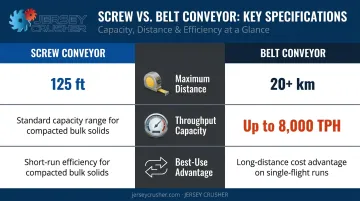
- Screw conveyor: Standard design limits horizontal runs to 125 ft; longer runs require special engineering or multiple units in series (SCC catalog)
- Belt conveyor: No comparable ceiling — single-flight installations exceed 20 km, with troughed belt capacities up to 8,000 TPH
Material Handling & Degradation
- Screw conveyor: Mechanical agitation from the blade can damage fragile materials; not suitable for stringy or wrapping materials that tangle around the flighting
- Belt conveyor: Gentle, low-agitation transport once material is loaded — preferred for friable, delicate, or irregular-shaped materials
Dust & Containment
- Screw conveyor: Fully enclosed design naturally contains dust, vapors, and hazardous materials without additional infrastructure
- Belt conveyor: Open design requires dust covers, suppression systems, or enclosed galleries for fine or regulated materials
Upfront vs. Long-Term Cost
- Screw conveyor: Lower initial cost; higher energy draw, particularly on inclines where horsepower requirements climb steeply
- Belt conveyor: Higher capital investment; lower energy cost per ton-mile over long distances
What Is a Screw Conveyor?
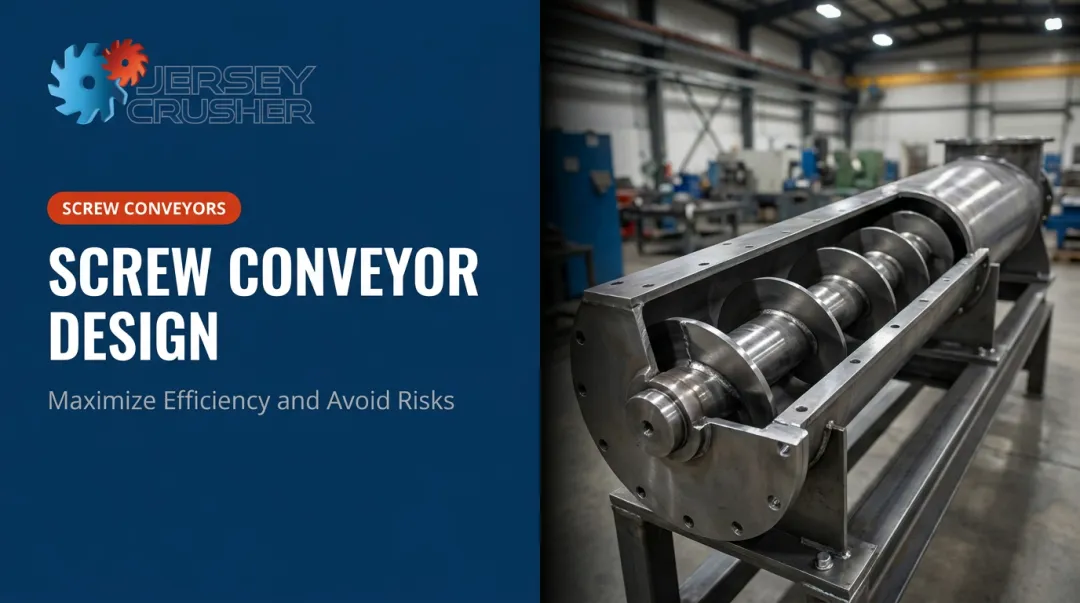
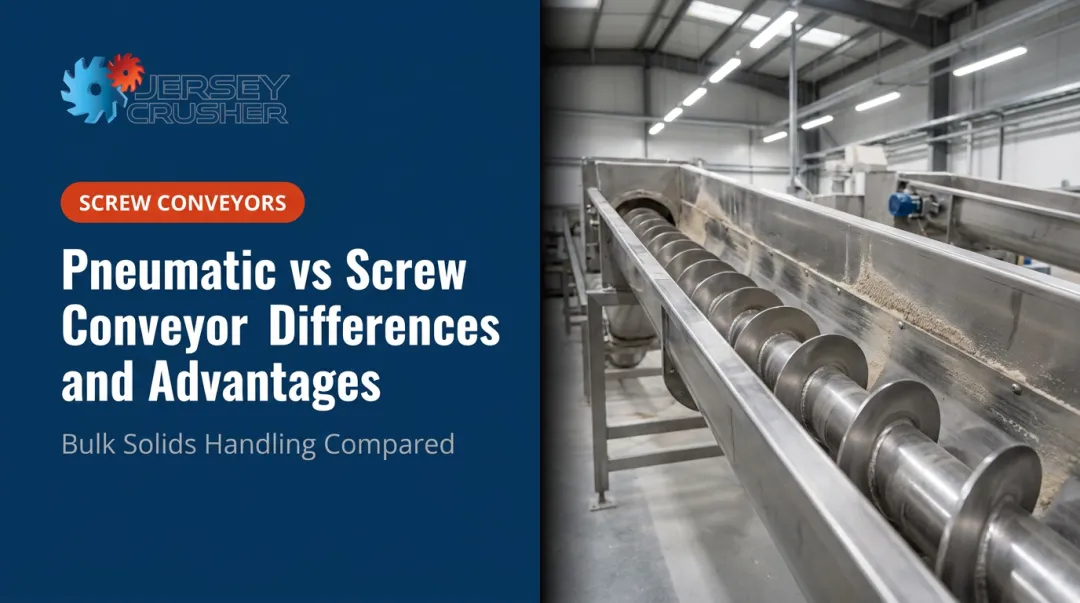
A screw conveyor moves bulk material using a rotating helical screw blade — also called flighting or an auger — inside an enclosed trough or tube. Material enters at the inlet, gets pushed forward by the spinning blade, and discharges at the far end.
The enclosed housing is the defining feature: it contains dust, vapors, and regulated materials in a way that open belt conveyors simply cannot replicate.
Core Operational Benefits
- Dust and vapor containment — critical for chemical processing, pharmaceutical, and food manufacturing compliance
- Multiple inlet/discharge points — distribute material to several process locations without additional equipment
- Compact footprint — fits into tight plant layouts where a belt conveyor of comparable capacity wouldn't
Screw Conveyor Types
| Type | Best For |
|---|---|
| Horizontal | Free-flowing to sluggish dry or semi-fluid materials; most common configuration |
| Inclined | Elevation up to 45°, with efficiency losses that increase with angle |
| Vertical | Compact elevation up to ~30 ft without internal bearings |
| Shaftless | Sticky, high-moisture, or fibrous materials that would clog a shafted design |
Key Limitations
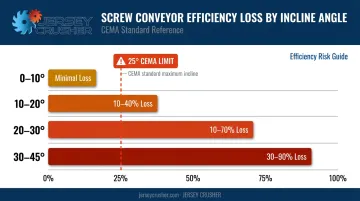
Incline performance deserves direct attention. According to KWS Manufacturing's engineering guide, efficiency losses are minimal from 0–10°, rise to 10–40% at 10–20°, climb to 10–70% at 20–30°, and reach 30–90% at 30–45°. CEMA Std. 350 adds that standard components should not be used above 25°, and preferably not above 15°.
Additional limitations:
- Not suitable for long/stringy materials (fibrous residues, wood chips) that wrap around the shaft
- Abrasive materials accelerate flighting and trough wear — hardened alloys or overlay coatings are often required
- Materials that pack under pressure may need breaker bars or additional horsepower
Screw Conveyor Use Cases
Screw conveyors are the natural choice when:
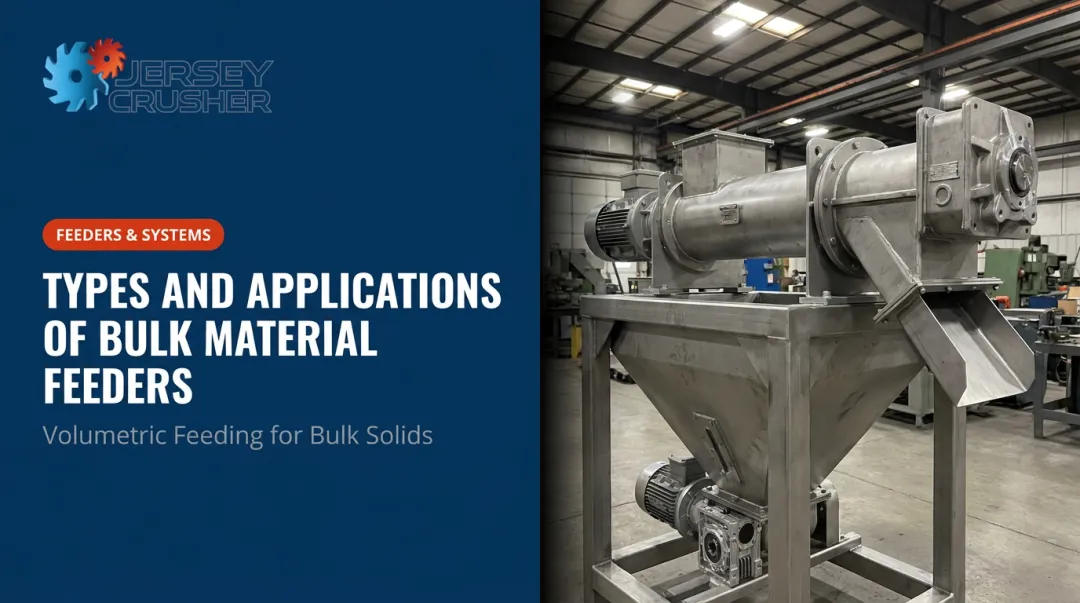
- Metering material out of hoppers or bins at a controlled feed rate
- Transferring between process stages in enclosed or regulated facilities
- Elevating granular or semi-fluid materials vertically or on modest inclines
- Dust control, contamination prevention, or space constraints are primary concerns
Industries where screw conveyors dominate: grain and agriculture, chemical processing, wastewater treatment (shaftless type), pharmaceutical manufacturing, food processing, and fertilizer production.
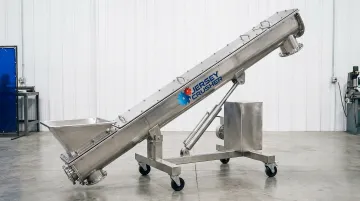
For applications in these industries, Jersey Crusher builds custom screw conveyors in 316 stainless steel, 304 stainless steel, and carbon steel. Each unit is designed around customer-submitted product samples — so the configuration is validated against your actual material before fabrication begins.
What Is a Belt Conveyor?
A belt conveyor carries bulk material on a continuous loop of flexible belting that runs between a drive (head) pulley and a tail pulley, supported by idlers along its length. Material rides from load point to discharge with minimal mechanical agitation. That makes belt conveyors the gentlest common method for moving bulk solids.
Core Operational Advantages
- High throughput — FEECO troughed belt conveyors support up to 8,000 TPH across belt widths from 18 to 72 inches; large overland systems reach 15,000–20,000 t/h
- Long distances — single-unit spans of thousands of feet are standard; no equivalent distance ceiling compared to screw conveyors
- Wide material compatibility — handles irregular-shaped, fragile, and long/stringy materials that screw conveyors cannot
- Incline flexibility — standard troughed belts work up to 18–20°; cleated and corrugated sidewall belts extend to near-vertical
Key Limitations
- Open design requires additional dust suppression or covers for fine or hazardous materials
- Larger floor space and structural clearance requirements versus screw conveyors
- Higher initial capital cost for comparable capacity
- Belt cleaning often requires a production shutdown
Belt Conveyor Variants
| Type | Application |
|---|---|
| Flat/troughed belt | Most common; bulk materials up to 8,000 TPH |
| Cleated belt | Steeper inclines where standard troughing fails |
| Steep-incline/sidewall belt | 30°–90° vertical handling |
| Reversing shuttle | Stockpiling or distributing to multiple fixed points |
Belt Conveyor Use Cases
Choose a belt conveyor when:
- Moving large volumes over distances beyond 100–125 ft
- Handling fragile, friable, or long/stringy materials that can't tolerate blade contact
- Maximum throughput capacity is the primary requirement
- Energy efficiency over long hauls is critical
Industries where belt conveyors dominate: mining and minerals, aggregate processing, fertilizer production (granular product handling), recycling, ports and terminals, and large-scale food processing.
Screw Conveyor vs Belt Conveyor: Which One Should You Choose?
There is no universal winner. The right choice comes down to five variables: material characteristics, conveying distance, throughput volume, available footprint, and regulatory requirements.
Choose a Screw Conveyor If…
- Your material is a free-flowing to semi-fluid powder, granule, or slurry
- Your conveying run is under ~125 ft per unit
- Your facility operates under dust control, food-grade, or chemical containment requirements
- You need a lower-cost solution for a constrained space
- Metered, controlled feed rates are critical to your process
Choose a Belt Conveyor If…
- You're moving large volumes over long distances
- Your material is fragile, friable, or stringy and cannot tolerate blade contact
- Maximum throughput capacity is non-negotiable
- Energy efficiency over long hauls is a priority
- Easy access for cleaning and inspection between product runs matters
Incline Scenarios
Both conveyors handle inclines, but by different mechanisms and with different consequences.
| Factor | Screw Conveyor | Belt Conveyor |
|---|---|---|
| Practical incline limit | Up to 45° (efficiency drops above 10°) | 18–20° for standard troughed belts |
| Consequences above limit | Requires larger motors, reduced pitch screws, modified trough | Cleated or corrugated sidewall belts needed — a distinct engineering configuration |
| Near-vertical option | Vertical screw conveyors (compact, cost-effective up to ~30 ft) | Steep-incline belt systems with specialized hardware |
The Hybrid-System Reality
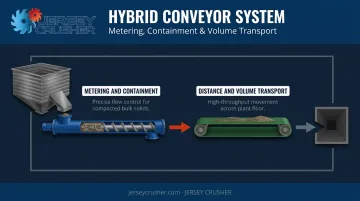
Most industrial facilities don't choose one conveyor type exclusively. A common setup: a screw conveyor meters material out of a storage hopper at a controlled rate into a belt conveyor that carries it across the facility to the next processing stage. The screw handles containment and metering; the belt handles distance and volume.
Treating conveyor selection as either/or misses how production lines actually work. Map each conveyor type to the stage where it performs best — and you'll likely find a place for both.
Real-World Scenarios: Getting the Decision Right
Consider a food processing facility handling calcium butyrate salts — a fine, dusty material at 48 lb/ft³ and 160°F, with pressure requirements of ±2 psig. An open belt conveyor in this environment would create dust containment failures, regulatory risk, and potential product contamination. The right solution is a fully enclosed screw conveyor designed for those exact material conditions.
The decision trigger in cases like this is rarely throughput or distance. It's usually a contamination event, a compliance audit, or an unexplained product quality issue traced back to open conveying. Once the operational pain point is identified, the evaluation shifts quickly toward material behavior:
- Particle size and flowability
- Bulk density and compaction tendency
- Moisture content and hygroscopicity
- Temperature sensitivity
- Regulatory classification (food-grade, pharmaceutical, hazardous)
When material integrity and containment outweigh distance and volume, the screw conveyor wins. The spec that matters isn't the line layout — it's the material's behavior under real process conditions.
If you're currently evaluating conveyor options — whether for a new installation or a problematic existing line — Jersey Crusher's engineering team can help identify the right system for your process. With over four decades of experience and custom screw conveyor solutions built to customer product samples, they've worked across food processing, chemical, pharmaceutical, fertilizer, and dozens of other bulk material applications. Call 973-686-5999 or visit the Jersey Crusher website to start a conversation.
Conclusion
Screw conveyors offer containment, compact footprint, and cost-effective handling for shorter runs of dry to semi-fluid materials. Belt conveyors deliver the throughput, distance, and gentle handling needed for high-volume or fragile-material applications. The best industrial setups frequently use both in complementary roles within a single production line.
The real stakes in this decision go beyond logistics. Choosing correctly reduces energy consumption, prevents material degradation and product loss, supports regulatory compliance, and minimizes maintenance-related downtime. Each of those factors has a measurable effect on operating costs — which makes conveyor selection an engineering decision, not just a layout one. If screw conveyor handling is part of your process, Jersey Crusher's custom-engineered screw conveyor systems are built to match your material type, throughput, and integration requirements.
Frequently Asked Questions
What is the difference between a belt conveyor and a screw conveyor?
A belt conveyor carries material on the surface of a moving belt with minimal agitation, suited for long distances and high volumes. A screw conveyor pushes material through an enclosed trough using a rotating helical blade — making it the better choice for short runs, dust containment, and regulated or sensitive material handling environments.
What are three common types of industrial conveyors?
Three of the most widely used types in bulk material handling are belt conveyors, screw (auger) conveyors, and bucket elevators. Each is designed for different material characteristics, distance requirements, and elevation applications.
What is another name for a screw conveyor?
A screw conveyor is commonly called an auger conveyor, named after the Archimedean screw principle it operates on. When fitted without a central shaft, the design is specifically called a shaftless screw conveyor.
Which conveyor type is better for food processing?
The answer depends on the material. Screw conveyors with stainless steel construction and enclosed housings suit powders, granules, and semi-fluids where contamination control is critical. Belt conveyors are the better fit for fragile or whole food products — nuts, grains, snacks — where gentle handling and minimal degradation matter most.
Can a screw conveyor handle abrasive materials?
Screw conveyors handle moderately abrasive materials, but flighting and trough wear accelerates significantly — highly abrasive applications require hardened alloy or chromium carbide overlay construction. Belt conveyors are preferred for the most abrasive bulk materials, since the material rests on the belt surface rather than grinding against moving components.
What is the maximum distance a screw conveyor can convey material?
A single horizontal screw conveyor is limited to 125 ft under standard design guidelines; runs beyond that require special engineering or multiple units in series. Belt conveyors, by contrast, can span thousands of feet in a single unit — making them far more practical for long-distance material transfer.