Key Takeaways
- Bulk material handling covers transporting, storing, feeding, and processing loose dry materials — not pallets or packaged goods
- Core equipment categories include conveyors, hoppers and feeders, size reduction equipment, and transfer components
- Skipping upstream size reduction with lumped or caked material causes blockages, accelerated wear, and downtime
- Equipment selection starts with material characterization — particle size, density, moisture, and flowability drive every decision
- Manufacturers who evaluate your actual material samples reduce guesswork and implementation risk
What Is Bulk Material Handling?
Bulk material handling covers the movement, storage, feeding, and processing of loose dry materials — powders, granules, lumps, flakes, and pellets — through a production or processing facility. Unlike general material handling, which deals with discrete unit loads like pallets and containers, bulk handling manages materials in unpackaged, flowing form.
The distinction matters practically. Forklifts, pallet jacks, and conveyors built for bagged goods are unit-load equipment. Bulk material handling equipment — conveyors, hoppers, feeders, lump breakers — is an entirely separate category designed for loose, unpackaged solids at scale.
Material Properties Drive Every Decision
Before selecting any equipment, you need to understand what the material actually does. According to ANSI/CEMA Standard 550, key physical properties include:
- Particle size and lump size/weight
- Loose bulk density
- Angle of repose and angle of surcharge
- Moisture content
- Flowability and cohesive strength
- Abrasiveness and particle hardness
- Hazards: explosiveness, flammability, hygroscopic behavior
Jenike & Johanson, a leading bulk solids engineering firm, states that flow property testing is an essential step in designing processes and equipment for any specific material. Specifying equipment without that data leads to bridging, compaction, or poor discharge — problems that become expensive to fix after installation.
Key Equipment Types in a Bulk Material Handling System
A bulk material handling system isn't a single machine. It's a coordinated set of components, each serving a specific role in moving material from raw intake to processed output.
Conveying Equipment
Conveyors are the transport layer of any bulk handling system. The main types:
- Belt conveyors — long-distance, horizontal or inclined transport of bulk solids; covered by CEMA's 815-page 7th edition belt conveyor standard
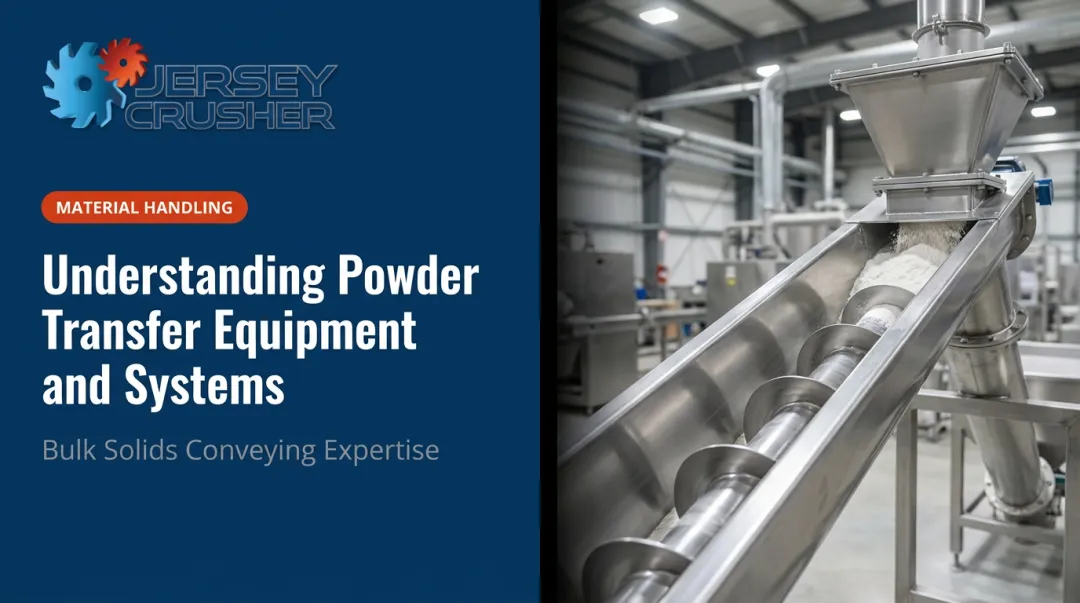
- Screw conveyors — enclosed, short-distance conveying of powders and granules; ideal when spillage control and contamination prevention matter
- Bucket elevators — vertical elevation of granular or lumpy solids, with selection and design standards from CEMA's Bucket Elevator Book
- Pneumatic conveyors — airflow-based transport of fine powders through sealed pipelines, available in dilute phase and dense phase configurations
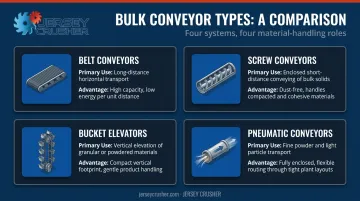
For enclosed applications — sugar, spices, chemical cake, grain, fertilizer — screw conveyors offer a practical fit. Jersey Crusher's screw conveyor line handles horizontal, inclined, and vertical movement with variable speed drives, adapting to existing plant layouts rather than requiring process redesign around the equipment.
Storage and Feed Equipment
Hoppers, bins, and silos hold bulk materials and stage them for discharge. Hopper geometry — outlet angle, outlet shape, wall surface — determines whether material flows freely or forms problems. Chemical Engineering identifies arching, ratholing, erratic flow, and no-flow as direct consequences of designing storage equipment without testing the actual material's properties.
Feeders are the control layer between storage and downstream equipment. They meter material at a consistent, controlled rate — preventing surges that overload downstream equipment and flow interruptions that starve it. Feeder types include:
- Screw feeders (for slotted outlets in mass-flow hoppers)
- Belt feeders
- Vibratory feeders
- Rotary valves
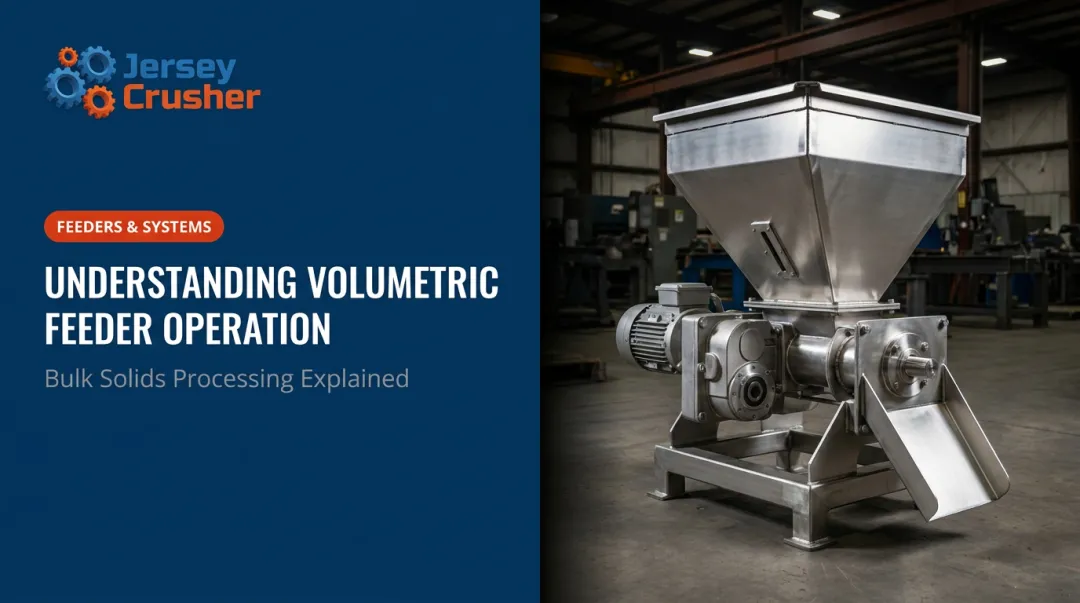
Jersey Crusher's volumetric feeders integrate directly with lump breakers, particle-izers, and screw conveyors — maintaining steady, uniform flow that protects downstream equipment from rate variability.
Transfer and Transition Equipment
At the larger end of bulk handling infrastructure, stackers and reclaimers manage outdoor stockyards — cement plants, ports, and aggregate facilities — where material piles are built and recovered mechanically. Belt trippers discharge material at multiple points along a conveyor run, creating configurable off-loading locations without dedicated transfer stations.
Transfer chutes handle the connections between components at a more contained scale. They guide material between equipment, controlling drop height to limit both spillage and dust at transition points. In powder-heavy applications, even minor drop height reductions can meaningfully cut airborne particulate.
Size Reduction: The Component Most Systems Get Wrong
Many materials — fertilizers, salts, chemicals, food ingredients, minerals — arrive at a facility, or come out of storage, as lumps, caked blocks, or oversized agglomerates. They cannot be conveyed, fed, or processed consistently without first being broken down. When lumps pass unchecked into a conveyor or feeder, they cause blockages, accelerate equipment wear, and disrupt everything downstream.
Size reduction equipment is not optional in these systems. It's a safeguard.
Lump Breakers
Lump breakers mechanically fracture friable lumps into a manageable, uniform particle size without pulverizing the material. The goal is to restore flowability while preserving product integrity.
Jersey Crusher's LUMPBUSTER® line uses a dual rotor crusher configuration. Two counter-rotating shafts shear material with controlled force, fracturing lumps along natural fault lines rather than through heavy impact. This matters for materials where product degradation or excessive dust generation are concerns — the design avoids the pounding approach used by hammer mills, ball mills, and pin mills.
Key specifications across the LUMPBUSTER line:
- Models available: 1515, 2020, 2024, 2048, 2424, 2448, 3648, 6464
- Screen hole diameters: ⅛" to 2" and beyond, customizable to target particle size
- Rotor speed: 300–1800 RPM, adjustable for particle size control
- Motor standard: 230/460/3/60 TEFC 1800 RPM, belt or direct drive
- Construction options: 316 stainless steel (food/pharma), 304 stainless steel (general industrial), carbon steel (heavy industrial), abrasion-resistant variants
- Standard feature: Air purge shaft seals on every unit — creates a positive pressure barrier at shaft penetrations, extending bearing life and preventing cross-contamination between product runs
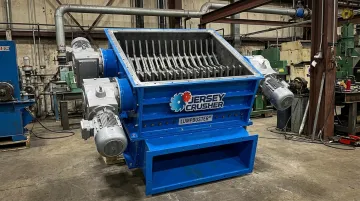
Optional accessories include infeed hoppers with safety baffles and support stands. The equipment is fully mobile and can be relocated between plant locations or deployed to construction sites.
When lump breaking alone isn't enough, finer output requires a different approach.
Particle-izers
Particle-izers take size reduction a step further. They achieve particle reduction down to 100 mesh or smaller — useful in spice processing, pharmaceutical API production, cosmetic pigment milling, fertilizer manufacturing, and cannabis processing where particle size uniformity directly affects product performance.
The output is controlled through adjustable screens with customizable hole diameters, engineered to the customer's specific particle size target.
Common Bulk Material Handling Challenges
Flow Problems: Arching and Ratholing
Jenike & Johanson identifies arching and ratholing as two of the most costly flow failures in silos, bins, and hoppers. Arching forms when an obstruction bridges across a hopper outlet, stopping discharge entirely. Ratholing creates a narrow discharge channel while stagnant material sits along the vessel walls — leading to caking, spoilage, and inconsistent feed rates.
Solutions include:
- Hopper geometry designed from actual material testing (wall friction, internal friction, cohesive strength)
- Vibration-assisted discharge and flow aids for cohesive materials
- Upstream size reduction to prevent oversized particles from reaching the hopper outlet
Wear and Tear at Transfer Points
High loads, abrasive materials, and constant impact at transfer points accelerate degradation of conveyors, bearings, belts, and chutes. The practical response:
- Select construction materials matched to the abrasiveness of what's being handled
- Maintain correct operating speeds (excess speed amplifies impact wear)
- Implement a proactive inspection schedule — don't wait for failure
Segregation
Jenike describes segregation as particle separation caused by differences in physical properties. Fines and coarse particles separate during conveying, storage, and discharge, producing non-uniform product. Mitigation strategies include:
- Anti-segregation chute design to control flow stream behavior
- Controlled conveyor speeds to limit particle trajectory differences
- Consistent upstream particle sizing to reduce the size spread entering the system
Dust and Contamination
Airborne dust at transfer points creates safety hazards, contaminates equipment, and draws regulatory scrutiny. Three combustible-powder explosions in 2003, investigated by the U.S. Chemical Safety Board, caused 14 fatalities — OSHA now maintains a National Emphasis Program for combustible dust under CPL 03-00-008.
Controls include enclosed conveyor systems, sealed bearing designs, dust suppression at transfer points, and minimizing drop heights.
How to Select the Right Bulk Material Handling Equipment
Getting equipment selection right comes down to three steps done in order.
1. Characterize the material first. Know the particle size distribution, bulk density, moisture content, flowability, cohesive strength, abrasiveness, and whether the material tends to cake or lump in storage. These properties drive every downstream decision. Equipment selected without this data is guesswork.
2. Size each component to match its neighbors. A capacity mismatch between a feeder and a conveyor — or between a conveyor and a lump breaker — creates bottlenecks immediately. Every piece must match the throughput, particle size tolerance, and flow control requirements of the components it connects to.
3. Work with a manufacturer who tests actual samples. Jersey Crusher offers a free sample evaluation service — customers ship material freight-prepaid to the engineering team in Wayne, NJ, who analyze the sample and design a custom configuration around it. Model size, construction grade, screen hole diameter, integration geometry, and throughput sizing all come out of that evaluation. It removes implementation risk before purchase, not after.
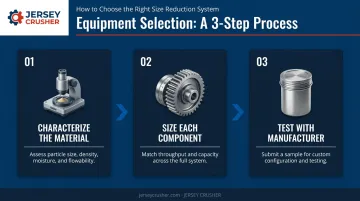
These three steps matter because no two applications are identical. The global bulk material handling equipment market was valued at $50.4 billion in 2025, projected to reach $81.4 billion by 2035 — a scale that reflects how foundational these systems are across dozens of industries.
Each industry brings distinct material properties and compliance requirements:
- Food and pharmaceutical applications demand 304 or 316 stainless steel and sanitary design per 21 CFR 117.40
- Chemical and fertilizer processing requires corrosion resistance and reliable flow control for hygroscopic or reactive materials
- Mining and recycling operations demand abrasion-resistant construction and high-impact tolerance
- Food grain and sugar processing prioritizes gentle handling to preserve particle integrity and product quality
Frequently Asked Questions
What types of equipment are used for bulk material handling?
The main categories include conveyors (belt, screw, pneumatic, bucket elevators), storage and feeding equipment (hoppers, bins, silos, feeders), size reduction equipment (lump breakers, particle-izers), and dust control systems. The right combination depends on material type, throughput requirements, and the hygiene or durability demands of the application.
What is a bulk material handler?
A bulk material handler is the overall system responsible for transporting, storing, processing, and controlling large volumes of loose dry materials — powders, granules, or lumps. It spans everything from raw material intake through final discharge.
Is MHE (material handling equipment) the same as a forklift?
MHE covers all equipment used to move materials — forklifts are one type, designed for unit loads like pallets and packages. Bulk material handling equipment (conveyors, lump breakers, hoppers, feeders) is a separate subcategory built for loose, unpackaged materials handled at volume.
What industries use bulk material handling systems?
Key industries include food processing, chemical manufacturing, pharmaceuticals, fertilizer production, mining and minerals, grain processing, recycling, and paper manufacturing — any industry that handles dry materials in bulk rather than in discrete packaged units.
What causes blockages in bulk material handling systems?
The main causes are oversized lumps entering conveyors or hoppers, arching or ratholing at hopper outlets from cohesive materials, and incorrect equipment sizing. Proper hopper geometry and upstream size reduction equipment prevent the majority of these issues.
How do you choose the right bulk material handling equipment?
Start by characterizing the material — particle size, bulk density, moisture, flowability, and caking tendency — then size each component for the required throughput. Working with a manufacturer who evaluates actual material samples, as Jersey Crusher does, ensures the configured system reflects real-world behavior rather than assumptions.