Introduction
Food manufacturers often discover particle size compliance requirements scattered across multiple CFR parts, industry standards, and FDA guidance documents, with no single consolidated rule to reference. That fragmentation creates real risk:
- A flour that passes a standard granulation sieve check may still trigger a misbranding violation if its distribution falls outside 21 CFR §137.105
- A spice blend processed too aggressively loses essential oils and fails functional quality benchmarks
- An iron-fortified ingredient that doesn't pass a 100-mesh sieve loses its GRAS protection under 21 CFR §184.1375
Particle size distribution (PSD) touches texture, bioavailability, flowability, microbial safety, and label accuracy . That's why FDA embeds PSD control across Standards of Identity, FSMA preventive controls, and food additive specifications rather than treating it as a single universal standard.
What follows covers the regulatory frameworks governing food particle size, specific requirements by product category, how to measure and validate PSD for compliance, and the consequences when specifications aren't met.
Key Takeaways
- FDA has no single particle size limit — requirements vary by product category and regulatory context
- Binding numerical limits appear in 21 CFR Part 137 (cereal flours), Parts 172–184 (food additives), and Part 117 (FSMA preventive controls)
- Spice, sugar, and salt particle size is governed by industry benchmarks, not explicit CFR numerical limits
- Sieve analysis (ASTM E11/AOAC) and laser diffraction are the two principal FDA-recognized measurement approaches
- Out-of-spec particle size distribution can trigger adulteration findings, warning letters, or mandatory recall
What Particle Size Specifications Mean in FDA Food Compliance
PSD as a Critical Quality Attribute
Particle size distribution is a statistical description of how particle diameters are spread across a batch. Expressed as D10, D50, and D90 percentiles, PSD tells you that 90% of particles fall below the D90 value, 50% below the D50, and 10% below the D10. Regulatory sieve analysis uses "percent passing" language — how much of a sample passes through a specific mesh opening.
In food manufacturing, PSD functions as a Critical Quality Attribute when it affects:
- Flowability during processing (caking, bridging, conveying behavior)
- Dissolution and texture in the finished product (powdered sugar mouthfeel, salt perception)
- Surface area exposure relevant to microbial risk and thermal penetration
- Bioavailability of micronutrients in fortified products (iron, calcium)
- Label accuracy when fineness is part of a Standard of Identity
Three Roles PSD Plays in Food Production
| Role | Description | When It Applies |
|---|---|---|
| Design parameter | Target PSD established during product development | Before production begins |
| Process parameter | PSD controlled during milling, grinding, or crushing | During manufacturing |
| Release specification | PSD verified before distribution | Batch release |
Who Bears Responsibility
FDA does not mandate a single PSD standard across all food types. Instead, it builds PSD control into three broader regulatory frameworks:
- Standards of Identity — fineness is legally defined for specific products
- GMP adulteration provisions — out-of-spec particle size can constitute adulteration
- FSMA hazard analysis requirements — PSD may be a preventive control point
The manufacturer's obligation is to identify when particle size is critical to their product's safety or quality, then establish, document, and control specifications accordingly.
FDA Regulatory Framework Governing Particle Size in Food
21 CFR Part 117 — FSMA Preventive Controls
Under FSMA's Preventive Controls for Human Food rule, particle size becomes a mandatory control point when it affects food safety. Section 117.135 requires that process controls include the maximum or minimum value to which any physical parameter must be controlled to significantly minimize a hazard.
FDA's draft guidance on preventive controls makes the connection explicit: "particle size and consistency can greatly affect the rate of heating." This requires scientific validation that all particles receive adequate heat treatment. Section 117.160 then requires manufacturers to validate that implemented preventive controls are adequate to control the identified hazard.
PSD is relevant as a preventive control in three scenarios:
- Thermal processing: oversized particles may not receive sufficient heat penetration
- Acidification: large particles slow pH reduction, leaving pathogen risks uncontrolled
- Functional ingredients: preservatives or antimicrobials must dissolve at a rate that depends on PSD
Standards of Identity — 21 CFR Parts 136–169
Several food Standards of Identity contain explicit sieve-based granulation requirements. Deviating from these standards constitutes misbranding or adulteration under 21 U.S.C. §§342–343, regardless of whether the product is otherwise safe. 21 CFR Part 137 provides the most detailed granulation requirements for cereal flours and grain products.
Key examples from 21 CFR Part 137:
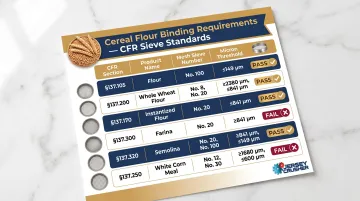
| Product | CFR Section | Sieve Requirement |
|---|---|---|
| Flour (wheat) | §137.105 | ≥98% passes 212 µm (No. 70) sieve |
| Whole wheat flour | §137.200 | ≥90% passes 2.36 mm (No. 8); ≥50% passes 850 µm (No. 20) |
| Instantized flour | §137.170 | All pass No. 20 (840 µm); ≤20% pass No. 200 (74 µm) |
| Farina | §137.300 | Passes No. 20; ≤3% passes No. 100 |
| Semolina | §137.320 | Passes No. 20; ≤3% passes No. 100 |
| White corn meal | §137.250 | ≥95% passes No. 12; ≥45% passes No. 25 |
Food Additive Specifications — 21 CFR Parts 172–184
Standards of Identity govern finished products, but FDA also imposes particle size conditions at the ingredient level. Several direct food additives carry explicit PSD requirements as part of their approved use:
- Silicon dioxide (§172.480): Must be manufactured "by vapor phase hydrolysis or by other means whereby the particle size is such as to accomplish the intended effect"
- Elemental iron (§184.1375): Reduced iron must result in "a grayish-black powder, all of which should pass through a 100-mesh sieve"
- Microcrystalline cellulose (§182.90): Particle size must be consistent with the functional purpose stated in the manufacturer's specification
Manufacturers using these ingredients must maintain PSD within approved ranges. Deviating from those ranges can jeopardize GRAS status protection.
Particle Size Ranges Across Key Food Categories
Cereal Flours and Grain Products
These carry the most explicit, legally binding PSD requirements in the CFR. Flour manufacturers must embed the Part 137 sieve checks into release specifications or face misbranding liability. The limits exist because starch digestibility, baking performance, and water absorption all depend on particle fineness — and consumers buying "flour" have a reasonable expectation the product meets its Standard of Identity.
Spices and Ground Herbs
The CFR does not codify numerical particle size limits for spices. 21 CFR 101.22 defines "spice" broadly without specifying granulation. The FDA recognizes ASTA Cleanliness Specifications as industry benchmarks for macroscopic extraneous matter, and ASTA Method 10.0 provides the industry standard for PSD determination by sieve analysis. Neither establishes mandatory numerical limits.
Functional performance drives particle size decisions here. Key considerations include:
- Particle size governs flavor and aroma release rates
- Aggressive size reduction volatilizes essential oils, degrading quality
- Significant deviation from expected fineness can support adulteration claims based on reduced quality
Hitting the target PSD (neither too coarse nor too fine) is both a quality and a compliance concern. For spice processors, equipment that uses gentle shearing rather than heavy pounding preserves essential oils while still achieving fine, consistent particle distributions. Jersey Crusher's Particle-izers use this approach, with interchangeable sizing screens and customizable hole diameters that give processors the control to hit target distributions reliably.
Sugar, Salt, and Powdered Ingredients
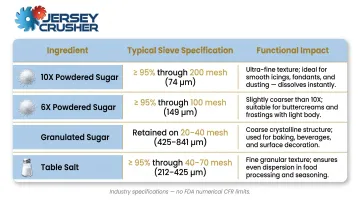
Particle size for these ingredients is driven by industry specifications and functional performance, not FDA numerical limits. Manufacturers must define and justify internal specifications based on product functionality.
| Ingredient | Typical Specification | Functional Impact |
|---|---|---|
| 10X powdered sugar | ≥97% passing No. 200 sieve | Ultra-fine; fast dissolution, smooth mouthfeel |
| 6X powdered sugar | ≥90% passing No. 200 sieve | General confectionery use |
| Granulated sugar | Average 0.5–1 mm | Crystal integrity at high temperature |
| Table salt (iodized) | ≤5% retained on No. 30 (600 µm); ≤9% passing No. 70 (212 µm) | Controls dissolution rate, salt perception |
Dietary Supplements and Fortified Ingredients
When particle size affects nutrient bioavailability, FDA and associated USP monographs impose tighter PSD controls with stricter documentation expectations. This applies to several common fortified ingredients:
- Reduced iron (§184.1375): must pass 100-mesh; PSD is a condition of legal GRAS use, not just a quality preference
- Calcium and fat-soluble vitamins: bioavailability is particle-size-dependent, with USP monographs specifying acceptable distributions
These examples illustrate a broader principle: finer particles increase surface area and absorption rates, but going below specification can trigger reformulation requirements or GRAS status challenges.
How Particle Size Is Measured and Validated for FDA Compliance
Sieve Analysis — ASTM E11 / AOAC Methods
Sieve analysis maps directly to the regulatory "percent passing" language in the CFR, making it the default method for food manufacturing compliance work. 21 CFR Part 137 explicitly incorporates AOAC "Nominal Dimensions of Standard Test Sieves" for flour granulation determinations.
USP General Chapter <786> identifies analytical sieving as most suitable when the majority of particles exceed 75 µm — a threshold that covers most bulk food ingredients.
Key parameters to control and document:
- Sample mass (must be consistent across batches)
- Agitation time and method
- Sieve sequence and calibration status
- Measurement variability characterization
Laser Diffraction and Dynamic Image Analysis
Laser diffraction delivers full particle size distribution data — reporting D10, D50, and D90 values — and is preferred when mesh-based methods lack sufficient resolution for fine powders or when the regulatory context requires full distribution characterization rather than a simple pass/fail check.
Selection considerations:
- Choose dry dispersion for most food powders — wet methods can alter particle structure
- Document and justify optical model selection, since it directly affects calculated size values
- Use laser diffraction when your specification calls for a full distribution profile (D10/D50/D90), not just a sieve fraction pass/fail
Validation and Documentation Under 21 CFR Part 117
Choosing the right measurement method is only half the compliance equation — how you document it is what FDA investigators actually scrutinize. When particle size functions as a preventive control, 21 CFR §117.165 requires that product testing procedures be "scientifically valid." During inspections, investigators review quality control operations and can demand processing records including analytical records and laboratory deviation reports.
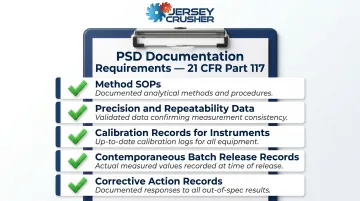
Documentation manufacturers should maintain:
- Method SOPs with specific analytical methods identified
- Precision and repeatability data
- Calibration records for all measurement instruments
- Contemporaneous batch release records (actual values, not just pass/fail)
- Corrective action records when specifications are not met
Consequences of Non-Compliance and Common Misconceptions
Regulatory Consequences
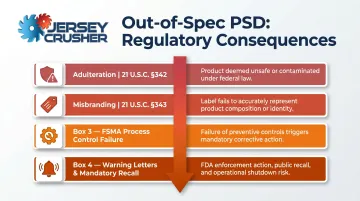
Out-of-specification PSD can trigger several enforcement pathways:
- Adulteration (21 U.S.C. §342): A food that departs from its professed standard of quality, or conceals inferiority, may be deemed adulterated — applicable to ground spices, powdered ingredients, and flour-based items where fineness defines product quality
- Misbranding (21 U.S.C. §343): Failing to meet a Standard of Identity while using the standard product name constitutes misbranding — no safety risk required to trigger this violation
- FSMA process control failure: FDA noted in a 2013 Federal Register rulemaking that if records show "food particle size is not being determined or that the particles are too large, acidification of all parts of the particle may not occur rapidly enough to ensure control of pathogens" — a direct FSMA violation
- Warning letters and recall: If the PSD deviation poses a safety risk, mandatory recall liability follows
Misconception 1 — "FDA Only Regulates Particle Size in Pharmaceuticals"
This is wrong. FDA's most explicit particle size language does appear in drug regulations, but food compliance obligations are equally real — arising through Standards of Identity, adulteration provisions, and FSMA hazard analysis requirements.
Food manufacturers face binding PSD obligations across several areas:
- Cereal flour manufacturers must meet legally binding sieve requirements
- Food additive users must maintain FDA-approved PSD ranges
- Any manufacturer that identifies PSD as a FSMA hazard control parameter must validate and document it
Misconception 2 — A Single Nominal Value Is Enough
A target D50 without established upper and lower limits backed by process data provides no meaningful compliance protection. FDA expects manufacturers to demonstrate control of the full distribution, not just a midpoint. Without defined specification limits and documented process capability, a nominal target cannot demonstrate compliance during an inspection or defend against an adulteration finding.
Frequently Asked Questions
What is the FDA guidance on particle size?
FDA does not publish a single consolidated particle size guidance for food products. Requirements are embedded across 21 CFR Part 117 (cGMP/FSMA), Standards of Identity (Parts 136–169), and food additive specifications (Parts 172–184). Control is required when PSD affects safety, quality, or label accuracy.
What is 21 CFR and GMP?
Title 21 of the Code of Federal Regulations (21 CFR) is the section of federal law covering all FDA-regulated products, including food. GMP — Good Manufacturing Practice — is codified within it at Part 117, establishing the minimum manufacturing and handling conditions required to prevent adulteration.
What are FDA particle size requirements for spices and ground food products?
The CFR does not set numerical particle size limits for spices — ASTA Method 10.0 and cleanliness specifications serve as industry benchmarks. For cereal flours, 21 CFR Part 137 provides binding sieve requirements. Departing from applicable Standards of Identity makes a product misbranded regardless of sensory quality.
How is particle size measured for FDA food compliance?
Sieve analysis (per ASTM E11 and AOAC methods) and laser diffraction are the two principal approaches. Whichever method is used must be validated for reproducibility and documented in an SOP that can be reviewed during FDA inspection, with actual measured values recorded contemporaneously.
What happens if a food product's particle size is out of specification?
Out-of-spec PSD can render a product adulterated or misbranded under the FD&C Act, triggering FDA warning letters, market withdrawal, or mandatory recall. For Standard of Identity products, non-conforming particle size can also invalidate use of the regulated product name.
Does particle size affect food safety under FSMA?
Yes. Under 21 CFR Part 117, manufacturers must conduct a hazard analysis covering attributes — including particle size — that affect safety. PSD can be a preventive control parameter for physical hazards, thermal process adequacy, acidification, and dissolution of functional safety ingredients.