The challenges are consistent across pharma production: lumps forming in hygroscopic APIs, fine dust escaping during open transfers, blend segregation undermining uniformity, and regulatory scrutiny demanding documented control at every step. 21 CFR 211.110(a)(3) explicitly requires manufacturers to test the "adequacy of mixing to assure uniformity and homogeneity" as an in-process control — meaning powder handling is a compliance issue, not just an operational one.
This guide covers the most impactful challenges, practical improvement strategies, the role of size reduction equipment, and GMP best practices for pharmaceutical powder handling.
Key Takeaways
- Lump formation, poor flowability, and moisture sensitivity cause most powder handling failures in pharma production
- Characterize your material first — Carr Index, bulk density, and particle size determine every handling system decision
- Break lumps upstream — before blending or compression — to protect content uniformity
- Enclosed, gravity-assisted transfers combined with humidity controls prevent moisture-related flow failures
- GMP compliance requires equipment qualification (IQ/OQ/PQ), cleaning validation, and formal change control
Why Powder Handling Directly Impacts Product Quality and Compliance
Oral solid dosage (OSD) forms — tablets, capsules, and sachets — are the most widely administered drug products in the pharmaceutical industry. They're also almost entirely composed of powdered APIs and excipients. Any inconsistency in how those powders are handled flows directly into the finished product.
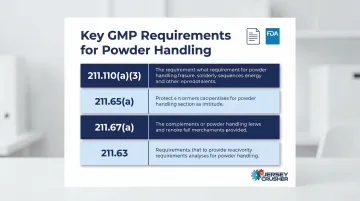
The regulatory framework reflects this. Under 21 CFR Parts 210 and 211, every step of powder processing carries compliance weight:
| CFR Section | Requirement |
|---|---|
| 211.110(a)(3) | Test blend uniformity for homogeneity in every batch |
| 211.65(a) | Equipment contact surfaces must not alter API purity or strength |
| 211.67(a) | Equipment must be cleaned at appropriate intervals per written procedures |
| 211.63 | Equipment must be of appropriate design, size, and location |
When these controls fail, enforcement follows. A Glenmark Pharmaceuticals warning letter cited a subpar investigation into tablet content uniformity failures — the company failed to test other batches manufactured on the same equipment after a uniformity failure, which the FDA treated as a systemic CGMP violation.
These compliance stakes extend beyond OSD manufacturing. APIs in aseptic injectables, biologics, and cell/gene therapy are also handled as dry powders at various process stages. The same handling failures that trigger tablet uniformity citations apply across these segments too.
Common Powder Handling Challenges in Pharmaceutical Manufacturing
Flow Interruptions: Bridging and Rat-Holing
Cohesive powders form stable arches inside hoppers and silos, blocking material flow entirely. Rat-holing follows the same pattern: a narrow channel forms through the powder mass while surrounding material stays stagnant. Both cause unplanned downtime and inconsistent feed rates to blenders or tablet presses.
Poorly designed hopper geometry is the most common culprit. Mass-flow hoppers with steep walls and smooth surfaces prevent these issues; funnel-flow designs promote them.
Lump and Agglomerate Formation
APIs and excipients absorb moisture during storage or transit, causing particles to bond into hard lumps. When those lumps enter a blend unbroken, they create localized high-concentration zones. The result: content uniformity failures, inconsistent dissolution profiles, and potential batch rejection.
Lump breaking must happen before blending. Waiting until content uniformity failures appear in finished dosage testing is far costlier than addressing the problem upstream.
Segregation During Transfer
Differences in particle size, density, or shape between blend components cause separation during pneumatic conveying, vibration, or gravity transfer. This problem compounds any lump-related inconsistencies already present in the blend. Research published in Pharmaceutics (2021) identifies three primary mechanisms: sifting (fines falling through gaps between coarser particles), fluidization (fine particles becoming airborne during filling), and trajectory segregation (particles following different paths during discharge).
This is particularly damaging in direct compression and dry granulation, where blend homogeneity is non-negotiable.
Moisture Sensitivity and Hygroscopic Behavior
Many APIs are moderately to very hygroscopic, absorbing moisture rapidly when exposed to ambient humidity. The European Pharmacopoeia classifies materials absorbing more than 2% weight at 25°C/80% RH as moderately hygroscopic; these require processing environments below 40% RH to maintain stable flowability and compressibility.
Even small humidity shifts can change a material's bulk density and flow behavior enough to cause equipment jams or require process adjustments mid-batch.
Dust Generation and HPAPI Containment
Fine pharmaceutical powders — especially high-potency APIs (HPAPIs) — generate airborne dust during any open transfer step. The global HPAPI market is projected to reach $45–48 billion by 2030–2033, with up to 25% of drugs currently in development classified as high-potency. That makes containment engineering a baseline capability for modern OSD facilities, not an optional upgrade.
Uncontrolled dust creates three compounding risks:
- Operator health hazards (particularly for compounds with OELs in the microgram range)
- Cross-contamination between products
- Combustible dust explosion potential at ignitable concentrations
How to Improve Powder Flow: Key Strategies
Start with Material Characterization
No improvement strategy works without knowing your powder's behavior. USP General Chapter <1174> defines four standardized methods for characterizing pharmaceutical powder flow:
- Angle of repose — measures cone angle; above 45° indicates poor flow
- Carr Index — calculated as 100 × [(V₀ − Vf) / V₀]; above 26% indicates poor-to-very-poor flow
- Hausner Ratio — V₀/Vf; above 1.35 signals significant flow problems
- Flow through an orifice / shear cell — measures mass flow rate under controlled conditions
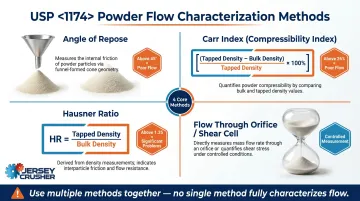
USP <1174> cautions that no single method fully characterizes powder flow — use multiple methods together. These measurements should be gathered from every new raw material lot to catch variability before it reaches the blend.
Design for Gravity-First, Enclosed Transfers
Vertically stacked process equipment — where material moves downward by gravity through the process train — minimizes mechanical agitation and reduces segregation risk. It also simplifies equipment layout and reduces energy requirements.
For potent compounds, enclosed, dust-tight connections between process vessels are non-negotiable. Each open transfer step is a containment failure point — and a potential regulatory citation.
That same principle extends beyond equipment layout to the environment surrounding it.
Control Environmental Conditions
For hygroscopic APIs and excipients, define and validate temperature and relative humidity limits in all powder handling areas. Monitor continuously — environmental drift is one of the harder-to-detect causes of batch-to-batch variability.
Facilities processing moderately-to-very hygroscopic materials should maintain production environments below 40% RH. Shifts above this threshold can alter material behavior enough to cause downstream processing failures.
Standardize Raw Material Transfer Using IBCs
Intermediate bulk containers (IBCs) as a common transfer vessel between the weigh/dispense area and process equipment:
- Reduce the number of open transfer steps
- Limit cross-contamination opportunities between batches
- Support lot traceability and reconciliation documentation
Use Feeders for Controlled Dosing
Screw conveyors and volumetric feeders give operators precise rate control over powder flow into downstream equipment. This prevents both starved-feed conditions (which cause blending gaps) and overfill (which damages tablet press punches and causes weight variation). For pharma applications, equipment built from 316 stainless steel with air purge shaft seals is standard — features that Jersey Crusher's screw conveyors and volumetric feeders include as baseline configurations.
Size Reduction and Lump Breaking in Pharma Powder Handling
Lump breaking is an upstream step that protects every process downstream. Before blending, granulation, or compression, agglomerated APIs and excipients must be reduced to a consistent, specified particle size. Skip this step, and the blend inherits the problem: localized concentration zones, tablet weight variation, and content uniformity failures.
Selecting the Right Lump Breaker for Pharmaceutical Applications
The wrong equipment causes as many problems as no equipment. Key selection criteria for pharma lump breakers:
- Produces a defined, repeatable particle size output — integrated screens or breaker bars ensure consistent exit size across every batch
- Uses 316 stainless steel on all product-contact surfaces, meeting 21 CFR 211.65(a) requirements for surfaces that must not alter API purity or strength
- Applies gentle fracturing action — hammer mills and pin mills generate excessive fines, heat buildup, and active degradation in friable APIs and excipients
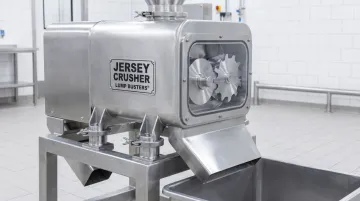
Jersey Crusher's Lump Busters® use a counter-rotating dual rotor design that fractures lumps without heavy impact. Integrated size reduction screens are customizable with hole diameters from ⅛" to 2"+, allowing precise particle size targeting for any product specification.
For pharmaceutical applications, Lump Busters® include several features built around sanitary and compliance requirements:
- 316 sanitary stainless steel construction with optional food-grade white epoxy interior finish
- Air purge shaft seals standard on all units, preventing material migration into bearing assemblies and supporting cross-contamination prevention between runs
- IQ/OQ/PQ documentation support, including material certifications and qualification protocols
For facilities that want to evaluate equipment against actual production materials, Jersey Crusher offers a free sample evaluation service. Ship a sample to their Wayne, NJ facility and the engineering team will recommend the appropriate model, screen size, and configuration.
Placement Within the Powder Handling Process Train
Lump breakers belong after raw material receipt and storage, and before weigh/dispense or blending — so every incoming lot meets particle size specifications before entering the blend.
Two common placement configurations:
- Pre-blend installation — standard positioning; ensures feed material is uniform before any mixing occurs
- Inline before tablet press or filling — a last-step safeguard to catch any agglomeration that may have formed during intermediate storage or transfer
Both configurations can be integrated with screw conveyors or volumetric feeders to maintain controlled, consistent feed rates downstream.
Dust Containment, Safety, and Combustibility Management
Containment Strategies for HPAPIs
The NIOSH Occupational Exposure Banding (OEB) system provides a five-tier framework for classifying potent compound hazards. The required containment technology escalates with potency:
| OEB Band | Airborne Concentration Limit | Typical Containment |
|---|---|---|
| A–B | General nuisance range | General ventilation, HVAC |
| C | >0.1 to <1 mg/m³ | Local exhaust ventilation |
| D | >0.01 to <0.1 mg/m³ | Dust collection, enclosed transfers |
| E | <0.01 mg/m³ (<10 µg/m³) | Gloveboxes, isolators, split butterfly valves |
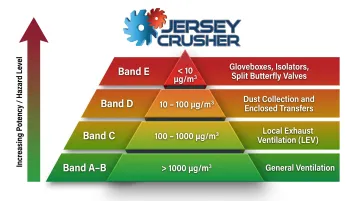
At OEB Band E (OEL below 10 µg/m³), physical isolation is mandatory. General ventilation alone cannot achieve adequate containment at these potency levels.
Inhalation exposure is only one side of pharmaceutical powder risk. Many of the same materials that require containment for potency also present ignition and explosion hazards.
Combustible Dust Compliance
Pharmaceutical powders — including common excipients like lactose, starch, and microcrystalline cellulose — are classified as combustible dusts under current NFPA standards. OSHA Directive CPL 03-00-008 (effective January 2023) established a revised National Emphasis Program covering pharmaceutical manufacturing facilities. NFPA 660, which consolidated NFPA 652 in December 2024, requires:
- A completed Dust Hazard Analysis (DHA) with five-year revalidation cycles
- Testing of powders for Kst, Pmax, MEC, and MIE values to determine combustibility
- Engineering controls appropriate to the identified hazard level
Facilities that completed initial DHAs under NFPA 652 must revalidate under NFPA 660. Failing to maintain a current DHA leaves facilities exposed to OSHA General Duty Clause citations.
GMP Best Practices for Pharmaceutical Powder Handling
Equipment Qualification and Cleaning Validation
All powder handling equipment must be included in the facility's IQ/OQ/PQ qualification program. Cleaning validation must demonstrate that residual material from one batch cannot contaminate the next — with acceptance criteria based on potency and therapeutic class.
Standard industry acceptance criteria include:
- No more than 1/1000th of the minimum therapeutic dose in the maximum daily dose of the subsequent product
- No more than 10 ppm of any product in another product
- No visible residue after cleaning
Under ICH Q7 Section 12.7, cleaning procedures for shared equipment "should normally be validated," with residue acceptance criteria defined and justified.
Material Flow Documentation and SOPs
GMP regulations require documented control over every powder transfer step:
- Written material flow maps with unidirectional traffic patterns (raw materials vs. finished goods)
- Dedicated equipment for potent compounds where practicable
- SOPs covering container identification, lot reconciliation, and in-process particle size and blend uniformity checks
Preventive Maintenance and Change Control
Powder handling equipment — lump breakers, screw conveyors, feeders — must be covered by a preventive maintenance schedule. Two failure modes warrant particular attention:
- Worn screens — allow oversized particles to pass, directly causing content uniformity failures
- Worn seals — create uncontrolled dust emission points and cross-contamination risk
Replacement screens and air purge shaft seals are the two most frequently cycled components in lump breaker maintenance programs. For Lump Busters® equipment specifically, Jersey Crusher stocks replacement screens across all hole diameter configurations and air purge shaft seals for the full product line — so facilities can source validated replacements without extended lead times that disrupt production schedules.
Any change to equipment configuration must go through formal change control before revalidation, per ICH Q10's change management requirements. This includes screen size changes, new materials of construction, and revised installation positions — each of which can affect validated performance.
Frequently Asked Questions
What is pharmaceutical powder handling?
Pharmaceutical powder handling covers every step — receiving, storing, transferring, size-reducing, blending, and dispensing — applied to the dry APIs and excipients used in drug manufacturing. The focus at each step is maintaining product quality, operator safety, and cGMP compliance.
How do you safely handle powder medications in manufacturing?
Use enclosed transfer systems or isolators scaled to the compound's OEB classification, implement dust collection at any open transfer points, and require PPE appropriate to the material's OEL. Confirm all handling steps follow validated, written SOPs within the facility's quality system.
What are API and OSD in pharmaceuticals?
API (Active Pharmaceutical Ingredient) is the biologically active component responsible for the drug's therapeutic effect. OSD (Oral Solid Dosage) refers to drug products taken by mouth in solid form — tablets, capsules, and sachets — which are predominantly composed of powdered APIs combined with excipients.
What are the types of process validation in pharma?
The FDA's 2011 Process Validation guidance defines three stages: Process Design (Stage 1), Process Qualification (Stage 2), and Continued Process Verification (Stage 3). Powder handling equipment — including lump breakers and blenders — is formally qualified in Stage 2, with ongoing monitoring continuing through Stage 3.
What causes poor powder flow in pharmaceutical manufacturing?
Poor flow stems from cohesive particle properties (small size, irregular shape, high surface area), moisture absorption in hygroscopic materials, lump and agglomerate formation during storage, and hopper geometry that promotes bridging or rat-holing — all four factors must be characterized before choosing a remedy.
How does lump formation affect drug product quality?
Unbroken lumps in an API or excipient blend create localized concentration differences, causing content uniformity failures — meaning individual tablets or capsules contain too much or too little active ingredient. This is a critical quality defect that can result in batch rejection, product recall, or patient harm.