Introduction
When wet, sticky, or semi-fluid materials enter a conventional shafted screw conveyor, they accumulate on the center pipe and flights, reducing conveying capacity, causing blockages, and forcing costly unplanned downtime. This operational failure is common across wastewater treatment plants, chemical processing facilities, food rendering operations, and pulp mills—anywhere adhesive or fibrous bulk solids must be moved reliably.
The financial exposure is real. Bulk material handling downtime costs range from $25,000 to over $100,000 per hour, with manufacturing facilities averaging $260,000 per hour in lost production.
For processing industries running continuous operations, a single jam can cascade into hours of cleanout labor, mechanical repairs, and lost throughput.
Shaftless screw conveyors address this directly. By eliminating the center pipe and intermediate hanger bearings—the two primary surfaces where sticky materials cling and compact—shaftless designs deliver non-clogging performance for the most difficult bulk solids. This article covers how shaftless conveyors work, how they differ from conventional designs, and which applications benefit most from their construction.
Key Takeaways
- Center pipe adhesion in shafted conveyors reduces capacity and causes jams that cost $100,000+ per hour in downtime
- Shaftless designs eliminate the center pipe and hanger bearings entirely — removing both primary surfaces where wet, fibrous material builds up and jams
- Widely used in wastewater (screenings/sludge), chemical (filter cake), food (rendering waste), pulp/paper, and recycling
- Specifying the right spiral grade, UHMW liner, and high-torque drive for your material prevents premature wear and unplanned downtime
Why Wet and Sticky Materials Defeat Conventional Screw Conveyors
A standard shafted screw conveyor consists of a helical flight welded to a center pipe, supported at intermediate points by hanger bearings mounted in the trough. This design works well for dry, free-flowing bulk solids like grain, sugar, or plastic pellets—but creates multiple failure surfaces when handling wet or adhesive materials.
The Buildup Mechanism
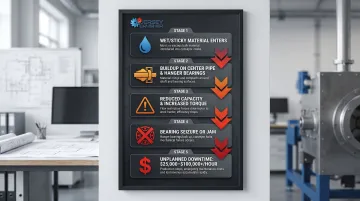
Wet or sticky materials—chemical filter cake, food slurries, wastewater screenings, rendering by-products—adhere to the center pipe and the joint between the flight and pipe. Over time, this mass hardens or compacts, reducing the open conveying area inside the trough. The rotating screw must then overcome both the material load and the resistance of the buildup itself, increasing torque on the drive and reducing throughput.
Hanger Bearing Failure
When sticky materials are present, material packs around intermediate hanger bearing housings, accelerating wear and eventually seizing the bearing. Air-purged hanger bearings are explicitly not used when handling wet sticky materials because purging cannot prevent adhesion. A seized bearing creates a jam that halts the entire line.
Secondary Problems
Once a jam or capacity loss occurs, operators face a cascade of downstream issues:
- Increased power draw and potential drive overload
- Mechanical stress on the screw shaft from uneven loading
- Labor-intensive cleanout before the line can restart
Misalignment from uneven loading puts enormous cyclical forces on screw sections, making fatigue the major cause of hanger bearing failures. The financial stakes are significant: industrial downtime costs range from $25,000 to $100,000+ per hour in bulk material handling, with 83% of leaders estimating losses between $10,000 and $500,000 per hour.
Why "Speed Fixes" Backfire
Increasing screw speed or trough fill level to recover lost capacity worsens the problem. Running screw conveyors at excessive speeds generates heat, accelerates wear, and leads to hanger bearing and ball bearing failures. Materials that pack under pressure form hard layers that deflect the screw and amplify fatigue stress.
How Shaftless Screw Conveyors Solve the Problem
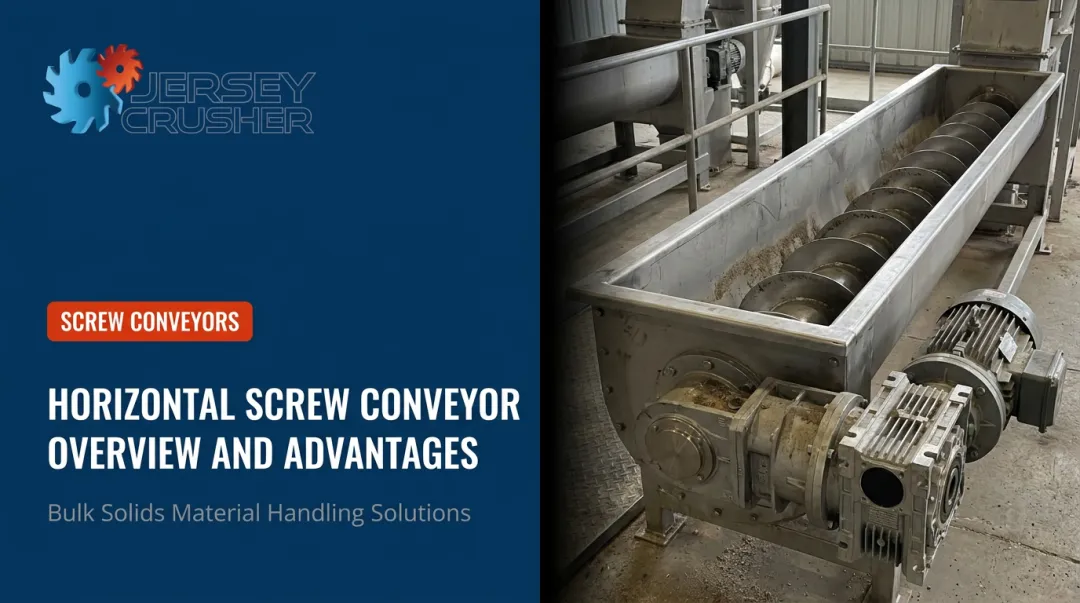
The solution comes down to one structural change: the center pipe is completely eliminated. A single continuous helical spiral—the "shaftless spiral"—rests directly on a low-friction liner at the bottom of the trough and connects only at the drive end. There are no intermediate hanger bearings.
Removing the Primary Adhesion Surface
Without a center pipe, sticky or wet material has nowhere to pack and accumulate. The rotating spiral continuously pushes material forward along the trough liner without buildup forming a blockage. The absence of a center pipe and hanger bearings creates a "non-clogging conveying surface" ideal for adhesive slurries, wet filter cake, and semi-fluid bulk solids.
Non-Clogging Performance for Fibrous Materials
Stringy or fibrous materials—paper pulp, rags, fibrous food waste, fish meal trimmings—cannot wrap around a center pipe or bridge across hanger bearings because these obstructions don't exist. Shaftless conveyors are ideal for stringy, sticky, wet, and lumpy materials where conventional shafted screws fail within hours or days.
Gas-Tight Construction Capability
The same design that eliminates hanger bearing fouling also enables fully enclosed operation. Because the spiral connects only at the drive end with no intermediate penetrations, shaftless screw conveyors can be built for vapor and odor-tight construction.
This matters when conveying materials that release hazardous or odorous vapors—chemical centrifuge discharge, rendering by-products, biosolids, or toxic filter cake. ANSI/CEMA-350 standards outline enclosure classifications including vapor-tight covers and pressure-tight housings with mechanical shaft seals and nitrogen purging for explosive or hygroscopic materials.
Shaftless vs. Ribbon Screw: The Right Choice for Severe Buildup
Both designs address sticky materials, but shaftless is the superior solution when buildup is severe or fibrous content is present.
| Selection Criteria | Shaftless Spiral (No Shaft) | Ribbon Flight on Shaft |
|---|---|---|
| Fibrous/Stringy Materials | Excellent; no center shaft for wrapping | Poor to Fair; materials wrap shaft and posts |
| Sticky/Adhesive Slurries | Excellent; open spiral and low-friction liner prevent adhesion | Good; "post type" ribbon minimizes contact area |
| Mixing/Shearing Needs | Limited mixing capability | Better; inner reversing ribbon flights enhance mixing |
| Long Spans/Support | Supported entirely by trough liner; no hanger bearings needed | Shaft provides stiffness but requires hanger bearings on long runs |
| Maintenance Points | Trough liners are primary wear items; periodic replacement required | Hanger bearings require maintenance and alignment; no trough liners |
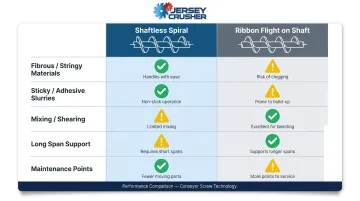
Use this table as a quick filter: if fibrous content or severe adhesion is the primary concern, shaftless is the right starting point. If active mixing is required and liner replacement is impractical, ribbon-on-shaft is worth evaluating.
Key Design Features That Make Shaftless Conveyors Effective
Shaftless Spiral Construction
The shaftless spiral must be self-supporting across its full conveying length because there is no center pipe for structural reinforcement. Spiral thickness and material grade directly determine performance: thinner or softer spirals deflect under load, reducing conveying efficiency and accelerating liner wear.
Heavy-duty shaftless spirals are typically constructed from high-strength micro-alloy steel with a Brinell Hardness Number (BHN) of 350 for abrasive applications. Flighting thickness ranges from 3/4" to 1" to increase wear resistance and uptime.
Spirals can be supplied in stainless steel grades—304 or 316—for food, pharmaceutical, or corrosive chemical applications. Jersey Crusher manufactures shaftless screw conveyors in 316 stainless steel, 304 stainless steel, carbon steel, and abrasion-resistant material options, covering corrosive, sanitary, and high-abrasion environments alike.
Replaceable Trough Liner
The low-friction liner forms the contact surface between the rotating spiral and the trough bottom, allowing the spiral to slide rather than scrape. This protects both the spiral and the trough from premature wear.
UHMW-PE (Ultra-High-Molecular-Weight Polyethylene) is the standard liner material, offering a low coefficient of friction ranging from 0.09 to 0.20. Standard UHMW-PE has a maximum continuous service temperature of 180°F (82.2°C), making it suitable for most processing applications.
Liner life can reach up to five years depending on duty cycle, though inorganic particulates (grit/sand) and dry running accelerate wear. Common mitigations include:
- Oil-impregnated UHMW for sections prone to dry running
- Polyurethane liners where abrasion resistance must exceed standard UHMW-PE
- "Wear-Alert" two-color liners that show a visual color change when replacement is due
When the liner reaches end of life, it replaces independently of the trough and spiral—a meaningful cost advantage over shafted units, where worn trough sections often require full replacement.
High-Torque Drive Unit
Shaftless conveyors require high-torque drives because the spiral must overcome friction between itself and the liner, plus the resistance of wet or sticky material, with no intermediate support. Undersized drives are a common source of premature failure.
Proper sizing requires more than selecting a motor—several compounding factors determine the final drive specification:
- Gear reducer class: AGMA Class II reducers with a minimum service factor of 1.4 are the standard recommendation for shaftless applications
- Material resistance factors: Wet, sticky, or high-density materials require upward torque corrections beyond baseline calculations
- Incline multipliers: Any elevation in the conveying path multiplies the required drive torque per ANSI/CEMA-350 standards
- Starting load: Full-trough start conditions—common in process upsets—place the highest instantaneous load on the drive
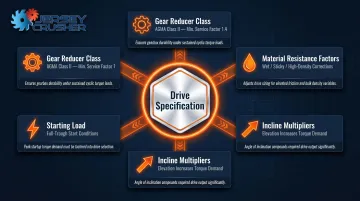
Getting the drive specification right from the outset prevents the most common failure mode in shaftless conveyor installations.
Industries and Applications Best Suited for Shaftless Screw Conveyors
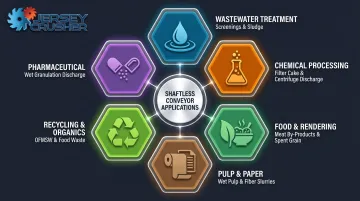
Shaftless conveyors dominate wherever wet, sticky, fibrous, or lumpy materials routinely defeat conventional equipment. The open spiral design eliminates the center pipe that causes jamming in shafted conveyors — making it the go-to choice across a wide range of process industries:
Wastewater Treatment:
Screenings (rags, wipes, debris), grit, dewatered sludge cake—all high-moisture, fibrous, or adhesive. Municipal master plans explicitly recommend shaftless screw conveyors with UHMW liners and sealed covers for reliable screenings conveyance. At the Montoursville WWTP, a shaftless system elevates 3 wet tons per hour of dewatered digested sludge (20% total solids).
Chemical Processing:
Filter press cake, wet precipitates from centrifuges, slurries with residual moisture. Sensient Flavors uses 304 stainless steel shaftless screw conveyors to move wet, sticky filter press cake (activated carbon and diatomaceous earth) at 62.5 cubic feet per hour.
Food Processing & Rendering:
Meat by-products, rendering waste, fish meal, fruit/vegetable pulp, spent grain from breweries/distilleries. Stringy, high-moisture, and often odorous—the shaftless design handles all three without jamming or clogging.
Pulp & Paper:
Wet pulp, broke, fiber slurries. Fibrous content wraps around center pipes in shafted conveyors; shaftless designs eliminate this failure mode .
Recycling & Organics:
Wet municipal solid waste, organic fraction of household waste (OFMSW), food waste for anaerobic digestion. CR&R, operating the largest anaerobic digester in North America, uses shaftless screw conveyors to move abrasive and corrosive organic waste at 500 cubic feet per hour continuously (24/7).
Pharmaceutical & Specialty Applications:
Wet granulation discharge, distillery/brewery spent grain, fertilizer production involving wet organic slurries. Food, pharma, and certain chemical applications also require sanitary construction — stainless steel, polished welds, and CIP-compatible design.
Across all these industries, the open spiral cross-section also handles variable lump sizes that would jam between a flight and center pipe in a shafted design — a cross-cutting advantage wherever incoming material size is inconsistent.
What to Look for When Selecting a Shaftless Screw Conveyor
Material Characterization
Before specifying a shaftless conveyor, define these material characteristics:
- Bulk density (lbs/ft³)
- Moisture content (%)
- Particle size and shape (including maximum lump size)
- Degree of stickiness or adhesion
- Abrasiveness
- Temperature
- Corrosive, toxic, or sanitary handling requirements
ANSI/CEMA-350 requires thorough characterization of bulk material including bulk density, moisture content, particle size, flowability, and abrasiveness to determine proper speed, trough loading, and horsepower. Providing a material sample to the equipment manufacturer for testing is strongly recommended before finalizing the specification.
Capacity and Layout Factors
Shaftless conveyors are most efficient at horizontal or slight inclines. Capacity falls off meaningfully as incline angle increases:
| Incline Angle | Approximate Capacity Loss |
|---|---|
| 15° | ~25% reduction from horizontal rating |
| 25° | ~50% reduction |
| 30°–45° | 30%–90% reduction |
For inclines between 20 and 30 degrees, use a tubular housing and reduced pitch screw (1/2 or 2/3 pitch). These inclines also demand increased horsepower to overcome gravity and material fallback.
Trough diameter, spiral pitch, and operating speed must all be matched to the required throughput rate and the material's flow resistance. The interdependency of these variables is why design decisions rarely have a single right answer — and why working with an experienced manufacturer matters.
Work With an Experienced Manufacturer
Select a manufacturer who can provide engineering guidance and customize the design to your specific requirements—including trough material selection, liner specification, drive sizing, and whether gas-tight or sanitary construction is needed.
Jersey Crusher engineers custom shaftless screw conveyor solutions based on your material's specific characteristics — from liner selection for sticky or abrasive materials to drive sizing for inclined layouts. Contact Jersey Crusher at 973-686-5999 or sales@jerseycrusher.com to discuss your application.
Frequently Asked Questions
What is the difference between a shaftless and a shafted screw conveyor?
A shafted conveyor has a helical flight mounted on a center pipe supported by intermediate hanger bearings. A shaftless conveyor uses a freestanding spiral with no center pipe or hanger bearings—which eliminates the buildup points that trap wet and sticky materials in conventional designs.
What types of wet or sticky materials can a shaftless screw conveyor handle?
Shaftless conveyors handle sludge, filter cake, food slurries, wet screenings, pulp, rendering by-products, spent grain, and chemical centrifuge discharge. If a material is semi-fluid, adhesive, or fibrous enough to clog a conventional shafted screw, a shaftless design will move it reliably.
Can shaftless screw conveyors be used in food-grade or pharmaceutical applications?
Yes. When constructed with 304 or 316 stainless steel, polished interiors, and sanitary drive connections, shaftless conveyors are well-suited for food, beverage, and pharmaceutical processing environments requiring sanitary handling and FDA compliance.
How do I know if my material requires a shaftless conveyor rather than a standard screw conveyor?
If a material is wet, sticky, high in moisture, fibrous, or has a history of jamming conventional conveyors, a shaftless conveyor is the right choice. Testing with a material sample is the most reliable way to confirm fit before committing to a design.
What are the maintenance requirements for a shaftless screw conveyor?
Maintenance is generally simpler than on shafted designs because there are no hanger bearings to service. Primary wear items are the replaceable trough liner and drive unit seals, which can be swapped without disassembling the conveyor.
Can a shaftless screw conveyor handle material with large lumps or fibrous content?
Yes. The open spiral cross-section (no center pipe) makes shaftless conveyors particularly well-suited for lumpy wet materials and fibrous content that would wrap around or bridge across the center pipe of a shafted unit.