Yet many processors struggle to budget accurately for the bulk solids handling equipment—lump breakers, screw conveyors, volumetric feeders, and particle-izers—that makes high-volume production possible. The core challenge isn't just upfront cost; it's understanding how equipment type, throughput requirements, food-grade material specifications, and customization level combine to drive total investment. Underestimating these variables leads to budget overruns, wrong equipment choices, and costly downtime in production lines where every hour of unplanned stoppage costs upwards of $169,000.
Key Takeaways
- Bulk solids handling equipment for pet food ranges from several thousand dollars for a single basic unit to $150,000+ for fully integrated systems
- Key cost drivers: equipment type, throughput capacity, food-grade stainless steel requirements (304/316), and customization complexity
- Single-unit upgrades cost less; high-volume lines with integrated conveying, feeding, and size reduction require substantially higher investment
- Higher upfront spend on food-grade equipment typically lowers total lifecycle cost through reduced downtime and maintenance
How Much Does Bulk Solids Handling Equipment for Pet Food Processing Cost?
There's no fixed price for bulk solids handling equipment—costs depend on equipment type, production scale, food-grade specifications, and whether you're buying individual machines or a complete integrated system.
Two budgeting mistakes consistently create problems for pet food processors:
- Underestimating total cost by researching only single-machine pricing — installation, integration, and commissioning add 10–30% to base equipment cost
- Over-specifying capacity for current throughput needs, generating unnecessary capital expenditure upfront
Typical Cost Ranges by Equipment Type
Equipment manufacturers customize pricing per project, typically requiring a formal quote request, but baseline ranges provide a practical budgeting framework:
Lump Breakers / Size Reducers: Used sanitary stainless steel lump breakers range from $5,950 to $17,526 depending on size and motor capacity, providing baseline indicators for new equipment pricing.
Particle-izers: Fine size reducers are priced based on rotor diameter, motor horsepower (5 HP to 75 HP range), and construction material (carbon steel vs. 304/316 stainless).
Screw Conveyors: A basic 10-foot screw conveyor with stock components starts around $6,000, while heavy-duty screw feeders with custom specifications can reach $40,000. Costs escalate with sectional flighting, non-stock components, or steep inclines.
Volumetric and Loss-in-Weight Feeders: Standard volumetric screw feeders start between $6,000 and $10,000. Gravimetric loss-in-weight feeders command higher prices due to integrated load cells and advanced control algorithms required for precision dosing.
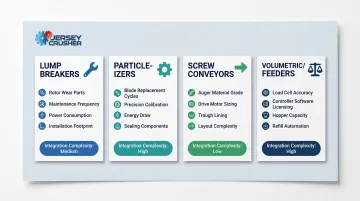
| Equipment Type | Primary Cost Drivers | Integration Complexity |
|---|---|---|
| Lump Breakers | Rotor diameter, motor HP, sanitary finishes (Ra ≤ 0.8 µm), CIP compatibility | Low to Medium |
| Particle-izers | Screen sizes, tool steel quality, dust-tight enclosures, ATEX/NFPA compliance | Medium |
| Screw Conveyors | Length, diameter, pitch type, 304 vs 316 stainless, continuous welds, drop-bottom covers | Medium |
| Volumetric/LIW Feeders | Accuracy class, load cell resolution, PLC/HMI controls, flow-aid devices | High |
Complete Integrated Systems: Fully integrated systems combining a lump breaker, conveyor, feeder, and automation controls typically run $80,000–$250,000+, depending on system complexity, materials of construction, and plant-specific engineering requirements.
Understanding where your operation falls across these tiers helps narrow the right configuration before requesting a quote.
Entry-Level / Single-Unit Configuration
Single-machine units with basic carbon steel or entry-level stainless construction, a fixed screen size, and limited throughput capacity. These suit smaller pet food operations, pilot lines, or processors adding one discrete step — such as lump breaking after bag dump — without requiring full system integration.
Mid-Range / Food-Grade Configured Unit
304 stainless steel construction with customizable screen sizes from ⅛" to 2"+ hole diameters, higher throughput capacity, and options for variable speed drives or integrated hoppers. Equipment at this tier meets food safety compliance requirements through proper sanitary finishes.
This configuration fits established pet food processors handling grain meals, rendered products, or premix powders that require consistent particle size distribution and food-grade certification. Jersey Crusher, for example, offers 304 stainless steel equipment with optional food-grade white epoxy interior finishes for exactly these applications.
High-End / Complete Process System
Fully integrated systems combining a lump breaker, conveyor, feeder, and automation controls — built in 316 stainless steel or abrasion-resistant materials with automation compatibility for existing plant control systems.
High-volume commercial manufacturers running continuous production schedules, multi-ingredient handling systems, or facilities processing 30,000 to 60,000 lbs per hour require this level of system engineering.
Key Factors That Affect the Cost of Bulk Solids Handling Equipment
Several variables determine what you'll actually pay for bulk solids handling equipment in a pet food facility. Understanding each one helps you build a realistic budget and avoid surprises during procurement.
Equipment Type and Configuration
Different equipment types carry different price points. A standalone lump breaker costs far less than a volumetric feeder with integrated controls or a particle-izer with interchangeable screen assemblies. Multi-function systems that combine several processing steps increase cost proportionally. Dual-rotor crusher configurations with both breaker bars and screens add capability but raise the purchase price compared to single-function units.
Throughput Capacity and Scale
Output requirements—measured in lbs/hr or tons/hr—directly drive equipment size and cost. A unit sized for 500 lbs/hr will be priced dramatically differently from one rated for 5,000 lbs/hr. Continuous-duty pet food lines typically demand heavier-duty construction, larger motors (ranging from 5 HP to 25 HP or higher), and more robust drive systems to handle extended operating cycles. Large-scale facilities capable of producing 30,000 to 60,000 lbs per hour require equipment engineered for maximum capacity and reliability.
Food-Grade Material and Build Quality
Pet food processing requires food-safe construction materials that meet FSMA requirements under 21 CFR 507.22—mandating nontoxic materials that withstand the processing environment, cleaning compounds, and sanitizing agents.
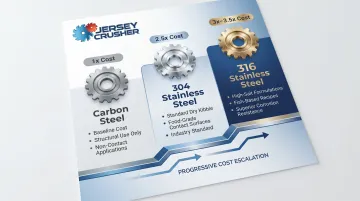
Carbon steel units are the lowest-cost option but don't meet sanitary standards for pet food. 304 stainless steel is standard for most applications, costing approximately 2.5x carbon steel prices. 316 stainless steel—containing 2–3% molybdenum for superior chloride resistance—adds a 20–30% premium over 304 stainless and is required for wet ingredient environments, high-salt treat formulations, or fish-based products exposed to aggressive CIP chemicals.
| Material Grade | Cost Premium | Best Pet Food Application |
|---|---|---|
| Carbon Steel | Baseline (Lowest) | Non-contact structural frames; dry, indoor environments only |
| 304 Stainless Steel | 2.5x carbon steel | Standard dry kibble, low-moisture ingredients, general food contact |
| 316 Stainless Steel | 20-30% above 304 | High-salt treats, fish formulations, aggressive sanitation protocols |
Sanitary design principles require food contact surfaces with maximum roughness of Ra = 0.8 µm (32 µin) and continuous welds free of pits and crevices. Jersey Crusher builds equipment in both 304 and 316 stainless steel, with optional food-grade white epoxy interior finishes available for facilities with strict hygiene protocols.
Level of Customization
Off-the-shelf equipment with fixed screen sizes and standard dimensions costs less. Custom-engineered solutions—such as breaker bars or screens sized to specific hole diameters, mobile configurations, or designs developed from customer product samples—increase purchase price but deliver precise particle size control and operational fit. Custom-built solutions often reduce downstream waste and rework costs by eliminating over-processing or under-sizing issues.
Installation, Integration, and Site Requirements
The purchase price covers only the equipment itself. Total installed cost includes additional line items that vary by facility:
- Installation labor, electrical connections, and structural supports
- Integration with existing conveying or packaging lines
- Commissioning and controls configuration
Standard setups typically add 10% to 30% to base equipment cost. Complex integrations can push that figure above 50%. Site-specific conditions—confined spaces, elevated installations, or hazardous area classifications—add further to total project cost.
Full Cost Breakdown of Bulk Solids Handling Equipment
The purchase price of equipment represents only 20% to 30% of its true lifetime cost—buyers must account for all one-time and recurring expenses over the equipment's lifecycle.
| Cost Category | Frequency |
|---|---|
| Initial Equipment Purchase | One-time |
| Installation and Setup | One-time |
| Operating Costs | Recurring |
| Maintenance, Spare Parts, and Repairs | Recurring |
| Upgrades and Replacements | Periodic |
Initial Equipment Purchase
The upfront cost of the machine(s) varies by type, capacity, materials of construction, and customization level. In food processing facilities, equipment purchase typically represents 40–50% of total fixed capital investment. Some configurations include factory testing before shipment.
Installation and Setup
Labor for physical installation, electrical hookup, integration into the production line, and commissioning ranges from a few hundred dollars for simple drop-in units to tens of thousands for complex system integration. Some suppliers provide technical guidance on implementation as part of the equipment sale.
Operating Costs
Energy consumption driven by motor horsepower creates ongoing utility costs. Lump breakers typically require 5 HP to 25 HP motors; screw conveyors demand careful Total Shaft HP calculations based on friction and material characteristics. Operator time for setup, changeover, and supervision adds labor costs. Energy-efficient, properly sized equipment reduces this expense over time.
Maintenance, Spare Parts, and Repairs
Routine maintenance tasks include:
- Screen inspections and bearing lubrication
- Breaker bar checks and periodic rotor replacement
- Drive component replacement as wear accumulates
Stainless steel construction requires minimal maintenance (approximately 1% of material value annually); carbon steel demands roughly 5% annually. Confirming spare parts availability from your equipment manufacturer is critical—unplanned downtime in pet food lines averages $169,889 per hour across industrial sectors.
Upgrades and Replacements
Periodic upgrade expenses typically fall into three categories:
- Screen size changes to handle new product formulations
- Capacity upgrades as production scales
- Full replacement at end of service life
Well-maintained stainless steel equipment can last 25+ years, while carbon steel lasts roughly 10 years. Modular or customizable equipment reduces upgrade costs versus replacing entire units.
Low-Cost vs High-Cost Bulk Solids Handling Equipment: What's the Difference?
Not all bulk solids handling equipment delivers the same value—understanding what separates budget and premium options helps buyers avoid costly mistakes in pet food processing environments.
Three factors drive the gap between budget and premium equipment: throughput consistency, food safety compliance, and total cost of ownership.
Performance and Throughput Consistency
Budget equipment may handle lower volumes adequately, but struggles when ingredients vary—sticky rendered fats behave very differently from dry grain meals. Throughput inconsistencies ripple downstream, throwing off formula accuracy and disrupting extrusion or mixing stages.
Premium equipment is engineered for stable output across ingredient types. Dual rotor configurations with customizable screen assemblies maintain precise particle size distribution regardless of material variation—a baseline requirement for reliable pet food formulation.
Durability and Food Safety Compliance
The material gap here is significant:
- Budget equipment typically uses carbon steel, which corrodes in wet environments, demands more frequent cleaning, and often falls short of FSMA hygiene standards or third-party audit requirements.
- Premium equipment uses 304 or 316 stainless steel with sanitary finishes meeting Ra ≤ 0.8 µm (a smooth, cleanable surface finish), making it far more resistant to corrosion and easier to validate for compliance.
The compliance stakes are real. Between 2003 and 2022, the FDA recorded 3,691 recalls of dog and cat products—51% were high-risk Class I recalls, and biological or chemical contamination drove 67% of those incidents. The average direct cost of a food recall is $10 million, before accounting for brand damage or litigation.
Long-Term Value and Total Cost of Ownership
| Factor | Budget Equipment | Premium Equipment |
|---|---|---|
| Annual maintenance cost | ~5% of purchase price | ~1% of purchase price |
| Expected service life | ~10 years (carbon steel) | ~25 years (stainless steel) |
| Unplanned downtime risk | Higher | Lower |
| Contamination exposure | Elevated | Minimal |
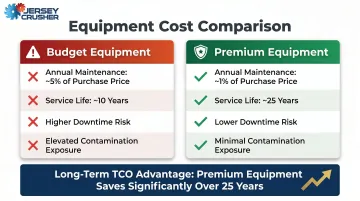
Budget equipment carries a lower sticker price, but frequent downtime, accelerated wear part turnover, and contamination exposure steadily erode those savings. Premium equipment's higher upfront cost is offset by longer service life, fewer shutdowns, and stronger alignment with pet food safety requirements—delivering better long-term ROI.
How to Estimate the Right Budget (and What Most Buyers Miss)
The right budget for bulk solids handling equipment is defined by operational fit and lifecycle cost, not the lowest purchase price. Several overlooked factors consistently cause budget overruns or force premature equipment replacement.
Before budgeting, assess these key factors:
- Throughput requirements — current capacity and projected growth based on production demand
- Ingredient properties — moisture content, abrasiveness, and agglomeration tendency for your specific materials (dry kibble, rendered meals, premix powders)
- Food-grade compliance requirements for your facility, including FSMA sanitary standards and third-party audit requirements
- Integration with existing equipment including conveyors, feeders, and automation systems
- Spare parts and technical support availability from the supplier to minimize downtime risk
Most Common Budgeting Mistakes
Purchase price only: Installation and integration add 10–30% minimum. Ongoing maintenance, energy, and spare parts run another 2–6% annually. Budgets built on sticker price alone will fall short.
Underestimating wear rates: Mineral additives and rendered products accelerate wear on screens, rotors, and breaker bars. Without a consumables budget, the first unplanned shutdown will exceed the cost of planning ahead.
Over-specifying capacity: A unit rated for 5,000 lbs/hr costs significantly more than one sized for 1,000 lbs/hr. Size to realistic production volumes, not theoretical maximums.
Skipping supplier reliability checks: When downtime costs $169,000 per hour, a $5,000 equipment savings disappears fast if replacement parts take weeks to source. Confirm spare parts availability and technical support before buying.
The Value of Engineering Partnership
Working with a manufacturer who engineers solutions from actual product samples — rather than catalog specifications — reduces the risk of mismatched equipment and costly retrofits after installation.
Jersey Crusher follows this approach directly: customers ship product samples for engineering analysis, receive custom equipment recommendations matched to their specific ingredients, and get integration guidance to ensure the equipment fits their existing production lines from day one.
Conclusion
The cost of bulk solids handling equipment for pet food processing varies dramatically based on equipment type, throughput capacity, material specification, customization level, and full system scope. Buyers who evaluate total cost of ownership make stronger long-term investments. Key TCO factors to account for include:
- Installation costs: typically 10–30% of purchase price
- Energy consumption: ongoing operational overhead that compounds over equipment life
- Maintenance: 1–6% of purchase price annually depending on equipment type
- Downtime risk: unplanned stoppages can cost $169,000+ per hour
- Food safety compliance: recall events average $10 million in costs
The right equipment balances performance, food-grade durability, and operational reliability for the specific demands of pet food ingredient handling. Engaging a knowledgeable supplier early—especially one that offers sample evaluation and process integration support—results in more accurate budgets and fewer costly surprises at startup.
Frequently Asked Questions
How much does a lump breaker cost for pet food processing?
Lump breakers for pet food applications typically range from approximately $6,000 for entry-level units to $40,000+ for food-grade stainless steel configurations with custom screens and integrated hoppers. Cost depends on size, throughput capacity (lbs/hr), and whether 304 or 316 stainless steel construction is required to meet FSMA sanitary standards. Request a quote based on your specific ingredient types and throughput requirements.
What is the cost of a packaging machine?
Packaging machinery falls outside the scope of bulk solids handling equipment. For pet food production lines, evaluate packaging costs separately from upstream lump breaking, conveying, and feeding equipment—each category is typically sourced from specialized suppliers.
Do bulk solids handling machines for pet food need to be stainless steel?
Yes. Most pet food environments require food-grade stainless steel under FSMA (21 CFR 507.22)—304 grade for dry kibble and grain, 316 for wet ingredients, high-salt treats, or fish-based formulations. Stainless steel adds roughly 2.5x the cost of carbon steel for 304 grade, with 316 running 20-30% more than 304.
What is the difference between a lump breaker and a particle-izer in pet food processing?
Lump breakers break agglomerated dry materials—compacted grain meals, rendered products—back to a workable particle size. Particle-izers produce finer, more uniform output for applications like premix powders where a specific size distribution is required. The right choice depends on your target particle size and downstream process, such as mixing or extrusion.
Is making dog food profitable?
Pet food manufacturing is profitable, with the U.S. industry generating $29.0 billion in revenue and projected growth to $69.7 billion by 2026. Margins depend on production efficiency and equipment reliability—downtime costs average $169,000+ per hour, and recalls average $10 million in direct costs, making well-specified bulk solids handling equipment a direct driver of profitability.
How long do bulk solids handling machines typically last in pet food processing?
Properly specified stainless steel equipment (304 or 316 grade) lasts 10–25 years in continuous pet food production with maintenance costs around 1% annually. Carbon steel units average roughly 10 years at 5% annual maintenance. Parts availability from the original manufacturer is the most critical factor in maximizing lifespan and avoiding unplanned downtime.