Introduction
Selecting the wrong industrial crusher creates more problems than it solves. Operations across industries run into the same cluster of failures: inconsistent particle size, excessive fines, material clogging downstream equipment, and accelerated wear that leads to unplanned shutdowns.
The consequences show up differently depending on the industry:
- In pharmaceutical manufacturing, particle size variance causes blends to fail content uniformity tests (RSD > 6%)
- In chemical processing, inconsistent sizing slows reaction rates and wastes raw materials
- In food production, irregular granules cause flow problems in pneumatic conveying systems
Industrial crushers transform raw materials into uniform, processable forms across these industries and dozens more. Not all crushers work the same way: compression-based jaw crushers handle hard minerals but fail with sticky materials, while impact-based hammer mills pulverize friable substances but wear quickly on abrasive feeds. This article breaks down the four main industrial crusher types, how they differ mechanically, and how to match the right crusher to your material and output requirements.
Key Takeaways
- Industrial crushers reduce bulk material into consistent, usable particle sizes via compression, impact, shear, or attrition
- Four main crusher types: jaw crushers, lump breakers, roll crushers, and impact crushers — each suited to different materials and outputs
- Wrong crusher choice leads to inconsistent output, excess fines, accelerated wear, and production bottlenecks
- Selection depends on material hardness, moisture content, required particle size, and throughput
What Is an Industrial Crusher?
An industrial crusher is a mechanical machine that applies force — through compression, impact, shear, or attrition — to reduce oversized lumps, clumps, or bulk materials into smaller, uniform particles suitable for downstream processing. Equipment is generally known as a crusher when it performs coarse size reduction (particles larger than 3 cm in diameter) and a mill when used for finer applications.
Industrial crushers differ from heavy mining or aggregate crushers. They are purpose-built for controlled, precise size reduction in process-driven environments such as food production, chemical blending, pharmaceutical manufacturing, and material recycling — where particle uniformity and product integrity matter as much as throughput.
In these settings, the crusher functions as a practical production tool within a larger processing line alongside conveyors, feeders, and screeners. Its output directly affects downstream mixing, packaging, conveying, and quality outcomes.
Four primary forces drive industrial size reduction — and matching the right mechanism to your material determines both equipment effectiveness and longevity:
- Compression — squeezes material between two surfaces; suited for hard, brittle solids
- Impact — breaks material through rapid collision; effective for friable, low-moisture substances
- Attrition (shear) — grinds material between moving surfaces; works well for fibrous or tough materials
- Cutting — slices through material with blades; ideal for flexible, elastic, or fibrous products
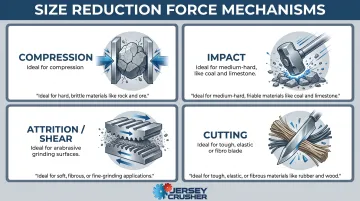
Material properties — brittleness, ductility, abrasiveness, and moisture content — all factor into which force (or combination of forces) your process actually needs.
Why Industrial Crusher Selection Matters
The right crusher type determines particle size consistency, which affects everything from blend uniformity in pharmaceuticals to flow rate in pneumatic conveying systems. A mismatched crusher creates recurring bottlenecks, product rejects, and accelerated equipment wear.
What goes wrong without proper selection:
- Oversized lumps block downstream equipment
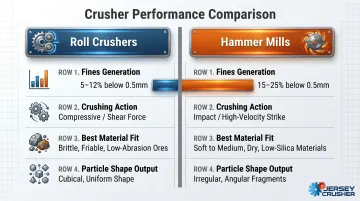
- Excessive fines degrade product quality (15-25% <0.5mm with hammer mills vs. 5-12% with roll crushers)
- Moisture-sensitive materials degrade under high-impact processing
- Production lines halt due to clogging or bridging
- Unplanned downtime costs food manufacturers $5,000 to $25,000 per hour
Industry-specific constraints make the decision even more exacting:
- Food & pharma: Sanitary construction (304 or 316 stainless steel) and compliance with 3-A Sanitary Standards
- Chemical & fertilizer: Explosion-resistant designs per NFPA 652 Dust Hazard Analysis
- Mineral processing: Abrasion-resistant alloys to handle high-wear material streams
Types of Industrial Crushers
Industrial crushers are not one-size-fits-all. The optimal crusher type depends on material hardness, moisture content, friability, required output size, and operational environment.
Jaw Crushers
Jaw crushers use two opposing jaw plates — one fixed, one moving — to compress and fracture material through a squeezing, reciprocating motion, Jaw crushers use two opposing jaw plates — one fixed, one moving — to compress and fracture material through a squeezing, reciprocating motion, as detailed in GlobalSpec's industrial crusher overview. Material enters the top of the V-shaped chamber and is progressively reduced as it moves downward. Because jaw crushers apply high compressive force without impact, they rank among the oldest and most reliable crusher designs.
Best suited for: Primary size reduction of hard, tough, or brittle materials — minerals, ores, ceramics, and solid industrial waste. Common users include mineral processors, construction material recyclers, and operations breaking large feed material into manageable pieces before secondary processing.
Key strengths:
- High compressive force suitable for hard and abrasive feed
- Durable construction with long wear life
- Relatively simple mechanical design that is easier to maintain
- Handles large feed sizes with high crushing ratio
Limitations: Jaw crushers are not well-suited for sticky, wet, or clay-like materials due to clogging risk. They produce somewhat irregular particle shapes with greater fines than roll crushers, and choke feeding increases fines generation, requiring careful feed control. Generally not the right choice where precise, fine particle size distribution is required.
Hammer Mills and Lump Breakers
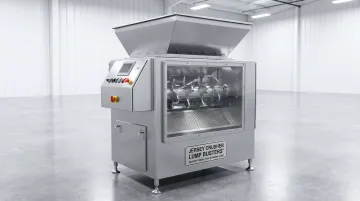
Hammer mills use rotating hammers mounted on a high-speed rotor to strike and shatter material inside a crushing chamber. According to AIChE's hammer milling fundamentals guide, screen aperture provides up to 70% control over output particle size. Lump breakers are a gentler, lower-speed variant designed specifically to break up friable lumps and agglomerates without heavy impact — preserving particle integrity rather than pulverizing material.
Best suited for: Friable, soft, and moderately hard materials including fertilizers, sugar, salt, food ingredients, grains, chemicals, and pharmaceutical powders that have agglomerated or caked during storage or transit. Lump breakers are particularly well-matched for industries where over-reduction, heat generation, or product degradation must be avoided — such as food processing, spice handling, and pharmaceutical manufacturing.
Key strengths:
- High reduction ratios achievable in a single pass
- Output size precisely controlled via interchangeable screen sizes
- Suitable for a wide range of material types
- Equipment can be constructed in food-grade or sanitary materials for regulated industries
Jersey Crusher's Lump Busters® line is a practical example of this approach: screen hole diameters are customizable from ⅛" to 2" and beyond, designed specifically to break friable materials without heavy pounding while maintaining consistent output size.
Limitations: Screen wear and potential blinding (clogging) with wet, sticky, or high-moisture materials. Not suited for very hard or highly abrasive materials without accelerated wear. High-speed variants generate more heat and fines than low-speed lump breakers, which can be a concern in heat-sensitive or dust-explosion-risk environments.
Roll Crushers
Roll crushers feed material between two counter-rotating cylindrical rolls, compressing and shearing it to a controlled output size, as described in McLanahan's roll crusher product overview. The gap between rolls is adjustable, giving operators direct control over maximum particle size. Both double-roll and single-roll configurations are common in industrial settings.
Best suited for: Soft to medium-hard, brittle materials where minimal fines generation is critical — including coal, potash, fertilizers, gypsum, bauxite, and limestone (per McLanahan's roll crusher specifications). Operations requiring a consistent top-size with a predictable, tight particle size distribution benefit most from this crusher type.
Key strengths:
- Produces very few fines compared to impact or hammer-type crushers (5-12% <0.5mm vs. 15-25% for hammer mills)
- Precise and adjustable top-size control via roll gap settings
- Gentle crushing action preserves product shape and integrity
- Relatively low dust and noise output
- Material fractures along naturally occurring cleavage lines, producing a cubical product
Limitations: Roll crushers offer a lower crushing ratio than jaw or hammer mill crushers, making them unsuitable for large or hard feed material. Rolls wear over time with abrasive materials, and wet, sticky, or plastic materials may wrap around or slip between the rolls entirely.
Impact Crushers
Impact crushers use a high-speed rotating rotor fitted with hammers, blow bars, or impeller blades to hurl material against impact plates or a hardened chamber wall. The material fractures through repeated high-energy collisions rather than sustained compression. Horizontal shaft impactors (HSI) are the most common industrial variant.
Best suited for: Medium-hard, less abrasive materials where high reduction ratios and a cubical product shape are priorities — including recycling operations (cardboard, foam, plastic), mineral processing, and certain chemical and industrial waste reduction applications, according to Weir's comminution overview. Also widely used in tissue and cardboard manufacturing environments.
Key strengths:
- Achieves high reduction ratios in a single pass
- Produces a more uniformly shaped output particle compared to jaw crushers
- Adaptable to primary, secondary, or tertiary crushing stages depending on configuration
- Relatively straightforward to adjust and maintain
- Size reduction occurs quickly along short fracture lines, producing more cubical product
Limitations: Impact crushers carry higher wear rates on blow bars and impact plates when processing hard or abrasive materials, increasing maintenance costs (911 Metallurgist, HSI Crushers). High moisture or clay content risks clogging, and this crusher type generates more dust and noise than roll crushers or lump breakers.
How to Choose the Right Industrial Crusher for Your Application
Choosing a crusher means matching your specific material characteristics, output requirements, and operational constraints to the right machine. That decision directly affects energy costs, downtime frequency, and the longevity of downstream equipment.
Start With Material Characteristics
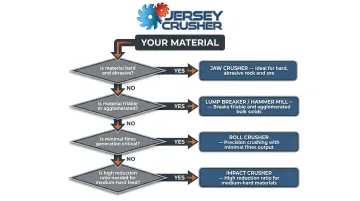
Identify the hardness, abrasiveness, moisture content, stickiness, and friability of your material. These properties eliminate incompatible crusher types immediately:
- Sticky or wet materials are poor candidates for hammer mills without special design provisions
- Hard, abrasive materials accelerate wear in impact crushers
- Brittle materials require compression or shearing mechanisms
- Ductile materials require shearing or cutting approaches
Define Your Output Requirements
Determine the target particle size range, allowable fines percentage, and whether particle shape affects downstream processing. In pharmaceutical manufacturing, inconsistent particle size causes tablets to fail content uniformity criteria (RSD > 6%). Screen-controlled crushers like lump breakers offer tighter particle size control than jaw or impact crushers.
Match Throughput and System Capacity
Assess required volume (tons or pounds per hour), feed size range, and whether the crusher will run continuously or batch-by-batch — including how it integrates with feeders, conveyors, and screeners upstream and downstream.
Account for Industry-Specific Requirements
- Food processing and pharmaceutical: Require sanitary construction (304 or 316 stainless steel), easy cleanability, and compliance with food-contact material standards
- Chemical and fertilizer: May need explosion-resistant designs or abrasion-resistant alloys
- Combustible dust environments: NFPA 652 requires a documented Dust Hazard Analysis (DHA) for processes handling combustible dust
When the right crusher isn't obvious from specs alone, Jersey Crusher's engineers evaluate actual customer product samples to design solutions for existing or new process systems.
Common Mistakes to Avoid When Selecting an Industrial Crusher
Over-specification: Many operations select high-capacity, high-energy crushers when a lower-speed lump breaker or roll crusher would achieve the same output with less wear, less energy, and less maintenance. Match the machine to the actual material challenge — not a worst-case assumption.
Material mismatch: Selecting a crusher that excels in dry, hard rock applications for a moist, fibrous, or sticky industrial material is a common and costly error. Validate crusher compatibility against actual material properties using supplier testing or sample trials before committing.
One cosmetics producer previously relied on labor-intensive manual removal and prescreening to handle agglomerated raw materials, resulting in halted production and waste. Installing the correct deagglomerating crusher streamlined the process in a single pass with minimal particle attrition or heat rise.
Overlooking total cost of ownership: Initial purchase price typically represents just 2–5% of total lifecycle costs. High-wear components — screens, hammers, rolls, and liners — in a mismatched crusher can quickly erase any upfront savings. Factor in spare parts availability, maintenance frequency, and downtime risk when comparing options.
Defaulting to familiarity: Operations often apply a familiar crusher type to new materials even when it's poorly matched to the application. Review each new situation against actual material properties and output requirements rather than defaulting to what's already on the floor.
Conclusion
Industrial crushers are a critical link in any material processing operation — the wrong choice creates downstream problems while the right one delivers consistent particle size, better flow rates, reduced downtime, and lower costs across the entire production line.
Each of the four main crusher types solves a different problem — understanding their mechanics is what separates a smart choice from a costly one:
- Jaw crushers handle hard, abrasive materials through compression
- Hammer mills and lump breakers provide screen-controlled particle size for friable substances
- Roll crushers minimize fines for brittle materials
- Impact crushers deliver high reduction ratios for medium-hard feeds
Evaluate your material properties, target particle size, and throughput requirements before committing to a design. If you're working with friable bulk solids — chemicals, food ingredients, fertilizers, pharmaceuticals — Jersey Crusher's engineers can analyze your product sample directly and recommend a configuration built around your actual processing conditions. Contact the team at Jersey Crusher to get started.
Frequently Asked Questions
What is a crusher (the machine that crushes materials)?
A crusher is a machine that applies mechanical force — through compression, impact, shear, or attrition — to reduce oversized bulk material into smaller, more uniform particles for use in downstream processing or as a finished product.
How do industrial crushers work?
Inside a crushing chamber, the machine applies mechanical force to break material down to a target particle size. The type of force used — compression, impact, shear, or attrition — determines which crusher design fits your material and output requirements.
What are the main types of crushers used in industrial crushing applications?
The four primary types are jaw crushers, hammer mills and lump breakers, roll crushers, and impact crushers. Each is best suited to specific material types and particle size requirements based on mechanical design and force application.
What's the difference between crushing and grinding?
Crushing reduces material to lumps or granules (typically above 1mm), while grinding takes it further to powder or sub-millimeter sizes. Most industrial operations run crushing first, then grinding.
What is the purpose and process of crushing in mineral and industrial processing?
Crushing prepares bulk material for downstream steps — blending, conveying, reacting, or packaging — by reducing it to a consistent, manageable particle size. Feed material enters the crushing chamber and is broken down to a target size set by machine settings or screen apertures.
What is a jaw crusher and how does it work in industrial crushing applications?
A jaw crusher uses a fixed jaw plate and a moving jaw plate to compress and fracture material through a reciprocating squeezing motion. This design makes it well-suited for primary size reduction of hard, abrasive, or oversized feed materials before further processing.