Both systems move bulk solids. That's where the similarities largely end.
Pneumatic conveyors push material through sealed pipelines using pressurized air. Screw conveyors push it forward mechanically using a rotating helical flight. Each approach has a distinct set of strengths, failure modes, and ideal applications—and matching the right one to your process makes a measurable difference in uptime, operating cost, and product quality.
This guide breaks down how each system works, where each wins, and how to decide which belongs in your plant.
Key Takeaways
- Pneumatic conveyors move dry, free-flowing materials through enclosed pipelines over long distances; screw conveyors use a rotating auger over shorter, fixed paths
- Where contamination control, dust containment, or complex routing matter most, pneumatic systems are the better fit
- Screw conveyors handle wet, sticky, heavy, or compacted materials that would clog pneumatic lines—at lower capital and energy cost
- The right choice depends on material type, transfer distance, layout, hygiene needs, and budget
- Many plants use both: pneumatic for inter-building transfers, screw conveyors for in-process feeding and discharge
Pneumatic vs. Screw Conveyor: Quick Comparison
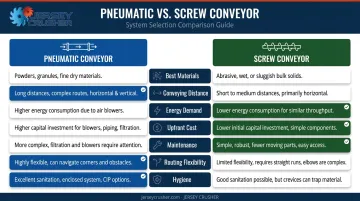
| Factor | Pneumatic Conveyor | Screw Conveyor |
|---|---|---|
| Best materials | Dry, free-flowing powders, granules, pellets | Wet, sticky, cohesive, heavy, or compacted bulk solids |
| Conveying distance | Dilute phase: up to 600 ft+; dense phase: up to 10,000 ft+ | Flexible screw: typically 40–80 ft; vertical screw: up to 100 ft |
| Energy demand | Higher—air compression drives significant power draw | Lower per ton, especially for short-to-medium runs |
| Upfront cost | Higher—blowers, filtration, cyclone separators required | Lower—simpler components, easier installation |
| Maintenance | Fewer moving parts in the conveying line; filter/blower servicing required | More wear components (flights, bearings, seals); replacement is generally straightforward |
| Routing flexibility | High—pipelines route over, under, and around obstacles | Limited—essentially linear; tight bends not possible |
| Hygiene | Excellent for dry powders; closed pipeline eliminates contamination exposure | Enclosed tube designs provide strong hygiene; ideal for wet food or pharma materials |
What Is a Pneumatic Conveyor?
A pneumatic conveyor is a closed-pipeline system that uses pressurized air—or in some cases an inert gas—to transport dry bulk materials from a feed point to a destination. A blower or compressor creates a pressure differential that drives material through sealed tubes with no direct mechanical contact with the product.
The Two Primary Operating Modes
Dilute phase suspends particles in a continuous high-velocity airstream. According to CED Engineering's pneumatic conveying reference, positive-pressure dilute-phase systems operate at 3,200–8,000 fpm and up to 14.7 psig. This mode works well for light, non-fragile powders like flour and talc—but high velocity accelerates pipe wear and can degrade fragile particles.
Dense phase moves material in slugs or plugs at much lower velocity: 200–2,000 fpm at 15–90 psig, with some systems reaching 125 psig. This is the better choice for heavier or fragile materials like sugar or plastic pellets where product integrity matters.
A third variant—vacuum conveying—uses negative pressure to pull material from multiple sources such as storage vessels, trucks, or process equipment. It's particularly valued for cleanliness and hazardous material handling because any leak pulls air in rather than pushing dust out.
Where Pneumatic Conveying Fits
Core advantages include:
- Fully enclosed pipeline eliminates dust exposure and contamination risk
- Pipelines route over, under, or around existing equipment—no floor space required
- Long-distance capability that mechanical systems can't match
- Strong fit for regulated industries where hygiene protocols are non-negotiable
The global pneumatic conveying systems market was estimated at $37.03 billion in 2026, projected to reach $47.53 billion by 2031, with food and beverage holding the largest end-user share at 30.35% of revenue in 2025. That share reflects how dominant pneumatic conveying is in food and pharma plants, where contamination control isn't optional.
Primary industries: food and beverage (flour, starch, spices), pharmaceutical (active ingredients, excipient powders), plastics (pellets, regrind), and chemical processing (fine powders, activated carbon).
Key Limitations
- Higher energy demand from continuous air compression in dilute-phase mode
- Wet, hygroscopic, or sticky materials cake and block pipelines
- Significant capital investment in air movers, filtration, and specialized fittings
- System design requires precise matching to material bulk density and particle size
What Is a Screw Conveyor?
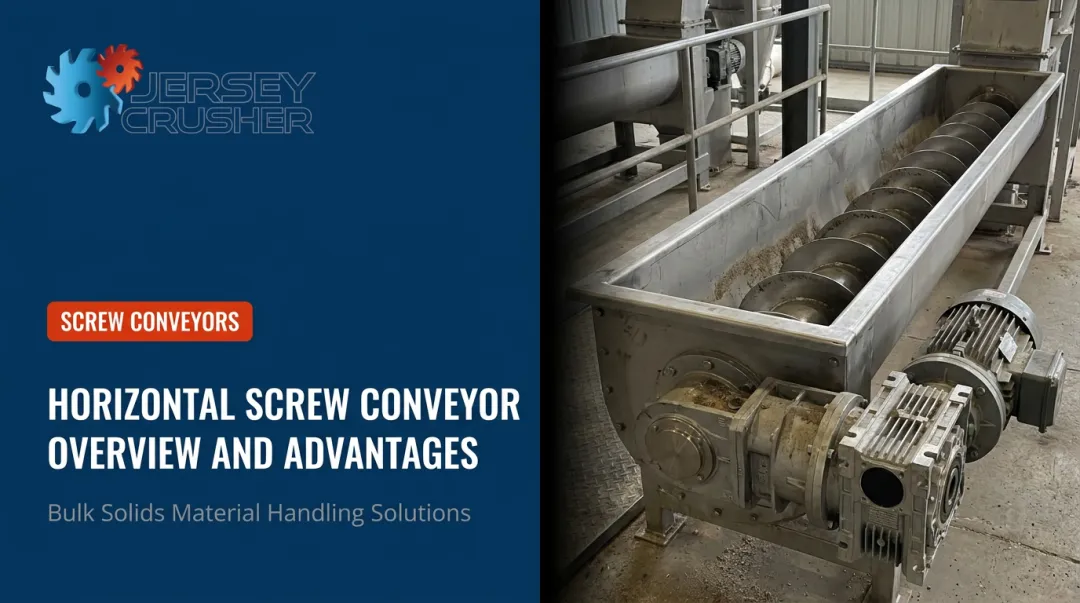
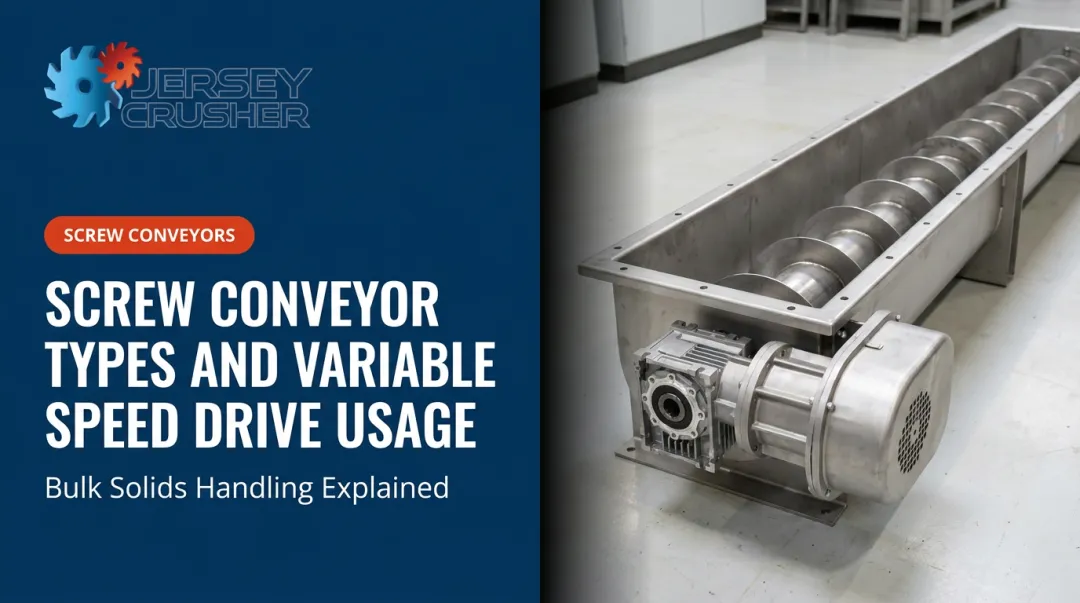
A screw conveyor, also called an auger conveyor, uses a rotating helical flight mounted inside a tube or trough to push material along a fixed path. The motor spins the screw, and with each revolution the material advances. No suspension, no airflow, no pressure system required.
Common Configurations
Three main subtypes serve different applications:
- Tubular screw conveyors — fully enclosed, preferred for dusty or sensitive materials and inclines above 20 degrees where fallback becomes a problem
- U-trough screw conveyors — open-top design, high capacity, easy to clean; standard for horizontal runs and inclines up to 20 degrees
- Flexible screw conveyors — a spiral inside a flexible tube that routes around obstacles; particularly valuable in tight spaces and hygiene-sensitive applications
Jersey Crusher's screw conveyor line covers all major configurations — horizontal, inclined, vertical, and flexible — in diameters from 6 to 12 inches, with custom diameters available for specialized throughput requirements. Construction options include 316 stainless steel, 304 stainless steel, carbon steel with blue enamel finish, and abrasion-resistant variants for aggressive bulk solids.
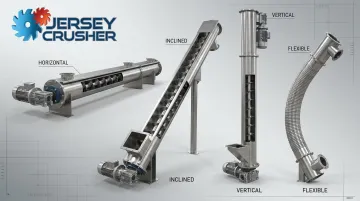
All units include air purge shaft seals as standard equipment, which prevents process material from migrating into bearings — a critical feature in food and pharmaceutical environments where cross-contamination between product runs is a compliance issue.
Where Screw Conveying Fits
Core advantages include:
- Handles wet, sticky, cohesive, and compacted materials that would clog pneumatic lines
- Lower capital cost with simpler components
- Enclosed tube construction prevents dust escape and external contamination
- Available in food-grade and sanitary construction for regulated industries
A published 2025 case study from Akona Solutions documents a flexible screw conveyor implementation at Joseph Dobson & Sons, a traditional confectionery manufacturer, handling sugar over a 10-foot transfer distance — achieving 9.4 minutes per batch and supporting at least 42 batches per 8-hour shift with documented hygiene and efficiency benefits.
Key Limitations
- Not practical for very long distances without intermediate drives
- Routing is linear — tight bends aren't possible
- Abrasive materials accelerate wear on flights and trough surfaces
- Open U-trough designs require covers to prevent material exposure
Pneumatic vs. Screw Conveyor: Which Is the Right Fit?
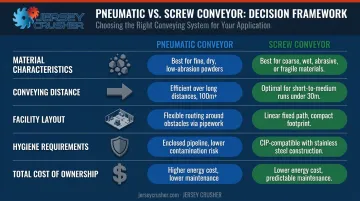
No single system wins across the board. The decision should be driven by at least five factors:
- Material characteristics — particle size, moisture content, fragility, bulk density
- Conveying distance — how far the material needs to travel
- Facility layout — available floor space, routing complexity, elevation changes
- Hygiene and containment requirements — regulatory environment, contamination risk
- Total cost of ownership — capital, energy, and maintenance over the equipment's life
Choose Pneumatic When:
- Material is dry, fine, and free-flowing
- Conveying distance is long or routing is complex
- Contamination risk is high (pharmaceutical, food powders)
- The facility can't accommodate open mechanical systems
- Dust containment is a regulatory requirement
Choose a Screw Conveyor When:
- Material is wet, heavy, sticky, high-density, or compacted
- Conveying distance is short to medium
- Precise, controlled transfer is needed between processing stages
- Budget favors lower capital and operating costs
- The material would cake or block pneumatic pipelines
The Case for Using Both
Many processing plants deploy both systems at different stages—and that's often the most efficient configuration. A pneumatic system might transfer dried powder from a storage silo to a processing floor, while a screw conveyor handles the short run from the floor-level discharge into a mixer, reactor, or packaging line. The result is a leaner, more reliable process — each technology applied where it genuinely performs.
If your process requires precise feed rate control at downstream stages, Jersey Crusher's Volumetric Feeders & Systems pair directly with their screw conveyor line — the feeders handle metering while the conveyors move material between process points.
Real-World Applications: When Each Conveyor Wins
Consider a spice processor moving ground product from a hopper to a packaging station. The material is compacted, slightly cohesive, and carries residual moisture from the grinding process. A pneumatic system is the first instinct—it's clean, enclosed, and easy to route. But that moisture content creates an immediate problem: damp spice powder coats pipeline walls, builds up at bends, and eventually blocks the line. Cleaning it requires disassembly and significant downtime.
A tubular screw conveyor solves this directly. The enclosed tube keeps the environment clean. The rotating flight pushes compacted material forward regardless of moisture content. The short transfer distance (say, 15–20 feet) is well within the screw conveyor's effective range. And the stainless steel construction—316 SS for a sanitary-grade installation—meets food-contact requirements without an elaborate compressed air system.
The result is a system built for the actual material rather than the theoretical ideal:
- Fewer blockage events across shifts
- Simpler maintenance with no compressed air components
- Lower energy consumption at comparable throughput
- Stainless construction sized to the specific bulk density and moisture level
Jersey Crusher's team builds screw conveyors to exactly this kind of specification. Customers can ship product samples to the Wayne, NJ facility for a free engineering evaluation: the team analyzes the material and designs a configuration matched to the specific bulk density, moisture level, required throughput, and integration geometry. That upfront analysis prevents the mismatched equipment decisions that cause early failures and costly retrofits.
If your process involves short-distance, controlled transfer of wet, heavy, or compacted bulk materials, a screw conveyor is the more cost-effective, lower-maintenance solution. Call 973-686-5999 or visit the website to discuss your application.
Frequently Asked Questions
What are the three types of conveyors?
The three primary conveyor types used in bulk solids handling are belt, screw (mechanical), and pneumatic. Belt conveyors move material on a continuous surface; screw conveyors use a rotating auger inside a tube or trough; pneumatic conveyors use airflow through sealed pipelines.
What is another name for a screw conveyor?
Screw conveyors are also called auger conveyors, a reference to the helical auger-style flight that rotates to push material forward. The two terms are interchangeable across the industry.
Can pneumatic and screw conveyors be used together in the same system?
Yes—many plants run both in sequence. Pneumatic systems handle long-distance transfers between buildings or storage silos, while screw conveyors manage short in-process runs into reactors, mixers, or packaging lines.
Which conveyor is better for food-grade or pharmaceutical applications?
Both can meet sanitary requirements. Pneumatic systems offer superior contamination control for dry powders over long distances, while enclosed stainless steel screw conveyors—particularly 316 SS with air purge shaft seals—are preferred for wet, cohesive, or high-moisture materials where pipeline caking is a risk.
What materials cannot be transported by a pneumatic conveyor?
Wet, sticky, high-moisture, or hygroscopic materials—such as wet grain, compacted spice cake, or sludge—are poor candidates for pneumatic conveying because they cake and block pipelines. Screw conveyors handle these materials reliably where pneumatic systems would fail.
How does conveying distance affect the choice between pneumatic and screw systems?
Screw conveyors are practical and cost-effective for shorter runs—flexible screw designs typically top out around 40–80 feet horizontally. Pneumatic systems become more economical for longer distances, with dilute-phase systems reaching 600 feet or more and dense-phase systems extending well beyond that.