Research from Splunk and Oxford Economics puts annual downtime costs for Global 2000 companies at $400 billion — and material handling failures contribute meaningfully to that figure. Getting size reduction right is not a secondary consideration; it's foundational to system performance.
This guide covers the major particle size reduction techniques, how to evaluate material properties against production goals, and the operational factors that determine which approach delivers the best results for your process.
Key Takeaways
- Particle size reduction uses shear, impact, or compression to break bulk solids into consistent, process-ready particle sizes
- Four criteria drive equipment selection: material hardness, friability, moisture content, and target output size
- Equipment choice depends on material type — lump breakers handle friable bulk solids, while heavier crushers and mills address harder materials or finer output targets
- Inconsistent particle size causes downstream jams, product variability, and accelerated equipment wear
- Solutions designed around your actual material samples consistently outperform off-the-shelf equipment
What Is Particle Size Reduction?
Particle size reduction is the mechanical process of breaking large solid materials, agglomerates, or lumps into smaller, more uniform pieces using controlled force. Unlike chemical processing, mechanical size reduction preserves the material's chemical composition throughout.
All size reduction equipment relies on three fundamental forces:
- Shear — cutting or scraping action that fractures material along planes
- Impact — collision-based fracturing where material is struck repeatedly
- Compression — crushing under sustained pressure between two surfaces
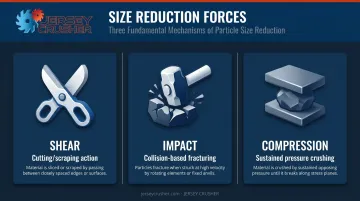
Different techniques combine these forces differently. A hammer mill is primarily impact-based; a jaw crusher relies almost entirely on compression; a lump breaker like Jersey Crusher's Lump Busters® uses a combination of shear and compression through counter-rotating dual rotors.
Coarse vs. Fine Reduction
The force combination your equipment uses only matters if it's matched to the output size you actually need:
- Coarse-to-medium reduction — lump breaking, crushing — targets output sizes from ¼" to several inches. This is the most common requirement in dry bulk solid processing.
- Fine to ultra-fine reduction — milling, grinding, homogenization — targets micron or nano-scale output, typical in pharmaceutical and specialty chemical manufacturing.
Trying to achieve ultra-fine particle sizes with coarse-reduction equipment wastes energy and produces poor results. Running coarse material through fine-reduction equipment creates the same problem in the other direction — oversized feed overloads the machine and drives up wear costs fast.
Why Particle Size Reduction Matters for Industrial Processing
Uniform particle size directly drives product quality — and the evidence is sector-specific.
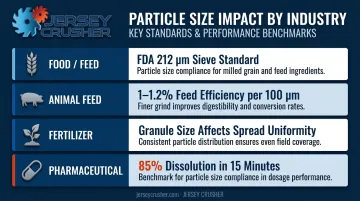
| Industry | Impact of Particle Size |
|---|---|
| Food/Feed | FDA's 21 CFR Part 137 requires flour to pass 98% through a 212 µm No. 70 sieve — particle size is a regulatory floor, not just a quality preference |
| Animal Feed | Iowa State research shows feed efficiency improves 1% to 1.2% per 100 µm reduction (900 µm to 500 µm range) in swine production |
| Fertilizer | Ohio State University confirms granule size and distribution directly influence spread width and field uniformity — uneven granules mean uneven nutrient delivery |
| Pharmaceutical | FDA dissolution guidance links particle size to bioavailability: 85% dissolution in 15 minutes in 0.1N HCl is the benchmark for high-solubility drugs |
Beyond product quality, there are hard operational reasons to get this step right:
- Flow rate: Properly sized particles move through conveyors and feeders without bridging or ratholing
- Equipment protection: Oversized lumps jam rotary valves, wear screw conveyor flights, and damage packaging equipment
- Cost recovery: On-site size reduction enables material reclamation that would otherwise require disposal or transport
Storage conditions introduce a separate risk to all three. Caking and agglomeration, driven by humidity, temperature, and mechanical stress, can convert free-flowing powder into a solid mass before it ever reaches processing equipment — bringing the production line to an unplanned halt.
The Major Particle Size Reduction Techniques
No single technique suits every material. Here's how each method works, what it's suited for, and where it falls short.
Lump Breaking
Lump breakers reduce oversized agglomerates, caked powders, and friable lumps into uniform, manageable particle sizes without aggressive impact. Rotating elements — teeth, breaker bars, or paddles — fracture material through shear and compression, not hammering.
This makes lump breaking the right choice for brittle or friable materials where preserving product integrity matters: sugar, salt, fertilizer granules, dried chemical compounds, food ingredients, grain, and pharmaceutical intermediates.
Jersey Crusher's Lump Busters® are purpose-built for exactly this application. The counter-rotating dual rotor design shears material between two shafts with controlled force, and integrated sizing screens regulate output particle size without over-grinding.
Key specs at a glance:
- Screen hole diameters customizable from ⅛" to 2" and beyond
- Eight model sizes (1515 through 6464) scale from pilot operations to high-volume continuous production
- Air purge shaft seals standard on all units; food-grade and sanitary configurations available
Hammer Milling
Hammer mills use high-speed rotating hammers to repeatedly strike material until it fractures. They're suited for harder, less friable materials where reduction to a fine or medium particle size is needed — grain, minerals, certain chemicals.
Trade-offs to consider:
- Generate significant heat and dust
- Can produce wider particle size distribution without precise screen control
- Not well-suited for heat-sensitive or moisture-sensitive materials
- Screen aperture, rotor speed, and blade gap all influence output PSD
Jaw and Roll Crushing
Jaw crushers apply compressive force between two plates to break hard, coarse materials — ores, rocks, hard minerals. Roll crushers use counter-rotating cylinders for uniform compression across a material surface. Both are standard in mineral processing and heavy industrial applications.
Crushers are engineered for high-hardness materials requiring significant force. Where product integrity or particle uniformity matters — food, pharma, chemical intermediates — the mechanical aggression of jaw and roll crushing creates more problems than it solves.
Ball Milling and Grinding
Ball mills use friction, impact, and attrition between grinding media and material to achieve fine to ultra-fine particle sizes — commonly used in pharmaceutical, chemical, and mineral processing where micron-level control is required.
A 2025 grinding-energy study found ball mills show a notable energy-efficiency drop when producing particles below 30 µm. Fine grinding is also energy-intensive and generates heat — a real concern for heat-sensitive materials. For coarse-to-medium reduction of friable bulk solids, the operating costs alone make ball milling impractical.
High-Pressure Homogenization and Ultrasonic Milling
These techniques apply to liquid-phase or wet processing — emulsions, suspensions, nano-scale particles. They're relevant in pharmaceutical emulsion manufacturing and food science research, but they have no practical application in dry bulk solid processing. If your material is dry and your target is coarse-to-medium reduction, neither method applies.
Matching the Right Technique to Your Material
Material Hardness and Friability
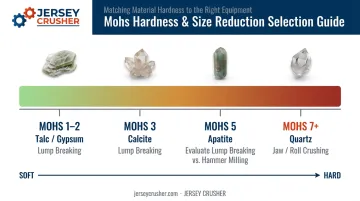
The Mohs hardness scale provides a useful reference for matching materials to methods:
| Mohs Value | Reference Mineral | Size Reduction Implication |
|---|---|---|
| 1–2 | Talc, Gypsum | Very soft — lump breaking or gentle abrasion appropriate |
| 3 | Calcite | Soft — lump breaking handles well |
| 5 | Apatite | Moderate — evaluate lump breaking vs. hammer milling |
| 7+ | Quartz | Hard — jaw or roll crushing required |
Friable materials — those that crack or crumble under relatively light force — are natural candidates for lump breaking. Applying hammer mill or jaw crusher force to a friable material produces excessive fines, dust, and often product degradation.
Moisture Content and Temperature Sensitivity
High-moisture materials clog screens and cause bridging in equipment not designed for them. Heat-sensitive materials degrade when exposed to heat generated by high-speed impact equipment.
Common heat- and moisture-sensitive categories include:
- Food ingredients (spices, sugars, grain-based products)
- Pharmaceutical APIs and excipients
- Certain specialty chemicals and cosmetic powders
For these materials, low-energy methods are the safer path. Lump breakers generate far less heat per unit of processed material than hammer mills running at full speed.
Target Particle Size Range
- Coarse-to-medium output (⅛" to 2"): Lump breakers with interchangeable screens offer the most precise output control. Jersey Crusher's Particle-izers extend this to ultra-fine output down to 100 mesh for applications requiring more precise sizing.
- Micron-level output: Grinding or homogenization technology is required. Do not attempt this with coarse-reduction equipment.
Once you've confirmed the right size range, equipment construction needs to match the material's corrosiveness and abrasiveness — especially in high-volume continuous operations.
Throughput and Material Construction
High-volume continuous operations need equipment built for it. Construction material (carbon steel vs. stainless vs. abrasion-resistant alloys) must match the corrosiveness and abrasiveness of the material being processed:
- 316 stainless steel: Pharmaceutical, food, cosmetics — sanitary applications with strict hygiene requirements
- 304 stainless steel: General industrial corrosion resistance
- Carbon steel with enamel finish: Dry, non-corrosive bulk applications — fertilizer, mineral, foundry
- Abrasion-resistant variants: Aggressive minerals, foundry sand, construction materials
Key Operational Factors to Evaluate Before Choosing Equipment
Particle Size Distribution Control
Output PSD is determined by the interaction of screen size, rotor speed, and feed rate. Equipment that allows precise screen customization gives operators far greater control than equipment with fixed geometry. Jersey Crusher's integrated sizing screens — customizable from ⅛" to 2" and beyond — are a direct response to this need.
Key factors that affect PSD output:
- Screen hole diameter (⅛" to 2"+ range)
- Rotor speed and tip velocity
- Feed rate consistency and material moisture content
Energy Efficiency
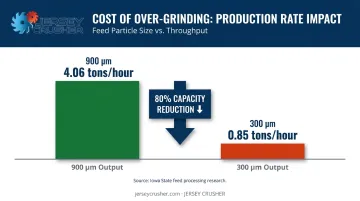
Getting PSD right also has direct energy consequences — size reduction is one of the most energy-intensive steps in material processing. Iowa State's feed processing research illustrates the cost of getting it wrong: production rate dropped from 4.06 tons/hour at 900 µm to 0.85 tons/hour at 300 µm — an 80% capacity reduction from over-grinding alone. Properly matched equipment running at optimal capacity uses substantially less energy per ton than oversized or mismatched equipment grinding material finer than necessary.
Maintenance and Spare Parts
For continuous-duty operations, unplanned downtime is the real cost driver — not the initial equipment price. Key factors:
- Are wear parts accessible without major disassembly?
- Are replacement screens, breaker bars, and rotors stocked and available to ship?
- Does the manufacturer provide technical support post-sale?
Jersey Crusher stocks spare parts for its full equipment line — including Lump Busters®, Particle-izers, Lump Abradors, and Screw Conveyors — and ships internationally and nationwide. Air purge shaft seals, standard on all Jersey Crusher units, protect bearing assemblies from process material migration, extending equipment life and reducing maintenance frequency.
Industries That Depend on Particle Size Reduction
Food and Agricultural Processing
Sugar, grain, spices, herbs, and dehydrated food ingredients all require controlled particle size for consistent texture, flavor release, and packaging efficiency. Equipment in food processing must meet strict sanitary standards:
- 316 stainless steel contact surfaces
- Food-grade interior finishes (white epoxy linings)
- Designs that support cleaning validation and inspection access
Jersey Crusher builds to these specifications, with sanitary lump breaker configurations designed specifically for food-plant environments.
Chemical, Fertilizer, and Mineral Processing
Bulk chemical powders cake during storage, fertilizer granules agglomerate in bags, and mineral ores need preparation before downstream concentration. These applications share a common challenge: abrasive or corrosive materials that wear out standard equipment fast.
Ruggedized construction options for these sectors include abrasion-resistant material variants and carbon steel with blue enamel finishes — both designed for extended service life in harsh processing environments.
Recycling, Pharmaceutical, and Specialty Manufacturing
On-site size reduction enables material recovery across foam, cardboard, glass bottles, and seafood waste — cutting disposal costs and reducing outbound transport volume.
Precision matters even more in regulated industries. In pharmaceutical manufacturing, particle size directly affects drug dissolution rates and bioavailability. In cannabis processing, consistency drives extraction yield and terpene preservation. For these applications, Jersey Crusher's Lump Abradors provide gentle de-agglomeration that reduces particle size without the heat or impact that degrades volatile compounds.
Frequently Asked Questions
What is the process of particle size reduction?
Particle size reduction is the mechanical breakdown of large solid materials into smaller, uniform pieces using shear, impact, or compression. The specific process — and the equipment chosen — depends on the material's physical properties (hardness, friability, moisture) and the target particle size required.
What is the difference between DLS and SEM?
Both are particle size analysis methods, not processing equipment. DLS (Dynamic Light Scattering) measures particle size distribution in liquid suspension using light scattering — fast, non-destructive, and best for submicron particles. SEM (Scanning Electron Microscopy) uses electron imaging to directly visualize particle shape and size, making it better suited for solid samples and research validation.
What factors should I consider when choosing a particle size reduction technique?
The decision comes down to material properties (hardness, friability, moisture content, heat sensitivity), target particle size range (coarse-to-medium vs. micron-level output), and operational requirements such as throughput capacity, energy efficiency, and maintenance burden.
What is the difference between a lump breaker and a hammer mill?
Lump breakers use gentle shear and compression to reduce friable agglomerates to a controlled output size with minimal fines, dust, or heat generation. Hammer mills use high-speed rotating impact to achieve finer particle sizes but generate more heat and dust, and produce a wider size distribution. The right choice depends on material fragility and target output size.
How does particle size affect product quality in manufacturing?
Uniform particle size ensures consistent downstream performance — from dissolution rates in pharmaceuticals and nutrient release in fertilizers to texture in food products and flow rates in bulk handling. Inconsistent sizing causes product variation, processing inefficiencies, and accelerated equipment wear.
What industries benefit most from particle size reduction equipment?
Most bulk solid manufacturing industries rely on size reduction equipment. The most active sectors — food processing, chemical manufacturing, pharmaceutical production, fertilizer and agriculture, mineral processing, and recycling — each have distinct equipment requirements based on material characteristics, regulatory standards, and throughput demands.