Introduction
Moving powdered and granular materials through a processing facility sounds simple. In practice, spillage contaminates product, dust clouds create explosion hazards, and clumped material blocks conveying lines. The wrong transfer system introduces bottlenecks that ripple across every downstream process.
These aren't edge cases. The U.S. Chemical Safety Board documented 281 combustible dust fires and explosions between 1980 and 2005, resulting in 119 fatalities and 718 injuries — many of them directly tied to how facilities handled dry bulk materials.
Powder transfer equipment covers everything from open screw conveyors to fully sealed pneumatic systems. Choosing the wrong approach puts product quality, worker safety, and throughput at risk. This guide breaks down the main system types, the material properties that drive selection decisions, and how to match equipment to your specific operation.
Key Takeaways
- Powder transfer systems include pneumatic (air/vacuum) and mechanical (screw, belt, bucket) conveying technologies
- Material properties — including bulk density, particle size, flowability, and abrasiveness — determine which system fits your application
- Sealed pneumatic and vacuum systems offer superior containment for hazardous or sensitive materials
- Mechanical systems are often more cost-effective for short, high-capacity runs where containment is less critical
- Pre-conditioning with lump breakers before conveying prevents line blockages and protects downstream equipment
- Regulatory requirements (OSHA, NFPA 654, ATEX, FDA GMP) often dictate system design in pharmaceutical, food, and chemical applications
What Is Powder Transfer Equipment?
Powder transfer equipment covers the machinery and systems used to move dry powdered or granular materials between points within a processing facility. This spans simple mechanical conveyors at one end and closed, pressurized pneumatic pipelines at the other.
What distinguishes powder transfer from general bulk solids handling is the specific challenge of fine or granular materials: cohesion, dust generation, segregation, bridging, and containment requirements that coarser materials don't present.
A complete powder transfer system typically includes:
- The conveying mechanism — screw, pneumatic line, belt, bucket elevator
- Feeding and dosing equipment — volumetric feeders, rotary valves
- Dust containment or filtration — venting provisions, collection integration
- Pre-conditioning equipment — lump breakers or size reducers to ensure material flows freely before entering the transfer line
Pre-conditioning is frequently skipped in system design — and it's one of the more costly oversights. Material that has caked, agglomerated, or formed hard lumps during storage will block conveying lines, damage downstream equipment, and produce unpredictable flow rates, no matter how capable the conveyor is.
Types of Powder Transfer Systems
Pneumatic Powder Transfer Systems
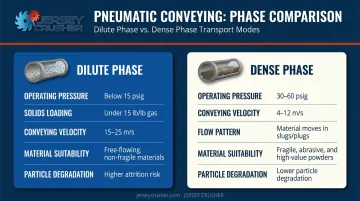
Pneumatic conveying uses pressurized air or vacuum to move powder through enclosed pipelines. There are two operating modes, and the difference matters significantly for material integrity.
Dilute (lean) phase suspends particles at high velocity above the saltation point (the velocity below which particles begin to settle). According to AIChE's guidance on pneumatic conveying, dilute systems typically operate below 15 psig with solids loading under 15 lb solids/lb gas. This makes them well-suited for free-flowing, non-fragile materials over longer distances — but the high velocity creates attrition risk for delicate particles and increases energy draw through blowers.
Dense phase moves material at lower velocity in slugs or plugs, generally requiring above 30 psig, often reaching 45–60 psig. Gericke reports dense-phase pulsed plug conveying at 4–12 m/s, compared to 15–25 m/s for continuous-layer flow. The lower velocity means less particle degradation, less wear on pipelines, and better preservation of particle size distribution — making dense phase the standard choice for fragile, abrasive, or high-value powders.
Vacuum conveying is a widely used subset of pneumatic transfer. Instead of pushing material with positive pressure, the system applies vacuum to the receiving vessel, drawing powder through the line.
The containment advantage is significant: if a leak occurs, ambient air is drawn inward rather than releasing powder outward. This makes vacuum conveying the standard choice for toxic, hygroscopic, pharmaceutical-grade, or allergen-sensitive materials.
Mechanical Powder Transfer Systems
Mechanical systems physically move powder using rotating or moving components rather than air. They generally cost less to operate for short, straight, horizontal runs — but most generate more dust and require more maintenance than enclosed pneumatic alternatives.
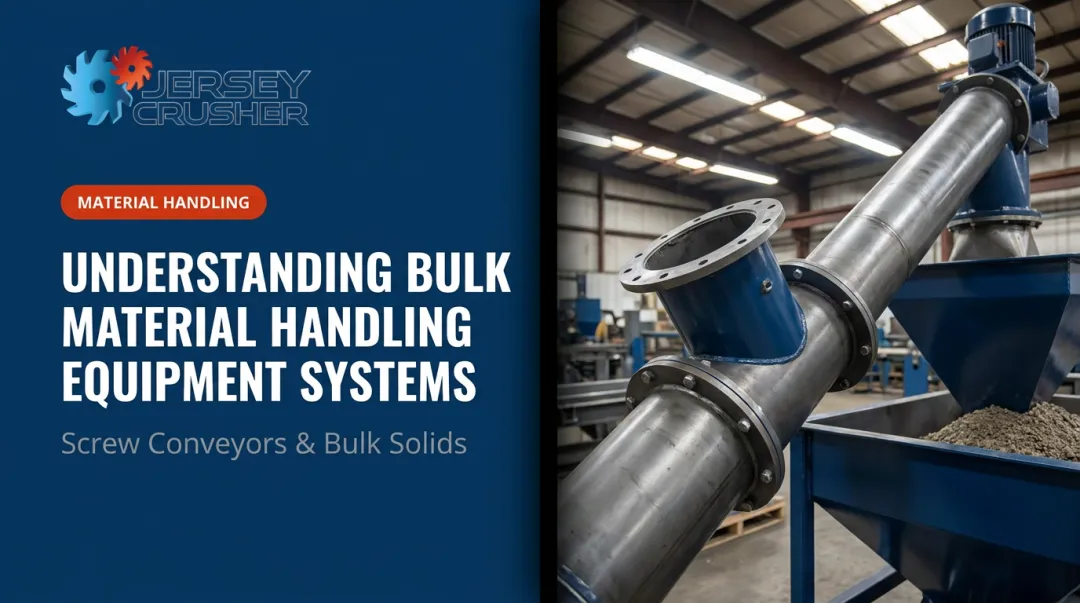
Screw conveyors are among the most commonly deployed mechanical options. A rotating helical screw inside a trough or tube moves material horizontally, at an incline, or vertically. Their enclosed tube design makes them well-suited for powder handling where containment matters, and they double as metering and feeding devices when paired with variable-speed drives.
Jersey Crusher manufactures screw conveyors engineered to integrate into complete process lines — available in 316 stainless steel, 304 stainless steel, carbon steel, and abrasion-resistant variants.
Standard units include air purge shaft seals on all configurations, which prevents material from migrating into bearings and supports cleaner operation in GMP-audited environments. Optional infeed hoppers, dust collection venting provisions, and support stands allow each unit to be configured for specific powder handling requirements.
Other mechanical options include:
- Belt conveyors — open design, suitable for coarse free-flowing materials; requires enclosure for dusty applications
- Bucket elevators — vertical lift for granular or pelletized materials (per CEMA No. 375-2017)
- Vibrating conveyors — gentle, hygienic transfer for fragile or sensitive powders where mechanical contact must be minimized
Key Material Properties That Affect Powder Transfer Performance
The material being conveyed determines the system design — not the other way around. These four properties drive most of the critical decisions.
Bulk Density and Particle Size
Bulk density, as defined by USP <616>, is the mass of an untapped powder sample divided by its volume including interparticulate void space. Low-density powders require lower convey velocities to prevent over-aeration and dusting; denser materials need more energy to sustain motion. System sizing that ignores density will either under-power or over-aerate the material.
Particle size distribution affects minimum conveying velocity in ways that aren't always intuitive. One Powder & Bulk Solids test documented that 40 μm alumina conveyed at roughly 1,000 ft/min, while 120 μm alumina blocked below approximately 2,500 ft/min in the same line.
Finer particles don't always need higher air velocity. The relationship depends on air retention, permeability, and the specific line geometry.
USP <1174> provides angle of repose, compressibility index, and Hausner ratio methods for characterizing powder flow. These measurements identify bridging and flooding risk before system selection, not after a blockage occurs.
Abrasiveness, Moisture, and Hazardous Properties
Abrasive materials such as minerals, certain fertilizers, and chemical granules accelerate wear on pipes, screw flights, and pump components. Specifying the right wetted-part material (hardened steel, abrasion-resistant alloys, or stainless steel grades) at the design stage reduces long-term maintenance costs significantly.
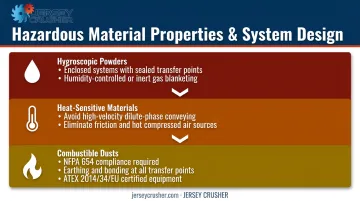
Moisture sensitivity, heat sensitivity, and explosive properties each require distinct design responses:
- Hygroscopic powders clump and block lines ; enclosed systems with humidity-controlled environments or inert gas blanketing may be required
- Heat-sensitive materials can degrade from friction or contact with hot compressed air in dilute-phase systems
- Combustible dusts require NFPA 654-compliant systems, proper earthing and bonding, and in EU facilities, equipment meeting ATEX Directive 2014/34/EU requirements
How to Choose the Right Powder Transfer System
No single system type suits every application. Selection comes down to matching the system to the material's specific characteristics and the operation's throughput, layout, and regulatory requirements.
Match System Type to Application Demands
Key decision variables:
| Factor | Favors Pneumatic/Vacuum | Favors Mechanical (Screw/Belt) |
|---|---|---|
| Transfer distance | Long runs, complex routing | Short, straight horizontal runs |
| Containment requirement | Toxic, pharmaceutical, allergen | Lower-risk bulk materials |
| Material fragility | Dense phase for delicate particles | Vibrating conveyor for sensitive powders |
| Throughput | Moderate | Very high capacity (>50 t/hr) |
| Elevation change | Flexible routing | Inclined/vertical screw or bucket elevator |
AIChE notes mechanical conveyors are generally preferred when capacity exceeds 50 t/hr or distance exceeds 1,500 ft — at those parameters, the energy cost of pneumatic blowers becomes difficult to justify.
Regulatory Compliance Is Non-Negotiable
Fully enclosed pneumatic and vacuum systems offer substantially better containment than open mechanical conveyors. For heavily regulated applications:
- OSHA Table Z-1 sets particulates not otherwise regulated at 15 mg/m³ total dust and 5 mg/m³ respirable fraction as 8-hour TWA limits
- 21 CFR 211.63 and 211.67 require pharmaceutical manufacturing equipment to be designed for cleanability and contamination prevention
- 21 CFR Part 117 covers sanitary design and preventive controls for food-powder handling
These requirements often make sealed system designs a compliance necessity, not just a preference.
Total Cost of Ownership vs. Capital Cost
Pneumatic systems consume more energy through blowers and compressors than mechanical alternatives. Energy is only one cost component, however. A true TCO comparison includes:
- Maintenance frequency and spare parts cost
- Cleaning labor and downtime between batches
- Product loss from spillage or contamination
- Wear rates based on material abrasiveness
For operations evaluating the mechanical side of this decision — screw conveyors, feeders, lump breakers, and size reduction equipment — Jersey Crusher provides application engineering support and a sample evaluation service where customers ship production material for analysis before committing to a configuration.
Benefits of Using the Right Powder Transfer Equipment
Matching powder transfer equipment to the actual material consistently produces gains across three areas: operational efficiency, product safety, and long-term reliability. The magnitude of improvement depends on the baseline — but the direction is the same.
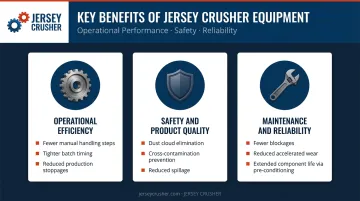
Operational efficiency gains include:
- Fewer manual handling steps between process stages
- Tighter batch time control with metered, consistent feed rates
- Reduced production stoppages from material blockages
Safety and product quality improvements include:
- Elimination of dust clouds that create respiratory hazards and explosion risk
- Prevention of cross-contamination between product batches
- Reduced spillage and associated cleanup labor
Maintenance and reliability benefits include:
- Systems matched to the material experience fewer blockages and less accelerated wear
- Pre-conditioning with lump breakers before conveying eliminates a major source of unplanned downtime
- Abrasion-resistant construction extends component life in high-wear applications
These gains rely on proper specification. A conveyor selected for a different material than what it actually handles will jam, wear prematurely, and pull operators away from higher-value work — erasing the efficiency benefits above.
Industries That Rely on Powder Transfer Systems
Powder transfer equipment appears in virtually every sector that handles dry materials at scale — and the regulatory and operational standards vary considerably depending on the application.
| Industry | Primary Driver | Key Standards |
|---|---|---|
| Pharmaceutical & nutraceutical | Containment, GMP cleanability | 21 CFR Parts 211, 117; USP <616>, <1174> |
| Food processing (grain, spice, sugar, seafood) | Sanitary design, dust control | 21 CFR Part 117; OSHA 1910.272 |
| Chemical & fertilizer | Abrasion, hazardous materials, PSM | OSHA 1910.119; NFPA 654; ATEX 2014/34/EU |
| Mineral processing & recycling | High-volume throughput, abrasion | NFPA 654; site-specific dust management |
Jersey Crusher supplies screw conveyors, volumetric feeders, and lump breakers across pharmaceutical, food, chemical, fertilizer, mineral, sugar, spice, grain, and animal feed applications. With over four decades of cross-vertical experience and a sample evaluation service that lets engineers test actual product before specifying equipment, the company's solutions are matched to material behavior — not adapted from generic designs.
Frequently Asked Questions
What is the difference between pneumatic and mechanical powder transfer systems?
Pneumatic systems use air pressure or vacuum to move powder through enclosed pipelines — they offer better containment and routing flexibility but consume more energy. Mechanical systems use physical components like screws, belts, or buckets — they're typically more cost-effective for short, high-capacity horizontal runs but are more open to dust exposure.
How do I know which type of powder transfer system is right for my application?
The choice depends on material properties (bulk density, flowability, abrasiveness), transfer distance, required throughput, and containment requirements. Shipping product samples to your equipment manufacturer for engineering evaluation — as Jersey Crusher offers — is the most reliable way to confirm the right configuration before finalizing specs.
What industries rely most heavily on powder transfer equipment?
Pharmaceutical, food and beverage, chemical, fertilizer, mineral processing, and recycling sectors are the primary users — each driven by the need to move dry materials safely and efficiently at scale, with industry-specific regulatory requirements shaping how those systems must be designed.
How does bulk density affect powder transfer system design?
Bulk density determines the air velocity and pressure required for pneumatic systems, or the drive torque needed for mechanical conveyors. Lightweight powders need lower velocities to prevent dusting and over-aeration; denser materials require more energy to initiate and sustain movement.
What are the main safety concerns with powder transfer?
Combustible dust explosion risk, toxic exposure, cross-contamination, and ergonomic hazards from manual handling are the primary concerns. Enclosed, sealed systems with proper earthing and bonding — meeting NFPA 654 and ATEX requirements where applicable — are the standard mitigation approach.
Can powder transfer systems handle lumpy or clumped materials?
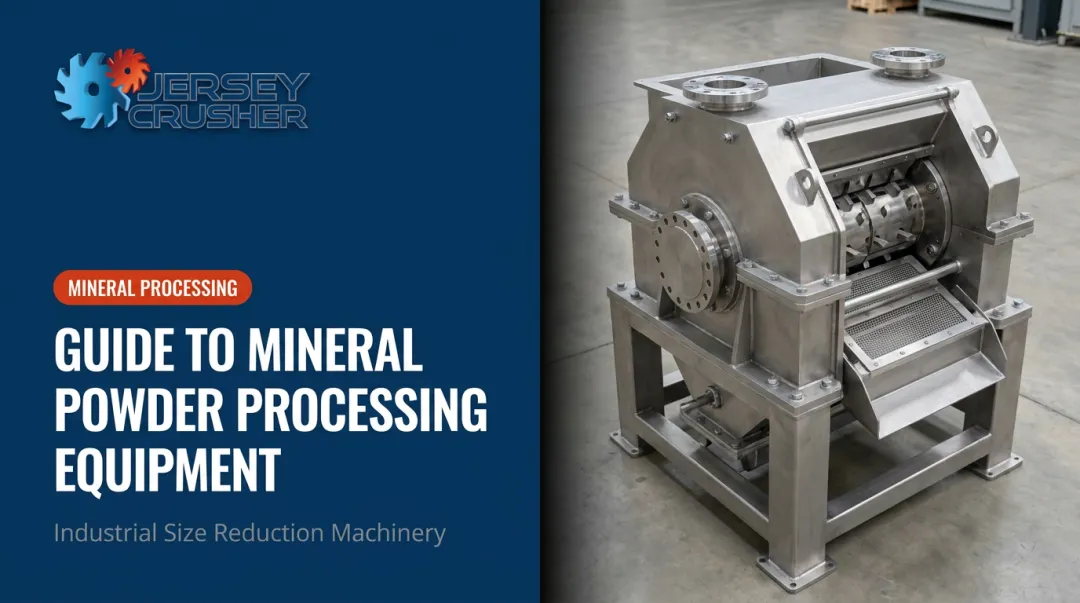
Not without pre-conditioning. Lumps and agglomerates block conveying lines and damage downstream equipment, so caking materials need a lump breaker upstream. Jersey Crusher's Lump Busters® and Lump Abradors handle this step with screen hole diameters from ⅛" to 2"+, customizable to match downstream particle size requirements.