Choosing the wrong system means integration headaches, inconsistent output, and costly retrofits. Choosing the right one means a line that runs predictably, meets spec, and scales with production demands.
This article covers what a turnkey size reduction system actually includes, the methods it uses, the innovations reshaping how these systems are built, and what to look for when evaluating a system partner.
Key Takeaways
- A turnkey system delivers a fully operational size reduction line from one provider, giving operators a single accountability point and no integration risk
- Core methods include lump breaking, granulation, particle-izing, and pulverizing — most production lines sequence two or more stages
- Smart controls, modular designs, VFDs, and food/pharma-grade materials are driving the biggest equipment upgrades right now
- Size reduction and size separation are distinct functions; a complete system needs both
- The best equipment partners test your actual material before specifying anything
What Is a Turnkey Size Reduction System?
A turnkey system means one provider supplies, integrates, and commissions every component — from primary size reduction equipment through conveyance, screening, controls, and downstream handling. The end user receives a fully operational processing line, not a collection of standalone machines requiring separate integration work.
Why Turnkey Matters for Multi-Stage Processing
When multiple reduction stages are involved, component compatibility directly determines throughput and particle consistency. A mismatch between feeder capacity and crusher inlet size, or between screen sizing and downstream conveyor speed, creates bottlenecks that catalog-based solutions rarely account for.
Turnkey execution eliminates integration risk by placing engineering, fabrication, and commissioning responsibility with one party. That single point of accountability matters most for plants that can't absorb extended commissioning cycles or vendor-to-vendor troubleshooting after installation.
What's Typically Inside a Complete System
Configuration varies by material and target particle size, but a complete turnkey size reduction line generally includes:
- Primary size reduction equipment — lump breakers, crushers, or lump abradors sized to material hardness and feed characteristics
- Secondary reduction stages — particle-izers or granulators for tighter downstream particle specs
- Integrated sizing screens or breaker bars — controlling output particle size at each stage
- Screw conveyors and volumetric feeders — delivering controlled, consistent material flow between stages
- Inlet hoppers and support accessories — managing feed consistency into the reduction equipment
- Centralized controls — monitoring throughput, motor load, and system faults
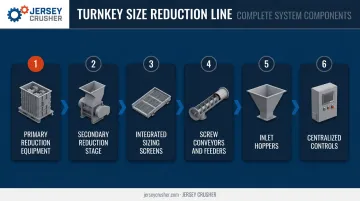
Jersey Crusher's Complete Process Systems, for example, integrate Lump Busters®, Particle-izers, screw conveyors, volumetric feeders, and inlet hoppers into a single engineered package — configured for greenfield builds, supplemental line additions, or capacity expansions.
Key Methods Used in Turnkey Size Reduction Systems
Most turnkey lines sequence two or more of these methods depending on material properties and the gap between incoming lump size and target output.
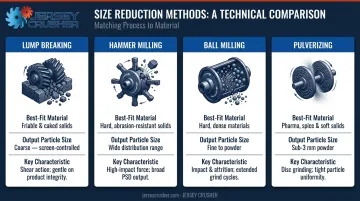
Lump Breaking
Lump breakers are the standard first-stage solution for friable and caked bulk materials — fertilizers, chemicals, sugar, salt, food ingredients, and pharmaceutical intermediates. Counter-rotating rotor shafts shear material between them rather than pound it, which preserves product integrity while achieving controlled size reduction.
Integrated sizing screens or breaker bars control output directly at this stage. Jersey Crusher's Lump Busters® use customizable screen hole diameters from ⅛" to 2" and beyond, so output particle size is matched precisely to downstream process requirements.
The key distinction from hammer mills: lump breakers use shearing action, not impact. For friable or heat-sensitive materials, that difference matters — excessive fines are avoided, heat buildup is eliminated, and particle morphology stays intact.
Hammer Milling and Impact Crushing
Hammer mills use high-speed rotating hammers to impact material, making them suitable for harder or more abrasion-resistant feedstocks where greater energy input is justified. Compared to lump breakers, they produce a wider particle size distribution and generate significantly more heat — a real liability for temperature-sensitive materials.
The right fit depends on feedstock characteristics:
- Friable materials: hammer mill energy input typically generates more fines than the process requires
- Hard, non-sensitive materials: hammer milling delivers the throughput and coarse reduction the process needs
- Temperature-sensitive materials: heat generation makes hammer milling a poor fit regardless of hardness
Granulation and Fine Particle Production
Granulators follow primary size reduction to achieve tighter, smaller output — typically targeting particles in the 8–12mm range or finer. Screen-based control within the granulation chamber ensures material only exits once it meets target size, with oversized particles continuously recirculated.
Jersey Crusher's Particle-izers extend this principle to ultra-fine production, achieving output down to 100 mesh or smaller for pharmaceutical APIs, cosmetic pigments, fine food powders, and cannabis processing applications. Adjustable screens with customizable hole diameters allow precise particle targeting across material types.
Ball Milling
Ball mills use a rotating cylindrical drum loaded with grinding media — steel, ceramic, or aluminum oxide balls — to reduce material through repeated impact and attrition. According to Union Process's engineering reference on attritor and ball mill operation, traditional ball mills use media of ½" or greater, run at 10 to 50 RPM, and commonly operate at 65–80% of critical speed with a standard media charge around 50% of mill volume.
Ball mills are best suited for hard, abrasion-resistant materials requiring very fine or powder-level output. In a multi-stage turnkey line, they typically function as a finishing or fine-grinding stage. Drum speed, ball size, and fill ratio all shift the energy input profile — getting these wrong for a given material hardness widens the particle distribution and increases wear on grinding media.
Pulverizing and Fine Milling
Pulverizers and disc mills achieve sub-3mm or powder-level output through high-speed disc grinding. These are primarily specified for pharmaceutical, spice, and specialty chemical processing where extremely consistent, fine particle distributions are required. Hosokawa's Mikro ACM air classifying mill integrates an internal dynamic classifier that returns coarse particles to the grinding zone — a closed-loop approach ensuring output meets spec before discharge.
Innovations Driving Modern Turnkey Size Reduction Systems
Smart Controls and Automation
Modern turnkey systems increasingly incorporate centralized PLCs and SCADA-linked controls that monitor throughput, motor load, system faults, and particle size feedback in real time. According to BulkInside, automation in powder and bulk material handling delivers:
- Tighter process control and more accurate batching
- Reduced cross-contamination risk across product changeovers
- Better traceability for regulatory compliance and audit readiness
- Real-time fault detection that supports consistent output
Predictive maintenance is where this pays off most directly. Systems that flag motor load anomalies or throughput deviations before failures occur reduce unplanned downtime — and that's where the real cost savings accumulate. The same data infrastructure that drives automation also makes modular system design more practical.
Modular and Mobile System Design
Newer turnkey configurations are engineered in modular skid-mounted or portable formats that can be repositioned between production areas, transported to construction sites, or scaled up by adding modules. The U.S. modular process skid market was valued at $854M in 2024, projected to reach $959M in 2025 — a signal of broad adoption across chemical, pharmaceutical, and food and beverage sectors.
Jersey Crusher equipment is fully mobile and portable, supporting multi-plant operators, contract processors, and construction industry recycling applications where equipment needs to follow the work rather than stay fixed to a foundation.
Energy Efficiency Through VFDs
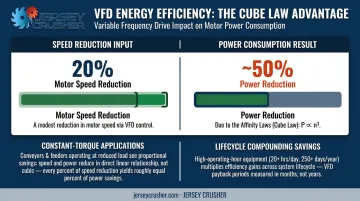
Variable frequency drives (VFDs) reduce energy consumption by adjusting motor speed to match actual process demand rather than running at fixed speed. The U.S. Department of Energy documents that for variable-torque loads, a 20% speed reduction can reduce input power requirements by approximately 50%. For constant-torque applications like conveyors and feeders, savings are proportional to speed — still meaningful across high-operating-hour processing equipment.
Direct-drive and belt-drive configurations, paired with VFDs, are now standard on properly specified turnkey lines. Over a system's lifecycle, that per-ton energy reduction compounds — making VFD integration a financially defensible decision in any new build.
Food/Pharma-Grade and Abrasion-Resistant Construction
Regulatory requirements under 21 CFR 117.40 for food equipment and 21 CFR 211.65 for pharmaceutical equipment require food-contact surfaces to be corrosion-resistant and non-reactive — driving demand for 316 stainless steel and 304 stainless steel construction in regulated industries.
Jersey Crusher addresses this with material options across all regulated applications:
| Construction | Primary Applications |
|---|---|
| 316 Stainless Steel | Pharmaceutical, food processing, cosmetics/personal care |
| 304 Stainless Steel | General industrial, animal feed, food (non-critical contact) |
| Carbon Steel (Blue Enamel) | Fertilizer, mineral, construction, general bulk solids |
| Abrasion-Resistant Alloys | Foundry sand, mineral ore, construction materials |
Optional interior finishes include food-grade white epoxy for sanitary non-contact surfaces and high-temperature inorganic carbon/zinc primer for elevated-temperature chemical applications.
Air purge shaft seals are standard on all units — preventing process material from entering bearings, which is critical for cross-contamination control in GMP-audited operations.
Size Reduction vs. Size Separation: Understanding the Difference
These two functions are distinct, but both are required in a complete turnkey system — and confusing them leads to troubleshooting in the wrong place.
Size reduction is the mechanical process of breaking down bulk material into smaller particles through applied force — impact, compression, shear, or attrition. It physically changes the dimensions of individual particles. Every method described in the section above is a size reduction method.
Size separation — screening, sieving, air classification — does not change particle size. It sorts an already-processed material stream into fractions based on particle dimensions. Screening reveals what you have; size reduction determines what you get.
How Both Functions Work Together in a Turnkey Line
A well-designed turnkey system sequences reduction and separation so that:
- Material enters the primary reduction stage
- Output passes through integrated screens or a downstream classifier
- On-spec material exits the system
- Oversized material recirculates back into the reduction equipment for regrinding
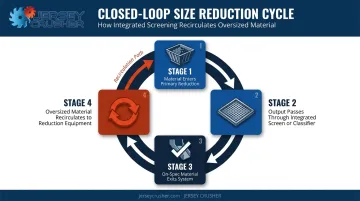
This closed-loop design ensures the entire product stream meets specification before discharge. Integrated screens — such as the customizable hole-diameter screens built into Jersey Crusher's Lump Busters® — act as the quality gate. Separation and reduction depend on each other: remove either stage and the system loses control over final particle size.
When output particle size runs inconsistent, isolating which stage is responsible speeds up the fix. Common root causes split along these lines:
- Reduction stage: worn screens, incorrect rotor speed, overloaded feed rate
- Separation stage: misaligned classifier wheel, blinded screen apertures, air velocity imbalance
They're different problems — and they need different solutions.
What to Look for in a Turnkey Size Reduction Partner
Application-Specific Engineering, Not Catalog Selection
The biggest risk in selecting a size reduction system is applying a generic solution to a specific material. Feedstock hardness, moisture content, agglomeration tendency, abrasiveness, and temperature sensitivity all affect which method works — and which creates costly problems.
Any credible partner should test your actual material before specifying equipment. Jersey Crusher's free sample evaluation service does precisely that: customers ship a representative sample freight-prepaid to the Wayne, NJ facility, where the engineering team assesses it to determine model size, screen hole diameter, material construction, rotor configuration, and integration requirements. The result is a custom equipment specification matched to real material behavior, not assumptions.
Single-Source Manufacturing vs. Reseller Assembly
Not every size reduction supplier builds what they sell. Some design and fabricate their own equipment; others assemble systems sourced from unrelated OEMs. Questions to ask any prospective partner:
- Do you design and fabricate the core equipment, or source it from third parties?
- Can you provide application engineering support from your own technical staff?
- Are spare parts manufactured to your spec, and are they stocked for fast delivery?
- What does post-installation support look like — parts, maintenance guidance, integration troubleshooting?
Jersey Crusher has manufactured lump breakers and complete process systems from its Wayne, NJ facility for over four decades. The full product line (Lump Busters®, Lump Abradors, Particle-izers, Screw Conveyors, and Volumetric Feeders) is built in-house, with spare parts stocked in inventory and expedited order options available to minimize production downtime.
The engineering team also evaluates existing conveyor systems — screws, belts, vertical lifts, rotary valve assemblies, and pneumatic transfer points — to confirm new equipment integrates correctly with what's already installed. That integration review comes at no additional charge.
For facilities evaluating a turnkey system, contact Jersey Crusher at 973-686-5999 or sales@jerseycrusher.com to discuss your application or arrange a material sample evaluation.
Frequently Asked Questions
What methods are used in a turnkey size reduction system?
Turnkey systems typically combine lump breaking, granulation, pulverizing, and screen-based sizing — often sequencing two or more stages. The right combination depends on target particle size and the physical properties of the input material. For friable bulk solids, gentler reduction methods that avoid heavy pounding preserve product integrity while still hitting particle size specs.
How does integrated screen sizing work in a turnkey size reduction system?
Integrated screens are built directly into the reduction equipment and control output particle size without a separate screening step. Hole diameters can be specified from ⅛" up to 2" or larger, depending on target granule size. Oversized material stays in the reduction chamber until it passes through — delivering a consistent, on-spec product stream without additional sorting equipment.
What is the difference between size reduction and size separation in a turnkey size reduction system?
Size reduction physically breaks particles into smaller pieces using force. Size separation — via screens or classifiers — sorts particles by size without changing them. In a turnkey system, both are integrated so oversized material recirculates through the reduction stage until the full product stream meets spec.
What industries benefit most from a turnkey size reduction system?
Chemical processing, food and spice manufacturing, pharmaceutical production, fertilizer processing, recycling, and mineral processing are among the highest-demand sectors. Each drives distinct requirements around output particle size, contamination prevention, and throughput capacity.
How do you choose the right turnkey size reduction system for your facility?
Evaluate based on material type, target particle size range, required throughput, and regulatory environment. Prioritize vendors who test your actual material samples before recommending equipment — Jersey Crusher, for instance, accepts product samples for engineering analysis and builds custom solutions around the results. Single-source design, fabrication, and post-installation support reduces integration risk compared to assembling systems from unrelated components.
What are the key innovations driving modern turnkey size reduction systems?
Modular and mobile skid-mounted designs, engineered-to-order configurations built around sample-evaluated materials, and advances in construction materials — 316 stainless steel, food-grade epoxy finishes, abrasion-resistant alloys — are driving the most meaningful changes in how turnkey systems are designed and sourced. Multi-stage configurations tailored to specific material properties, rather than off-the-shelf assemblies, are increasingly the standard expectation.