Introduction
Lumps form in bulk bags, silos, and hoppers. Powders cake during storage. Granules agglomerate under pressure or humidity. By the time raw materials reach the process line, they're already jamming conveyors, clogging feeders, and triggering costly production stops — before a single reaction starts.
Research published by Chemical Engineering illustrates the stakes precisely: salt with a 100-micron median particle size remained free-flowing, while the same material ground to 10 microns became highly cohesive after just 24 hours of storage. Particle size isn't just a handling variable — it determines whether your process runs or stalls.
Here's what you need to know to select the right approach for your production line.
TLDR
- Lump breaking, mechanical milling, and high-pressure homogenization serve distinct roles in chemical processing
- Particle size directly affects reaction rates, dissolution speed, and downstream flowability
- Material properties — hardness, moisture content, abrasiveness, reactivity — must drive equipment selection
- Dust explosion risk, hygroscopic behavior, and cleanability requirements add chemical-specific complexity
- Testing actual product samples before specifying equipment is the most reliable path to correct sizing
What Is Size Reduction in the Chemical Industry?
Size reduction is the mechanical process of breaking solid materials — lumps, agglomerates, granules, or oversized particles — into smaller, more consistent pieces that downstream processing can actually use.
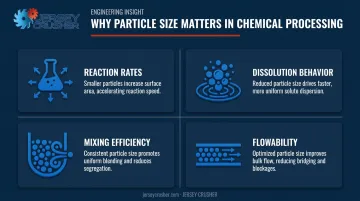
In chemical manufacturing, this matters more than in general production because feedstocks behave unpredictably. Many chemical materials are abrasive, hygroscopic, or reactive, and particle size directly controls:
- Reaction rates — surface area determines how fast a solid contacts a reagent or catalyst
- Dissolution behavior — particle size distribution governs how quickly and evenly a solid dissolves in solvent-based processes
- Mixing efficiency — uniform particles blend more consistently, reducing batch-to-batch variation
- Flowability — oversized or irregular particles bridge, arch, and jam material handling equipment
The work itself divides into two practical categories:
- Primary reduction: Handles bulk lumps and large aggregates, breaking caked material back into processable form
- Secondary (fine) reduction: Targets specific particle size distributions for formulation, reaction, or downstream handling requirements
Key Size Reduction Techniques Used in Chemical Processing
Technique selection starts with understanding the material: its hardness, friability, moisture content, abrasiveness, reactivity, and the target output size. No single method works across all chemical feedstocks.
Lump Breaking
Lump breaking is the first-stage workhorse for chemical plants dealing with caked, agglomerated, or bridged bulk powders and granules. It's common in fertilizer, polymer, resin, salt, and chemical additive handling — anywhere material has consolidated during storage or transport and needs to be restored to a flowable state before entering the process.
The mechanism is deliberate: rotating elements break friable lumps using controlled shearing force rather than heavy impact. Aggressive pounding — the kind used in hammer mills or ball mills — generates excessive fines and can degrade chemical materials that need to maintain specific particle morphology downstream.
Jersey Crusher's Lump Busters® line is purpose-built for this application. The registered trademark equipment uses a counter-rotating dual rotor design where the shafts shear material between them rather than pound it. Key features relevant to chemical plant specifications:
- Integrated size reduction screens or breaker bars sized to customer specifications
- Screen hole diameters from ⅛" to 2" and beyond, customizable per application
- Air purge shaft seals standard on all units — prevents process material from migrating into bearings, critical for chemical service
- Available in 316 stainless steel, 304 stainless steel, carbon steel, and abrasion-resistant variants
- Model sizes from 1515 through 6464 to match production scale
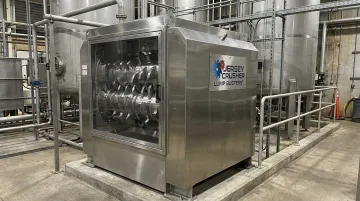
For chemical plants handling corrosive intermediates, 316 stainless steel is the most commonly specified construction. For dry, non-reactive bulk chemical applications, carbon steel with blue enamel finish is the economical standard.
Mechanical Milling
Mechanical milling covers a range of approaches suited to finer reduction requirements:
- Hammer mills — impact-based grinding for brittle materials; AIChE data indicates finished product ranges from millimeters to tens of microns; generally limited to materials at Mohs hardness 3.5 or below
- Ball mills — grinding media impact and attrition, used wet or dry depending on the process; output ranges are material- and mill-specific
- Jet mills — compressed gas drives particle-on-particle impact for ultra-fine or heat-sensitive materials; fluidized-bed variants reach D97 = 3–40 microns at 50–120 psig operating pressure
Jersey Crusher's Particle-izers occupy the fine reduction space within the company's product line — producing particles down to 100 mesh or smaller for chemical powder applications where downstream reaction efficiency or formulation uniformity demands tight particle size control.
Lump Abrasion
Where dust generation is a contamination or safety concern, Jersey Crusher's Lump Abrador line offers an alternative approach. Single large-diameter rotor with spaced impacting fingers and fixed combs abrades agglomerates with minimal dust creation — the preferred choice for explosion-zone-classified chemical environments or when particle morphology must be preserved.
Capacity ranges from 60 to 1,600 cubic feet per hour, with rotor speeds from 300 to 1,800 RPM. Available in the same material grades as the Lump Busters® line.
Grinding and High-Pressure Homogenization
When shearing force alone isn't sufficient, two additional approaches cover harder compounds and liquid-phase applications:
- Grinding (roll compaction or friction-based surfaces) — suited to harder chemical compounds; roll compaction also handles chemical intermediate processing where size reduction and particle re-formation are needed simultaneously
- High-pressure homogenization — forces emulsions, dispersions, or slurries through a restrictive orifice; cavitation and turbulent stresses reduce droplet or particle size for chemical intermediates formulated as liquid concentrates
Chemical Industry-Specific Challenges in Size Reduction
Hazardous and Reactive Materials
Many chemical feedstocks are flammable, explosive as airborne dusts, corrosive, or toxic. OSHA classifies particulates below approximately 500 microns as generally hazardous, with minimum ignition energies as low as 1 to 3 mJ for some solids — meaning size reduction equipment itself can become an ignition source if not properly specified.
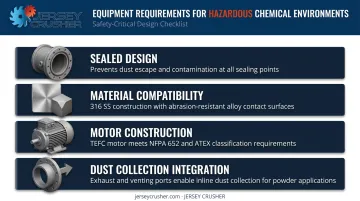
Equipment requirements for hazardous chemical environments:
- Sealed designs that prevent dust escape into the surrounding area
- Material compatibility — 316 stainless steel for corrosive chemicals, abrasion-resistant alloys for aggressive abrasive compounds
- TEFC motor construction as a baseline; for dust-classified zones, consult NFPA 652 and ATEX Directive 2014/34/EU requirements
- Dust collection venting integration for powder applications
Jersey Crusher's standard TEFC motors and air purge shaft seals on all units address baseline containment requirements. For explosion-proof motor specifications specific to your hazard classification, the engineering team evaluates requirements on a per-application basis.
Hygroscopic and Temperature-Sensitive Materials
Certain chemical powders absorb atmospheric moisture rapidly, causing re-agglomeration hours after size reduction. This drives rework and raises per-unit processing costs.
Fertilizers Europe identifies moisture pickup, caking, dust formation, and thermal-cycling breakdown as core storage and transport risks for solid mineral fertilizers. Ammonium nitrate-based fertilizers are particularly sensitive around the 32°C phase-transition threshold.
Chemical Engineering identifies crystalline bonding, moisture evaporation, plasticization, and fines generation as the primary caking drivers across bulk chemical materials.
Mitigation approaches:
- Low-speed, low-friction operation minimizes heat generation during reduction
- Open-rotor configurations reduce residence time and frictional contact
- Appropriate material of construction prevents moisture-reactive contamination
- Downstream sealing and controlled-atmosphere storage limits re-exposure
Contamination Control and Cleanability
Chemical plants processing multiple products or purity grades require equipment that cleans completely between batches and resists cross-contamination. Process material entering bearing housings causes equipment failure and introduces contamination into the product stream.
Air purge shaft seals on all Jersey Crusher units create a positive-pressure barrier that blocks material from entering bearing housings. Combined, the standard feature set supports the cleanability requirements chemical manufacturing demands:
- Air purge shaft seals on every unit prevent bearing contamination
- 316 stainless steel construction resists corrosive process chemicals
- Accessible internals allow complete cleaning between batches
- Optional food-grade white epoxy interior finish for sanitary applications
Continuous vs. Batch Integration
Chemical plants running continuous production cannot accommodate size reduction equipment that operates as a separate batch step. The lump breaker or mill must integrate in-line, matching throughput to the production rate without becoming a bottleneck.
Practical requirements for continuous-line integration:
- Equipment throughput matched to upstream feed rate and downstream capacity
- Compatibility with screw conveyors, volumetric feeders, and hopper geometry
- Consistent output particle size so downstream equipment — reactors, feeders, mixers — operates at stable conditions
How to Choose the Right Size Reduction Equipment
Start with Material Characterization
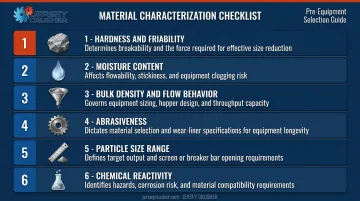
Before selecting equipment, characterize the material fully. The properties that must be known:
- Hardness and friability: determines whether lump breaking, abrasion, or harder grinding is needed
- Moisture content: affects agglomeration tendency and equipment design requirements
- Bulk density (ASTM D6683) and flow behavior (ASTM D6128 shear testing): determines hopper geometry and feeder sizing
- Abrasiveness: drives material of construction selection
- Particle size of incoming material and target output size: defines screen configuration
- Chemical reactivity or corrosiveness: determines allowable materials of construction
Skipping this step leads to equipment that either fails prematurely or underperforms from day one.
Match Throughput to the Production Line
Undersized equipment creates bottlenecks. Oversized equipment wastes capital and may operate inefficiently at low loads.
Jersey Crusher offers a free product sample test and evaluation service: customers ship freight-prepaid samples of actual production material to the Wayne, NJ facility, where the engineering team determines the appropriate model size, screen configuration, material grade, and drive option before any purchase commitment.
For continuous chemical production lines, this pre-purchase evaluation is the most reliable way to confirm sizing accuracy. To initiate, call 973-686-5999 for sample shipping instructions.
Material of Construction and Compliance
| Application Type | Recommended Construction |
|---|---|
| Corrosive chemical intermediates | 316 stainless steel |
| General chemical service | 304 stainless steel |
| Dry, non-reactive bulk chemicals | Carbon steel with blue enamel |
| Highly abrasive compounds | Abrasion-resistant alloy variants |
When chemical intermediates feed into pharmaceutical or food downstream processing, sanitary construction standards (316 SS with optional food-grade white epoxy finish) may apply even at the chemical stage.
The right construction choice also shapes how the equipment fits into the broader line.
Integration and System Design
Size reduction rarely operates in isolation. Jersey Crusher supplies the full system:
- Inlet hoppers with safety baffles, customized geometry to prevent bridging and ratholing
- Screw conveyors for enclosed material transport downstream
- Volumetric feeders for controlled, consistent feed rate into reactors or packaging
- Turnkey complete process systems combining all components into a single engineered package
For chemical plants running greenfield projects or adding size reduction to an existing line, working with a supplier who can design and supply the full system eliminates the integration problems that arise when components from different manufacturers meet at the flange.
Mobility and Flexibility
Jersey Crusher equipment is fully mobile : units can be repositioned between production lines or across facilities. For multi-plant chemical operators or seasonal production schedules, this avoids the capital cost of multiple fixed installations.
Chemical Industry Applications: Where Size Reduction Makes a Difference
Chemical processing spans several distinct segments, each with specific size reduction requirements:
Fertilizer and agrochemical production — Caking during storage is the primary problem. Crystal-bond growth under moisture, temperature cycling, and storage pressure consolidates granules into hard masses. Proper lump breaking restores flowability and ensures uniform granule size for accurate agronomic application rates.
Polymer and resin processing — Agglomerated pellets, compacted flakes, and resin cake from production all require controlled reduction before melting or compounding. Jersey Crusher equipment handles a range of materials, including:
- ABS resin, epoxy resin, and polyethylene
- Nylon, rubber, and polypropylene
Polypropylene, for example, shows greater cohesive strength when stored at 70°C than at room temperature — storage conditions alone can create lump-breaking requirements mid-process.
Specialty chemicals and catalyst manufacturing — Catalyst activity is sensitive to particle size. Research on Pt/SBA-15 catalyst systems found that smaller platinum particles showed higher activity, confirming the direct link between surface area and reactivity. Achieving tight particle size distributions for specialty chemical and catalyst applications requires equipment that controls output precisely, not just reduces bulk size.
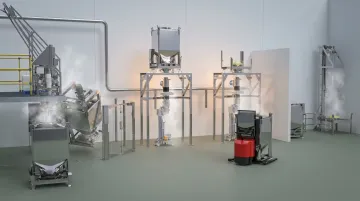
Chemical recycling — Recovering polymeric waste into usable raw materials requires size reduction of mixed reclaimed materials. Jersey Crusher serves recycling operations across its product line, with equipment handling oversized reclaimed materials before reprocessing.
Downstream industries — pharma, food, and mineral processing — Chemical intermediates from these segments frequently feed into pharmaceutical tablet manufacturing, food ingredient processing, and mineral extraction. Jersey Crusher serves all three downstream industries with the same equipment lines: 316 stainless steel construction for pharmaceutical and food applications, and abrasion-resistant variants for mineral processing. The particle size standard set upstream carries forward without an additional reduction step.
Frequently Asked Questions
What is size reduction in industrial chemistry?
Size reduction in industrial chemistry is the mechanical process of breaking large solid materials (lumps, agglomerates, or oversized particles) into smaller, uniform pieces. The goal is improved processability, consistent reaction contact, and reliable product quality across batches in chemical manufacturing.
What is the difference between a lump breaker and a crusher?
Lump breakers use low-force rotating elements designed for friable, relatively soft agglomerates (caked powders, lumped granules), restoring flowability without generating excessive fines. Crushers apply significantly higher compressive or impact force suited to harder, more rigid materials. Material hardness and friability determine which is appropriate.
How do I choose the right size reduction technique for my chemical plant?
Selection depends on material hardness, moisture content, reactivity, target output particle size, and throughput requirements. Testing actual production samples before specifying equipment is the most reliable approach, eliminating assumptions about material behavior that lead to mismatched equipment selection.
What safety considerations apply to size reduction in chemical processing?
Key safety factors include dust explosion risk (particulates below ~500 microns are generally hazardous), material corrosiveness requiring stainless or abrasion-resistant construction, and containment for toxic or reactive substances. NFPA 652 and ATEX Directive 2014/34/EU set the governing standards for equipment in explosive atmospheres.
How does particle or lump size affect chemical reaction efficiency?
Smaller, uniform particles expose more surface area per unit volume, accelerating reaction rates and improving dissolution contact in solvent-based processes. Inconsistent particle size means inconsistent reagent exposure , which translates directly to variable reaction yields and product quality variation batch to batch.
Can size reduction equipment handle both abrasive and corrosive chemical materials?
Yes, with proper specification. Material of construction is selected based on the chemical being processed: 316 stainless steel for corrosion resistance, abrasion-resistant alloy variants for high-wear applications. Air purge shaft seals and accessible internals address containment and cleanability in the same design.