Size reduction equipment solves this by using mechanical force to break bulk solids into smaller, more uniform particles. The result: better flow, easier handling, and consistent output quality that downstream processes depend on.
This guide covers how these machines work, the main equipment types available, which applications each serves best, and how to choose the right solution for your process.
Key Takeaways
- Size reduction uses four force mechanisms—compression, impact, shear, and attrition—often in combination
- Equipment categories—lump breakers, crushers, grinding mills, and pulverizers—each suit different materials and applications
- Choosing correctly depends on material hardness, feed size, target particle size, throughput, and regulatory requirements
- Industries from food and pharma to chemical manufacturing and recycling rely on size reduction for efficiency and quality
- Send material samples to a manufacturer before buying—it's the most reliable way to confirm equipment selection
How Size Reduction Equipment Works
All size reduction equipment applies one or more of four fundamental mechanical forces, as defined in AIChE technical literature:
- Fractures material by compression — pressing it between two opposing surfaces
- Breaks particles via impact — a sharp, instantaneous blow from a moving component
- Slices or cleaves through material using shear/cutting action
- Degrades particles through attrition — rubbing against each other or a hard surface in opposing parallel motion
Most industrial machines combine at least two of these mechanisms. A lump breaker, for example, uses both shear and compression as counter-rotating rotors pull material inward.
From Feed to Discharge
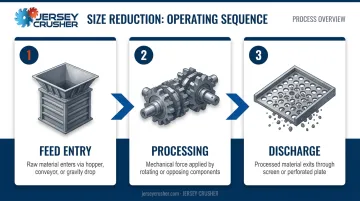
The general operating sequence follows three stages:
- Feed entry — Raw material enters through a hopper, conveyor, or gravity drop into the reduction chamber
- Processing — Rotating or opposing components apply mechanical force to break material apart
- Discharge — Processed material exits through a screen, perforated plate, or outlet port that limits maximum particle size
How Screens Control Output
Sizing screens give operators precise control over particle size distribution. The screen's hole diameter acts as a physical gate — nothing exits until it fits. Different machine types handle this gating differently:
- Cone mills use screens or perforated plates as the limiting barrier
- Granulators combine internal knives with sizing screens for two-stage control
- Air classifier mills replace screens with a classifier wheel — wheel speed determines fineness
This screen-based approach is central to how Jersey Crusher's Lump Busters® deliver consistent output. Their integrated screens are available in hole diameters from ⅛" to 2", with custom options beyond that range, so output particle size is built to your specification from the start.
Types of Size Reduction Equipment
Lump Breakers
Lump breakers are designed for friable, caked, or agglomerated bulk materials—sugar, fertilizer, salt, dried chemicals, pharmaceutical ingredients—that have hardened during storage or transport. The goal isn't fine grinding. It's breaking material back to a manageable, flowable size without over-reducing it into dust.
How they work: Counter-rotating dual rotor shafts pull material inward, applying shear and compression to fracture lumps along natural fault lines. This controlled action—without the heavy pounding of hammer mills, ball mills, or pin mills—preserves product integrity while restoring flowability.
Jersey Crusher's Lump Busters® exemplify this approach. Key specifications:
- Screen options: ⅛" to 2" hole diameter, with custom configurations beyond that range
- Models available: 1515, 2020, 2024, 2048, 2424, 2448, 3648, 6464—spanning a wide range of throughput requirements
- Material construction: 316 stainless steel, 304 stainless steel, carbon steel (blue enamel), or abrasion-resistant alloys
- Optional finishes: Food-grade white epoxy interior, high-temperature inorganic carbon/zinc primer
- Standard features: Air purge shaft seals on all units, 230/460/3/60 TEFC 1800 rpm motor, belt or direct drive (gear reduction available for demanding applications)
Two additional product lines address specialized requirements:
- Lump Abradors — use abrasion rather than shear, suited to applications where dust generation must be minimized or particle morphology needs to be preserved
- Particle-izers — use high-speed impact and shear to produce fine, evenly sized particles down to 100 mesh or smaller, for pharmaceuticals, chemicals, and food processing
Crushers
When lump breakers aren't enough, crushers handle harder, denser materials—rocks, ores, minerals, construction debris—using significantly higher compressive or impact forces. Primary types include:
- Jaw crushers — compressive reduction in a V-shaped chamber; suited for primary crushing of large, coarse feedstock
- Gyratory crushers — an oscillating mantle applies compression against a fixed outer shell
- Impact/hammer mill crushers — high-speed rotors with hammers or fixed knives fracture material through impact
Applying crusher-grade force to friable materials like sugar or dried chemicals generates excessive fines—the wrong tool for the job.
Grinding Mills and Pulverizers
For finer particle reduction than crushers can achieve:
| Equipment Type | Mechanism | Typical Output Range |
|---|---|---|
| Hammer mill | Impact + screen control | Down to ~45–150 microns |
| Cone mill | Screen/perforated plate | 5 mm to 150 microns |
| Attrition mill | Surface-against-surface rubbing | ~300–1,200 microns |
| Air classifier mill | Impact + dynamic classification | Down to D50 = 15 microns |
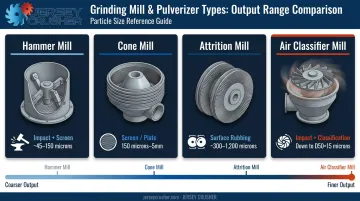
Air classifier mills are particularly useful when tight particle size distributions are required and screen-based control isn't fine enough—common in pharmaceutical and specialty chemical manufacturing.
Key Industrial Applications
Chemical and Fertilizer Processing
Fertilizers and many bulk chemicals are highly hygroscopic. According to Fertilizers Europe, ammonium nitrate reaches its critical relative humidity at 66.9% at 20°C and 59.4% at 30°C—meaning it begins absorbing moisture and caking well before conditions feel humid. Temperature cycling across 32°C can further break down ammonium nitrate products into fine-and-lump mixtures that disrupt metering.
Lump breakers recondition this caked material mechanically, restoring flowability for accurate feeding through downstream conveyors and dosing equipment. Jersey Crusher builds carbon steel and abrasion-resistant configurations for bulk fertilizer, and 316 stainless steel for corrosive chemical intermediates.
Food, Spice, and Agricultural Processing
Sugar, salt, dried herbs, dehydrated food ingredients, and grain products all agglomerate during storage. Size reduction restores them to processable form—but with food, the process itself matters as much as the output.
High heat and aggressive mechanical force degrade essential oils, flavors, and aromas. Research on cryogenic grinding of cumin found volatile-oil recovery improved by 33.9% and 43.5% in two cultivars compared to conventional milling.
Food-grade equipment must meet 21 CFR 117 requirements and USDA construction standards, including:
- Corrosion-resistant, nontoxic, cleanable contact surfaces
- AISI 300-series stainless steel construction
- Minimum 32 micro-inch Ra surface finish on product-contact surfaces
Jersey Crusher's food-grade configurations meet these requirements with 316 stainless steel construction, food-grade white epoxy interior finishes, and air purge shaft seals to prevent cross-contamination.
Pharmaceutical Manufacturing
Particle size is a regulated attribute in drug manufacturing. ICH Q6A states that for some solid and suspension drug products, particle size can significantly affect dissolution rates, bioavailability, and stability. The FDA further notes that excipient particle size changes may affect content uniformity.
This means pharmaceutical size reduction isn't just a handling convenience—it's a quality-critical step. Equipment for this environment must deliver:
- Reproducible particle size distributions
- Contamination prevention between batches
- GMP-compatible construction and cleanability
Jersey Crusher's pharmaceutical configurations use 316 stainless steel, air purge shaft seals (standard on all units) to prevent cross-contamination, and customizable screen hole diameters to hit formulation-specific particle size targets.
Mineral Processing and Mining
Mineral processing covers a wide range of size reduction needs. At the primary crushing end—jaw crushers, gyratory crushers, and grinding mills for ore and rock—equipment durability and throughput capacity drive selection, and comminution is notoriously energy-intensive: a 2014 Minerals Engineering study found 36% of mine energy consumption was used solely by these processes.
For mineral handling downstream—breaking agglomerated mineral powders, reclaiming caked product, and conditioning bulk mineral solids for conveying and dosing—lump breakers handle the work without the energy overhead of primary crushing equipment.
Recycling and Waste Processing
The EPA's 2018 data shows 292.4 million tons of municipal solid waste generated in the US, including 67.4 million tons of paper and paperboard (recycled at a 68.2% rate) and 35.7 million tons of plastics.
On-site size reduction reduces material volume, lowers transport costs, and supports sustainability targets. Jersey Crusher's bottle crushers handle glass recycling with abrasion-resistant construction built to withstand continuous glass processing. Portable equipment designs allow deployment across multiple sites or construction locations without reinstallation.
How to Choose the Right Size Reduction Equipment
Start With the Material
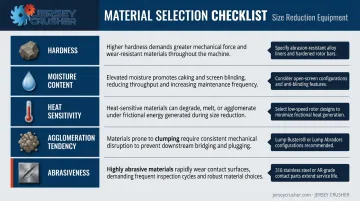
Material properties determine which reduction mechanism is appropriate and rule out equipment that would damage or fail to process the material:
- Hardness — Friable materials (sugar, fertilizer, dried chemicals) need shear-based lump breakers; hard materials (rock, ore) need compression or high-impact crushers
- Moisture content — Wet or sticky materials may bridge screens or foul bearings; equipment design must account for this
- Heat sensitivity — Materials that degrade under thermal load need low-energy, low-friction processing
- Agglomeration tendency — Hygroscopic materials need equipment that can handle variable lump sizes and irregular feed
- Abrasiveness — Drives material-of-construction selection; abrasive materials require hardened alloys to prevent premature wear
Define Your Particle Size Target and Throughput
The desired output particle size—expressed as a screen mesh or size range—directly determines screen selection. The required throughput in tons per hour drives equipment sizing. Undersized equipment creates bottlenecks; oversized equipment wastes capital.
Be specific before you go to market. A target of "⅜" maximum particle size at 5 tons/hour" gives a manufacturer something to engineer to. "Smaller lumps" does not.
Match Construction Materials to Your Industry
| Application | Recommended Construction |
|---|---|
| Food, pharma, cosmetics | 316 stainless steel; food-grade epoxy interior |
| General industrial, chemical | 304 stainless steel or carbon steel |
| Fertilizer, bulk mineral | Carbon steel or abrasion-resistant alloys |
| Explosive dust environments | ATEX-compliant (EU Directive 2014/34/EU); NFPA 654 compliance for combustible particulate solids |
Test Before You Buy
The most reliable way to validate equipment selection is to send your actual material to the manufacturer for evaluation. Jersey Crusher offers a free product sample evaluation service: ship a sample of your production material freight-prepaid to their Wayne, NJ facility, and their engineering team analyzes it to determine the right machine configuration.
The evaluation covers:
- Model size and rotor setup
- Material grade and interior finish
- Screen specification and hole diameter
- Process integration points
Contact Jersey Crusher at 973-686-5999 for sample shipping details. Testing with your actual material removes the guesswork that spec-sheet comparisons can't resolve.
Benefits of Using the Right Size Reduction Equipment
Operational Efficiency
Properly matched equipment eliminates the conveyor jams, hopper blockages, and metering errors that oversized lumps create. Material flows predictably, feeders meter accurately, and downstream equipment runs as designed. For bulk-solid operations, this translates directly to higher throughput and fewer unplanned shutdowns.
That efficiency extends beyond the production line. Jersey Crusher equipment is fully mobile, so it can be relocated between plant locations or construction sites without reinstallation — a practical advantage for operations with multiple processing points or seasonal shifts in production demand.
Consistent Product Quality
Uniform particle size distribution improves every downstream process that depends on it:
- Food manufacturing — consistent blending and controlled flavor compound retention
- Pharmaceuticals — dissolution uniformity and dosage accuracy that meet ICH Q6A requirements
- Chemical processing — predictable reaction rates and extraction yields
Lump Busters® integrated sizing screens — with hole diameters customizable from ⅛" to 2" and beyond — give operators precise, repeatable control over output.
On-Site Recycling and Cost Reduction
On-site size reduction lets facilities process waste streams without paying for disposal or transport. That applies across a range of materials:
- Off-spec product and rejected batches
- Packaging and recyclable materials
- Oversized bulk solids that clog downstream equipment
Reducing material to a consistent particle size also cuts energy consumption in subsequent steps — mixing, heating, and conveying all run more efficiently when input particle size is controlled.
Frequently Asked Questions
What equipment is used for size reduction?
The main categories are lump breakers, crushers, grinding mills, pulverizers, hammer mills, and granulators. The right choice depends on material type—particularly hardness and agglomeration behavior—and the target output particle size.
What is an example of size reduction?
Common examples include breaking up caked fertilizer with a lump breaker to restore flowability, crushing limestone in a jaw crusher for aggregate production, or running spices through a mill to achieve a uniform powder for packaging.
What equipment is used for size separation?
Size separation classifies already-reduced particles by size rather than breaking them down. Equipment includes screens, sieves, air classifiers, and cyclone separators — typically used downstream of size reduction machines to sort product into fractions.
What type of grinding machine is used for size reduction of medicinal substances?
Cone mills, hammer mills with fine screens, and air classifying mills are the most common choices for pharmaceutical size reduction. All require sanitary construction, precise particle size control, and cleanability documentation to meet GMP standards.
What is the difference between a lump breaker and a crusher?
Lump breakers are designed for friable, agglomerated materials—sugar, fertilizer, dried chemicals—and produce controlled particle sizes without over-grinding. Crushers are built for hard, dense materials like rock and ore, using much higher compressive or impact forces that would destroy most friable bulk solids.
How do I know which size reduction equipment is right for my process?
Start with your material's hardness, moisture level, heat sensitivity, and target particle size. Then consult a manufacturer who can run tests on your actual material. Jersey Crusher's free sample evaluation service is a practical first step — reach us at jerseycrusher.com or call 973-686-5999.