Equipment selection directly shapes production efficiency, product consistency, food safety compliance, and total operating cost. Get it right, and downstream processes run cleanly. Get it wrong, and you're dealing with quality failures, excessive downtime, or a machine that damages the very ingredient it's supposed to process.
This guide helps food processing professionals connect the right size reduction technology to their specific materials, output targets, and operational requirements.
Key Takeaways
- Size reduction equipment breaks bulk food materials into uniform particles to improve consistency, handling, and downstream processing
- Equipment types — including lump breakers, particle size reducers, and lump abraders — each suit different material properties and output requirements
- Key selection factors: feed material properties, target particle size, throughput volume, sanitary design requirements, and heat sensitivity
- Mismatched equipment causes uneven particle distribution, flavor loss, compliance failures, and unplanned downtime
- Working with a manufacturer who evaluates your actual product sample is the most reliable path to the right fit
What Is Size Reduction Equipment in Food Processing?
Size reduction equipment uses mechanical force to reduce the particle size or lump dimensions of solid food materials. The goal: consistent particle size, reliable flowability, and predictable downstream performance — whether that means breaking caked sugar back into free-flowing granules or grinding dried herbs into fine powder.
The Four Core Mechanical Principles
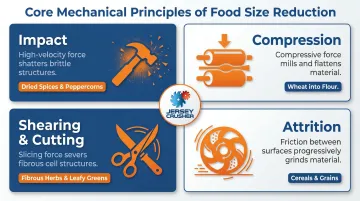
Most food-grade size reduction equipment works through one or more of these mechanisms:
- Impact — High-speed strikes shatter particles; used in hammer mills for dried spices and pepper
- Compression — Opposing surfaces press material down to size; the dominant mechanism in wheat flour milling and cocoa refining
- Shearing/Cutting — Blades or rotating surfaces cut through material; preferred for fibrous vegetables and herbs
- Attrition — Rubbing surfaces grind material progressively; applied in disc mills for corn wet milling and grain processing
The choice of mechanism matters beyond particle size. Research published in Cleaner Engineering and Technology found that ambient hammer milling of spices can generate temperatures between 42–95°C. That range is sufficient to volatilize essential oils and degrade antioxidants — meaning gentler methods like compression or shearing are the practical choice for heat-sensitive ingredients.
Why Food Manufacturing Relies on Size Reduction
The operational benefits are direct:
- Eliminates lump-related blockages in conveyors, hoppers, and feeders
- Creates consistent particle size distribution for uniform blending, extraction, and dissolution
- Increases surface area to improve reaction rates and flavor release
- Enables packaging and downstream processes to run without interruption
- Preserves essential oils, aroma compounds, and nutritional content in sensitive ingredients
Types of Size Reduction Equipment Used in Food Processing
No single machine fits all food materials. The right equipment depends on what you're processing, what you need as output, and what you can't afford to lose in the process.
Lump Breakers
Lump breakers are designed specifically for de-agglomeration — restoring caked or compacted bulk ingredients like sugar, salt, starch, powdered milk, and seasoning blends back to free-flowing granules. They do not grind individual particles; they break up the bonds that form between particles during storage or transit.
The mechanical distinction matters. Where hammer mills use high-speed impact to pulverize material, lump breakers apply a controlled shearing action between counter-rotating rotors to fracture agglomerates without over-reducing them or generating excessive fines.
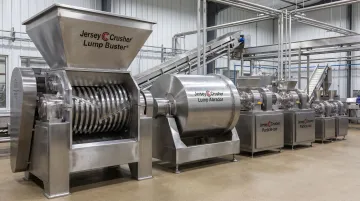
Jersey Crusher's Lump Busters® use a dual-rotor shearing design, with counter-rotating shafts and finger-pattern geometry that fracture material at controlled intensity. Key food-application specs include:
- Integrated sizing screens with hole diameters from ⅛" to 2" and beyond
- 316 stainless steel construction with optional food-grade white epoxy interior finishes
- Air purge shaft seals standard on every unit
The Lump Abrador, a separate product line from Jersey Crusher, takes a different approach: a single large-diameter rotor with evenly spaced impacting fingers and fixed combs liberates agglomerates through gentle abrasion rather than shearing.
This makes it particularly valuable for chocolate powder, cocoa, pasta noodles, and spices where preserving original particle shape and aromatic compounds is a priority.
Hammer Mills
Hammer mills use high-speed rotating hammers to impact and shatter materials into fine particles. Dried spices, pepper, sugar crystals, and dried dairy ingredients are all well-suited to this method when the goal is fine powder production at volume.
Output fineness is controlled via screen sizing, and hammers can be replaced with cutting blades for fibrous materials. The trade-off is heat: the same energy that drives fine particle production can volatilize sensitive aromatic compounds. Cryogenic pre-treatment before milling — using liquid nitrogen to harden materials — can increase volatile oil recovery by 34–44% compared to ambient grinding, a worthwhile investment for premium spice production.
Crushing Rolls
Crushing rolls use two counter-rotating cylinders to apply compressive and shearing force, the standard mechanism in wheat flour milling, cocoa mass refining, and grain processing. They deliver tight particle size distributions with fewer fines than impact-based methods, making them the preferred choice when uniformity is non-negotiable.
Operators adjust three variables to dial in output without equipment changes:
- Roll gap — controls final particle size
- Speed differential — governs shear intensity between cylinders
- Cylinder diameter — affects both throughput capacity and residence time
Disc and Attrition Mills
Disc mills use shearing force between rotating and stationary grooved discs to grind cereals, pulses, spices, and nut pastes. They handle both wet and dry applications, and the adjustable disc gap provides flexibility for small and medium-scale food operations. Double disc variants deliver greater shearing force than single disc configurations for finer output products.
Cutting Mills
Cutting mills use high-speed rotating blades to cut through fibrous vegetables, fresh or dried herbs, and plant-based ingredients that resist impact-based reduction. The cutting action produces more uniform particle shapes and generates less heat than impact methods, both meaningful advantages when texture control and aroma preservation are priorities.
Key Factors for Selecting the Right Size Reduction Equipment
Six factors determine whether size reduction equipment performs as expected in food processing: feed material properties, target particle size, throughput requirements, sanitary design, heat sensitivity, and total cost of ownership. Evaluate each before shortlisting equipment.
Feed Material Properties
Hardness, moisture content, stickiness, and fiber content are the foundational inputs. A sticky oily spice will clog a hammer mill. A hard crystalline product like sugar needs different clearance and rotor speed than a soft dried herb. Fibrous vegetables resist impact and smear under hammers — they need cutting action.
Before shortlisting equipment, characterize your feed material:
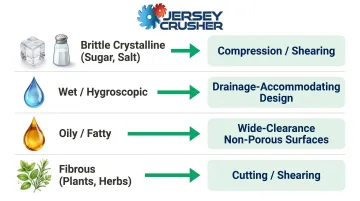
- Brittle crystalline materials (sugar, salt) respond to compression and shearing; hard granules may require higher-energy impact
- Wet or hygroscopic (moisture-absorbing) materials can cake on surfaces and bridge in hoppers — equipment design must accommodate drainage and airflow
- Oily spices and fatty ingredients require wider clearances and non-porous surfaces to prevent buildup
- Fibrous materials need cutting or shearing action rather than impact to avoid smearing
Required Particle Size and Distribution
Particle size distribution affects bulk density, flow, viscosity, and extraction efficiency — inconsistent PSD impairs blending performance and downstream quality. Define your target output before evaluating any equipment.
Key specifications to establish:
- Target particle size range (coarse granule vs. fine powder)
- Acceptable distribution span (tight vs. broad)
- Maximum allowable fines generation
- Whether secondary sizing steps are acceptable or must be avoided
Screen sizing from ⅛" to 2" and beyond allows processors to meet product specifications consistently within a single pass, eliminating rework and secondary processing overhead.
Once particle specifications are fixed, throughput becomes the next constraint. Rated equipment capacity must match actual line speed — an undersized machine creates bottlenecks; an oversized machine wastes energy and capital.
Throughput and Production Volume
Evaluate scalability alongside base capacity:
- Can throughput be adjusted via rotor speed, screen changes, or drive configuration without replacing the unit?
- Can the equipment accommodate seasonal volume swings or product-mix changes?
- What happens if production volume grows 30% in two years?
Sanitary Design and Food Safety Compliance
FDA 21 CFR Part 117 requires that food processing equipment be designed, constructed, and maintained to be adequately cleanable and to protect against contamination. Equipment construction choices directly affect your compliance posture.
| Material | Best For |
|---|---|
| 316 stainless steel | High-acid, high-salinity, or aggressive washdown environments |
| 304 stainless steel | General food processing with standard sanitation requirements |
| Food-grade epoxy interior | Non-contact surfaces requiring smooth, cleanable finishes |
All Jersey Crusher food-grade units include air purge shaft seals as standard — these prevent process material from migrating into bearings, eliminating a common contamination pathway that many processors overlook during procurement.
Heat Sensitivity and Flavor Preservation
Impact-based size reduction generates heat. For premium spices, herbs, and heat-sensitive ingredients, that heat volatilizes essential oils and degrades the compounds that define product quality.
Processors working with heat-sensitive materials should:
- Prioritize compression or shearing mechanisms over high-speed impact
- Evaluate equipment operating at lower rotor speeds
- Consider cryogenic pre-treatment for ambient-temperature milling of aromatic spices
- Confirm that the equipment supplier has direct experience with similar materials
Jersey Crusher's shearing-based Lump Busters® and Lump Abradors are specifically designed for heat-sensitive food ingredients, avoiding the heavy pounding of hammer mills while delivering controlled size reduction.
Maintenance and Total Cost of Ownership
Screen and blade wear, spare parts availability, and cleaning accessibility between product runs directly affect operational uptime. These factors get underweighted during procurement — but they're what drive long-term cost once the equipment is running.
Evaluate before purchasing:
- How quickly can screens or breaker bars be swapped without specialized tools?
- Are spare parts stocked by the manufacturer, or do they require long lead times?
- Does the manufacturer provide maintenance planning support to anticipate wear before it causes downtime?
Jersey Crusher stocks spare parts across the full product line — screens, breaker bars, rotors, combs, blades, and conveyor components — at pricing designed to support both large processors and smaller manufacturers.
How Jersey Crusher Can Help
Jersey Crusher has been manufacturing lump breakers and size reduction systems from Wayne, NJ for over four decades, serving food processing applications across spice, grain, herb, sugar, seafood, and food rendering industries.
The product line covers the full range of food-grade size reduction needs:
- Lump Busters® — flagship lump breaker line for de-agglomerating caked sugar, salt, starch, seasoning blends, and similar friable food ingredients using shearing action rather than heavy pounding
- Lump Abradors — gentle abrasion-based de-agglomeration for materials like chocolate powder, cocoa, spices, and pasta where particle morphology must be preserved
- Particle-izers — fine, evenly-sized particle production down to 100 mesh or smaller for applications requiring precision size control
- Screw Conveyors and Volumetric Feeders — material handling components designed to integrate directly with size reduction equipment, including connections to bulk bag unloaders, IBC totes, and downstream blending systems
All food-grade equipment is available in 316 stainless steel (preferred for high-acid or high-salinity applications) or 304 stainless steel, with optional food-grade white epoxy interior finishes and air purge shaft seals standard on every unit. Multiple model sizes — from Model 1515 to Model 6464 — cover light-duty spice processing through high-volume food rendering applications.
The Product Sample Evaluation Process
Jersey Crusher's approach to equipment selection starts with your actual material. Processors ship a product sample freight-prepaid to the Wayne, NJ facility, and the engineering team analyzes it to determine:
- Appropriate model size for the application
- Optimal material grade (316 SS, 304 SS, carbon steel, or abrasion-resistant)
- Screen hole diameter for target particle size
- Rotor configuration
- Integration points with existing conveyors, feeders, and downstream equipment
This is especially useful for materials with unusual properties — moisture sensitivity, abrasiveness, or inconsistent lump sizes — where standard catalog selection falls short. To initiate a sample evaluation, call 862-356-6112 for shipping details.
Conclusion
Size reduction equipment selection is not a catalog decision. The right choice requires matching mechanical principles to material characteristics, aligning throughput capacity to production line speed, meeting sanitary design standards, and protecting heat-sensitive ingredients from the thermal effects of the wrong reduction mechanism.
Treat it as an ongoing process. As ingredient sourcing shifts, product mixes evolve, or production volumes change, review and adjust equipment configurations accordingly. Working with a manufacturer that evaluates your actual materials — not just your spec sheet — is what separates a well-matched installation from one that underperforms at scale.
Jersey Crusher's engineers work directly from customer-submitted product samples to design configurations suited to specific materials, particle size targets, and sanitary requirements. That evaluation step is where the right equipment decision actually gets made.
Frequently Asked Questions
What are the main methods of size reduction in food processing?
The four primary mechanisms are:
- Impact — hammer mills shattering dried spices
- Compression — crushing rolls milling wheat into flour
- Shearing — disc mills processing cereals and pulses
- Attrition — disc mills in corn wet milling
Most real-world equipment combines two or more of these mechanisms.
What are the types of size reduction equipment used in food processing?
The most common types are lump breakers, hammer mills, crushing rolls, disc/attrition mills, and cutting mills. The right type depends on the food material's physical properties (hardness, moisture, fiber content, and heat sensitivity) and the required output particle size. For friable bulk ingredients, lump breakers like Jersey Crusher's Lump Busters® are a common choice, designed to break agglomerated material without heavy pounding.
Which mill is used for size reduction of fibrous material?
Cutting mills and hammer mills fitted with cutting blades are most effective for fibrous food materials like dried herbs, vegetables, and plant-based ingredients. Their shearing action handles fibrous structure cleanly without smearing or producing irregular particles.
How does size reduction impact food processing?
Proper size reduction improves extraction efficiency, blending uniformity, and dissolution rates while eliminating lump-related blockages in downstream equipment. It ensures consistent particle size across batches, which directly affects flavor distribution, texture, and product quality in the finished item.
What are examples of size reduction in food processing?
Common examples include:
- Grinding pepper and spices into powder (hammer mills)
- Milling wheat into flour (crushing rolls)
- Breaking caked sugar back to granules (lump breakers)
- Wet milling of corn for starch separation (disc mills)
Each application requires a different mechanism and machine configuration.
What is the difference between size reduction and size separation?
Size reduction actively breaks materials into smaller particles through mechanical force. Size separation — such as sieving or screening — sorts existing particles by size without altering them. The two are often used in sequence: reduce first, then screen to verify or classify the output.