Introduction
Particle size consistency drives product quality, process efficiency, and — in regulated industries — regulatory compliance. Whether you're milling pharmaceutical APIs or breaking down fertilizer granules, the uniformity of your output particles shapes everything downstream.
Two challenges come up across every industry that relies on size reduction:
- Matching the right reduction method to the material — get this wrong and you waste energy, generate excessive fines, and degrade product value
- Controlling process variables tightly enough to maintain consistent particle size distribution without creating dust hazards or yield losses
This article covers both: the primary reduction methods and their real trade-offs, the key process variables that affect output, and the best practices that separate efficient operations from those fighting equipment problems and off-spec product.
Key Takeaways
- Integrated screen or bar sizing is the primary mechanical control for output particle size in lump breakers
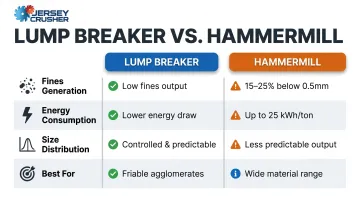
- Lump breakers generate fewer fines than impact mills and use less energy for equivalent throughput on friable materials
- Excessive fines waste material, drive up energy costs, and create combustible dust hazards — address the root cause, not just symptoms
- For friable materials requiring controlled de-agglomeration, lump breakers are a lower-energy alternative to hammermills and impact mills
- Material characterization before equipment selection prevents costly mismatches between process requirements and machine design
What Is Fine Particle Reduction in Industrial Processing?
Fine particle reduction is the mechanical process of breaking bulk materials, agglomerates, or lumps into smaller, controlled particle sizes. In industrial contexts, that typically means targeting output ranges from several hundred microns down to sub-millimeter scales — though specific targets vary widely by application.
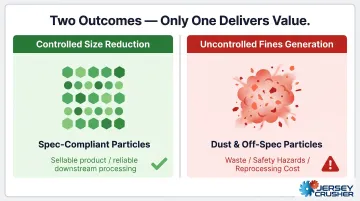
The distinction that matters operationally: intentional size reduction (achieving uniform, spec-compliant output) versus uncontrolled fines generation (dust and sub-spec particles as byproducts). Both involve small particles. Only one delivers value.
Controlled vs. Uncontrolled Particle Generation
| Type | Result | Business Impact |
|---|---|---|
| Controlled size reduction | Uniform, spec-compliant particles | Sellable product, reliable downstream processing |
| Uncontrolled fines | Dust, off-spec particles | Waste, safety hazards, reprocessing cost |
Understanding that distinction shapes equipment selection. Jersey Crusher's Lump Busters® line targets controlled de-agglomeration of friable materials — reducing bulk material from 6 inches down to ¼ inch in a single pass. For applications requiring finer output, the Particle-izers achieve particles down to 100 mesh or smaller, serving pharmaceutical, cosmetic, fertilizer, and cannabis processors where uniform, ultra-fine output is the primary objective.
Why Particle Size Control Matters Across Industries
Getting particle size wrong has cascading consequences across your process. Here's where it hits hardest:
Product Quality and Regulatory Compliance
In pharmaceutical manufacturing, FDA's ICH Q6A guidance establishes that particle size distribution procedures should be determined by developmental data, with full D10/D50/D90 specifications rather than single-point mesh targets. Off-spec particle sizes directly affect dissolution rates and dosage accuracy, with implications for both regulatory compliance and patient safety.
In food and spice processing, the problem is different but equally costly. Ambient grinding generates heat that destroys volatile flavor compounds. Research shows ambient grinding of black pepper results in roughly 50% loss of volatile oil compared to cryogenic grinding, with no offsetting process benefit.
Yield and Operating Costs
Excessive fines — particles below your target size range — represent pure waste. They may need to be:
- Reprocessed at additional energy cost
- Discarded entirely
- Sold into secondary markets at lower value
Each path erodes margin. Appropriate equipment selection and process control keeps fines generation in check — and keeps yield numbers where they need to be.
Safety: Combustible Dust
Uncontrolled fine particle generation creates serious safety exposure. OSHA's Permissible Exposure Limit for total dust (Particulates Not Otherwise Regulated) is 15 mg/m³, with a respirable fraction limit of 5 mg/m³ as an 8-hour TWA. In industries processing combustible materials such as grain, sugar, and certain chemicals, fine particle accumulation creates explosion risk in dust-classified zones. That's a live compliance obligation, not a background risk to defer.
Equipment Reliability
Oversized particles clog conveying systems, blind screens, and create uneven feed to downstream machinery. The result: unplanned downtime, accelerated wear, and maintenance spend that compounds over time. Consistent particle size output reduces emergency maintenance calls and extends equipment service life.
Common Methods and Equipment for Fine Particle Reduction
Equipment selection depends heavily on target particle size, material properties, and acceptable fines generation. These are the primary options — with honest trade-offs for each.
Lump Breakers
Lump breakers are purpose-built for one specific problem: agglomerated or caked bulk material that has clumped during storage, transport, or cooling. The goal is breaking lumps back to a manageable, flowable state — not pulverizing material into dust.
The mechanical action matters. Jersey Crusher's Lump Busters® use a counter-rotating dual rotor design where two parallel shafts shear material between them with controlled force. This is explicitly designed for friable materials that don't require heavy pounding — a meaningful distinction from hammermills or ball mills that crush through impact.
Integrated size reduction screens or breaker bars control output particle size. Screen hole diameters range from ⅛" to 2" and beyond, allowing output to be sized to specific application requirements across chemical, pharmaceutical, fertilizer, sugar, and food processing. For applications needing gentler handling, the Lump Abrador line uses abrasion rather than shearing — preserving particle morphology and minimizing fines where dust control is the priority.
Available configurations include:
- Model 6464 — heavy-duty unit designed for high-volume applications beneath silos and bulk bag unloaders
- 316 stainless steel — pharmaceutical and food-grade applications
- 304 stainless steel — general industrial use
- Abrasion-resistant construction — aggressive minerals and harsh bulk solids
Hammermills
Hammermills use high-speed rotating hammers to impact and shatter material, with perforated screens controlling output size. Screen sizes provide 70% or more of control over finished particle size, and screens are available from 3 inches down to 0.020 inches.
The trade-offs are real: hammermills handle a wide range of materials and reach fine output sizes, but generate more fines (15–25% below 0.5 mm), consume more energy (up to 25 kWh/ton for hard materials), and produce less predictable size distribution. If fines are a waste stream in your process, the ongoing cost of that loss adds up quickly.
Particle-izers for Fine and Ultra-Fine Output
When the target falls below 100 microns — or when the priority is fine, evenly-sized particles rather than simple lump breaking — Jersey Crusher's Particle-izer line fills that gap. Unlike pin mills or attritor mills that rely on high-speed impact, Particle-izers are designed around the same controlled-force philosophy as the Lump Buster line: reducing material without the excessive fines and heat generation that heavy-pounding methods introduce.
These are purpose-built for applications where particle uniformity and product integrity both matter — fertilizer granulation, chemical powder processing, pharmaceutical ingredients, and similar targets where a tight size distribution is the objective, not a side effect.
Key Process Variables That Affect Particle Size Output
Choosing the right equipment matters — but how you operate it determines whether output stays consistent across shifts and product grades.
Feed Material Properties
Material characteristics set the baseline for everything else:
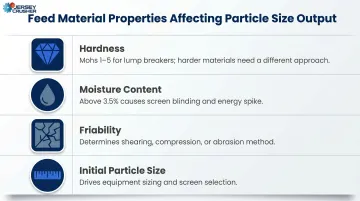
- Hardness: Lump breakers suit Mohs hardness 1–5; harder materials require a different mechanical approach
- Moisture content: Above ~3.5%, moisture causes classifier clogging and screen blinding — and energy consumption climbs fast (biomass data shows 92 kWh/ton at 10% moisture rising to 92–112 kWh/ton at 20%)
- Friability: Determines whether shearing, compression, or abrasion is the right action for your material
- Initial particle size: Feed size drives equipment sizing and screen selection from the start
Jersey Crusher's sample evaluation service addresses this directly: customers ship production material to the Wayne, NJ facility, and the engineering team evaluates it to recommend model size, material grade, and screen configuration before purchase.
Screen and Bar Sizing
In lump breakers and hammermills, screen perforations or breaker bar spacing physically cap the maximum output particle size. This is your most reliable control mechanism for top-size management — particles can't exit larger than the opening allows.
Changing screen configurations lets operators switch between output specifications without equipment replacement, which is particularly useful for facilities running multiple product grades.
Feed Rate Control
Feed rate variability directly affects particle size distribution. Overfeeding causes:
- Uneven breakage and elevated fines
- Screen blinding
- Increased energy draw
Underfeeding reduces efficiency without quality benefit. Consistent, controlled feed rate — maintained through volumetric feeders or screw conveyors integrated with the reduction unit — is the highest-impact variable operators can control. Jersey Crusher's Volumetric Feeders and Screw Conveyors are built to integrate with Lump Busters® and Particle-izers as a unified feed control system.
Best Practices for Efficient Fine Particle Reduction
Characterize Before You Configure
Before selecting or configuring equipment, understand your material properties. A mismatch between equipment and material is costly to correct after installation.
Key properties to evaluate upfront:
- Bulk density and flow characteristics
- Moisture content and tendency to agglomerate
- Particle shape and target output size
- Friability (how readily the material breaks under force)
Jersey Crusher's sample evaluation service provides engineering analysis based on actual production material, so equipment recommendations reflect your real-world process conditions.
Maintain Screens and Wear Parts Proactively
Worn screens, breaker bars, or roll surfaces produce inconsistent output, elevated fines, and higher energy draw. As a general benchmark, one set of hammers should wear out 2–4 sets of screens — a rough benchmark for anticipating replacement cycles. Build a preventive maintenance schedule based on:
- Material abrasiveness (more abrasive = more frequent checks)
- Throughput volume
- Visual inspection for holes, tears, or elongated perforations
Jersey Crusher maintains a ready inventory of spare parts for its full equipment line, with expedited options to minimize downtime when unplanned replacements are needed.
Design for Dust and Fines Management
Dust and fines management should be built into system design from the start, not retrofitted later:
- Use closed-loop systems where possible to return oversized or undersized material for reprocessing
- Integrate venting and dust collection for any powder application
- Size infeed hoppers with safety baffles to control feed rate and prevent overloading
- Match the reduction unit's mechanical approach to your dust generation tolerance
Jersey Crusher's equipment supports dust collection integration as a standard add-on. For applications with strict dust limits, the shearing-based design generates significantly less airborne particulate than impact methods — a meaningful difference in pharmaceutical, food, and chemical environments.
Choosing the Right Fine Particle Reduction Equipment
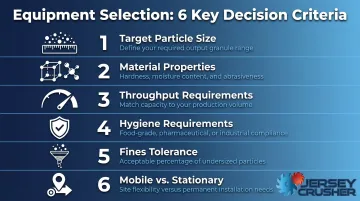
Key decision criteria, in order of priority:
- Target particle size range — defines which equipment categories are viable
- Material properties — friability, hardness, moisture, and abrasiveness narrow the options further
- Throughput requirements — determines model sizing; Jersey Crusher's line spans models from compact to high-capacity (Model 6464 for heavy continuous operations)
- Hygiene requirements — food, pharma, and cosmetics applications typically require 316 stainless steel construction with optional food-grade white epoxy interior finish
- Fines tolerance — applications where fines are waste should lean toward roller-based or lump-breaking methods over impact milling
- Mobile vs. stationary — Jersey Crusher's equipment is fully portable, which matters for multi-plant operations, seasonal manufacturing, or construction site deployment
Once those criteria are mapped, equipment selection becomes straightforward for most industrial scenarios.
For applications involving controlled de-agglomeration of friable materials — the most common industrial scenario — lump breakers deliver efficient, lower-energy size reduction with customizable screen sizing that hammermills can't match for controlling fines generation. When ultra-fine output is the objective, Particle-izers extend that capability to 100 mesh and below.
Jersey Crusher supports the full selection process: pre-purchase engineering consultation based on your actual material samples, technical guidance on process integration, and stocked spare parts for every unit in the product line — whether you're running a large continuous operation or a smaller batch process.
Frequently Asked Questions
What is the difference between a lump breaker and a hammermill?
Lump breakers use a low-speed shearing action suited for breaking friable, agglomerated materials with minimal fines generation. Hammermills use high-speed impact to pulverize material. They can achieve finer output sizes, but produce significantly more fines and consume more energy in the process.
What particle sizes can industrial lump breakers achieve?
Lump breakers are typically configured for output ranging from a few millimeters to several centimeters, depending on screen hole diameter. Jersey Crusher's Lump Busters® offer screen sizing from ⅛" to 2" and beyond — customizable to meet specific application requirements.
How do fine particles affect product quality in food or pharmaceutical manufacturing?
Excessive fines cause flow and dosing inconsistencies and alter dissolution or extraction rates. In spice and herb processing, heat from high-impact grinding degrades volatile compounds — ambient grinding can destroy roughly 50% of volatile oil content.
How can manufacturers control fine particle and dust generation during size reduction?
Controlling fines starts with selecting the right reduction method — low-speed shearing generates far fewer airborne particles than high-impact milling. Dust collection venting, enclosed equipment designs, and air purge shaft seals all help contain fine particles at the source.
How much PM2.5 is safe?
The WHO 2021 Air Quality Guidelines set the annual PM2.5 guideline at 5 µg/m³ and the 24-hour guideline at 15 µg/m³. Prolonged exposure above recommended levels is associated with respiratory and cardiovascular health risks.
Do HEPA filters remove ultrafine particles?
True HEPA filters capture 99.97% of particles 0.3 microns and larger and are highly effective against fine particulates. Ultrafine particles below 0.1 microns may require additional filtration stages or specialized equipment to address adequately.