
Introduction
Calcium carbonate shows up in pharmaceutical tablets, paper coatings, rubber compounds, and construction fillers — but its performance in any of these applications hinges on one factor: particle size. Get it wrong, and the consequences hit fast.
Inconsistent particle size means rejected batches, processing bottlenecks, and wasted raw material. A paper coating requiring sub-micron PCC fails if particles cluster at 5 microns. A concrete filler tolerant of 200-micron particles can't accommodate ultra-fine grades without reformulation.
The tolerance window is narrow, and the stakes are high.
This article covers the two primary production routes—grinding and precipitation—along with the key mechanical and chemical methods for controlling particle size, the process variables that matter most, and how to measure and verify results in production environments.
TLDR:
- Particle size governs CaCO3 surface area, reactivity, dispersibility, and optical properties
- GCC uses mechanical grinding (coarser distributions); PCC uses chemical synthesis (finer, tighter control)
- Key size control levers: screen aperture, supersaturation, temperature, and feed material hardness
- Laser diffraction (ISO 13320:2020) is the measurement standard; 325-mesh sieve analysis catches coarse tails
- Fine PCC grades for pharma/paper run <3 µm D50; construction fillers exceed 200 µm
Why Calcium Carbonate Particle Size Matters
How Particle Size Drives End-Use Performance
Particle size directly governs specific surface area, reactivity, dispersibility, and optical properties. In premium paper coatings, sub-micron PCC (D50 < 1.5 µm) delivers the high brightness and smoothness required for glossy magazine stock. In contrast, concrete or asphalt fillers tolerate—and often prefer—coarser grades exceeding 200 microns, where bulk volume matters more than surface reactivity.
Finer particles increase specific surface area, improving absorption efficiency, whiteness, and reactivity. These characteristics matter across pharmaceuticals (precise dissolution rates for excipients), food processing (calcium supplementation and anti-caking), and paints (opacity and coverage). That said, excessively fine particles introduce real handling challenges:
- Increased dustiness and respiratory exposure risks
- Poor flowability in hoppers and feed systems
- Agglomeration during storage or transport
- Higher energy costs for dispersion in liquid systems
Downstream Consequences of Poor Size Control
Oversized particles cause abrasion of downstream pumps, mixers, and coating heads, leading to unplanned maintenance and equipment replacement. Clogged processing lines and filter screens halt production. Product rejection due to out-of-spec particle size distributions means scrap, rework, and lost revenue.
Inconsistent particle size distribution creates variability in viscosity, filler loading efficiency, and coating coverage. Two examples show just how tight the tolerances need to be:
- A paint optimized for D50 = 3 µm will exhibit poor hiding power if half the batch measures 8 µm
- Rubber compounds designed around 10 µm filler lose tensile strength when the distribution shifts to 25 µm
Getting particle size right from the start is what separates consistent, profitable production from costly rework cycles.
Two Production Routes: Ground vs. Precipitated Calcium Carbonate
Ground Calcium Carbonate (GCC)
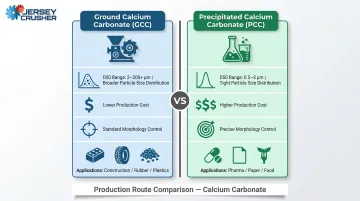
GCC is produced by mechanical crushing and grinding of natural calcite or limestone. Particle size is determined by the grinding process and downstream classification equipment. Typical GCC grades span a wide range from a few microns to several hundred microns depending on application.
Representative GCC grades:
- Construction fillers: D50 ≈ 20 µm, D98 ≈ 53 µm (e.g., Omya Calibrite SL)
- Plastics/PVC: D50 ≈ 16 µm, D98 ≈ 78 µm (e.g., Omya OMYACARB 15-PZ)
- Fine coating grades: D50 ≈ 2 µm, 325-mesh residue < 0.005% (e.g., Huber Hubercarb G2)
GCC is valued for its cost-effectiveness and is the dominant form used in construction, rubber, and commodity filler applications.
Precipitated Calcium Carbonate (PCC)
Where GCC relies on mechanical force, PCC production uses controlled chemical synthesis — most commonly a carbonation reaction in which CO₂ reacts with calcium hydroxide slurry. Manufacturers gain much tighter control over:
- Particle size (typically 0.5 to 3 microns)
- Crystal morphology (calcite, vaterite, aragonite)
- Surface chemistry and coating compatibility
Representative PCC grades:
- Paper coating/paints: D50 = 1.4 µm, rosette shape (e.g., MTI ALBACAR T1O)
- Pharma/food: D50 = 0.7 µm, prismatic shape (e.g., MTI ViCALity ALBAFIL)
This precision makes PCC preferable for high-purity food, pharmaceutical, and high-performance coating applications. PCC consistently delivers finer, more uniform particle sizes than GCC — but at higher production cost. For applications where a D50 below 2 µm or tight morphology control is non-negotiable, that premium is justified. For general-purpose fillers, GCC's lower cost wins.
Mechanical Size Reduction: Methods and Equipment
Common Grinding and Milling Approaches
Mechanical size reduction follows a staged hierarchy, with each method applying a different stress mechanism suited to specific target size ranges:
Primary reduction: Jaw and cone crushers handle initial reduction of limestone rock to millimeter-range fragments through compression.
Intermediate and fine grinding: Ball mills, roller mills, and hammer mills accomplish reduction to 10-100 micron range through impact, attrition, and compression.
Ultrafine grinding: Air classifier mills achieve sub-10-micron particles by combining high-speed impact with integrated air classification.
Lump breaking and de-agglomeration: Lump breakers and Particle-izers handle caked, compacted, or agglomerated calcium carbonate without heavy pounding — preserving particle morphology while producing consistently sized, free-flowing output. The screen aperture sets the maximum output particle size directly. Jersey Crusher's lump breakers, for example, offer customizable screens with hole diameters from ⅛" to 2", covering a wide range of size reduction targets.
Classification and Closed-Circuit Grinding
Mechanical grinding alone rarely achieves tight particle size control. Classification systems separate on-spec particles from oversized material:
- Air classifiers: Use centrifugal force and air flow to separate by aerodynamic diameter
- Vibrating screens: Mechanically separate by aperture size
- Cyclones: Separate particles based on settling velocity
In closed-circuit grinding, oversized material is returned to the mill for regrinding. This produces narrower distributions compared to open-circuit operation and is the standard approach in GCC production plants.
Wet vs. Dry Grinding Considerations
The choice between wet and dry grinding affects product fineness, downstream handling, and operating costs. The table below summarizes the key trade-offs:
| Factor | Dry Grinding | Wet Grinding |
|---|---|---|
| Typical D50 range | Above 10 µm | Below 10 µm achievable |
| Operating cost | Lower (no drying step) | Higher (drying required) |
| Dust generation | Present | Eliminated |
| Surface coating | Applied post-process | Easier in slurry form |
| Preferred applications | Dry-form products, filler grades | Paper-coating grades, fine pigments |
Dry grinding suits coarser products where the final form is dry and drying costs would be wasteful. Wet grinding is the standard route for fine-pigment and paper-coating grades, where tighter size distributions justify the added processing steps.
Chemical Precipitation: Controlling Particle Size Through Solution Chemistry
Supersaturation as the Primary Precipitation Lever
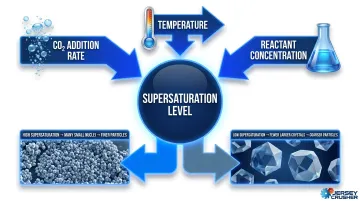
In PCC production, the degree of supersaturation governs both nucleation rate and crystal growth rate. Supersaturation is defined as the ion activity product relative to the solubility product of calcite.
High supersaturation: Generates a burst of many small nuclei that remain fine Low supersaturation: Favors fewer, larger crystals
Managing supersaturation through controlled CO₂ addition rate, temperature, and reactant concentration is the central control strategy for PCC particle size.
The Impact of Ca²⁺:CO₃²⁻ Ion Activity Ratio
Research has shown the ratio of calcium ion to carbonate ion activities in solution significantly affects both timing and rate of CaCO₃ particle formation:
- Stoichiometric conditions (ratio ≈ 1): Promote faster nucleation and faster growth
- Non-stoichiometric conditions (excess of either ion): Suppress growth and slow precipitation, keeping particles smaller longer
pH adjustment is an effective industrial handle on this ratio because pH directly controls carbonate ion activity through the bicarbonate/carbonate equilibrium.
Crystal Modifiers and Additives
Organic and inorganic additives are widely used to fine-tune PCC particle size and crystal form:
- Magnesium ions stabilize amorphous CaCO₃ and inhibit calcite crystal growth, producing smaller or more controlled particles
- Polyphosphates and natural organic matter adsorb on crystal surfaces and slow growth rates
- Polymers such as polyacrylic acid stabilize PCC dispersions and suppress agglomeration during and after precipitation
Additive selection directly shapes the final particle size distribution and crystal morphology — choices made here often determine how well the PCC performs in downstream applications like coating, filling, or compounding.
Key Process Variables That Affect Final Calcium Carbonate Particle Size
Temperature and Reaction or Residence Time
In PCC synthesis: Elevated temperatures accelerate crystallization kinetics and promote Ostwald ripening, where larger crystals grow at the expense of smaller ones, resulting in coarser final particles. Lower temperatures slow crystal growth and preserve finer particle sizes.
In mechanical grinding: Temperature rise can cause agglomeration and sticking, particularly with fine CaCO3 powders. Longer residence times in mills push size distribution toward finer values, up to a practical limit where energy input no longer produces additional size reduction.
Feed Material Characteristics
For GCC, the hardness, crystal lattice structure, and degree of consolidation of the limestone feed strongly affect grindability and resulting particle size distribution:
- Harder or more crystalline calcite requires significantly more energy per unit size reduction
- Pre-consolidated lumps (vs. loose rock) may require pre-conditioning with a lump breaker to protect downstream grinding equipment
- Calcite at Mohs 3 is relatively soft overall, but remains abrasive in high-throughput grinding circuits
Screen Aperture and Equipment Configuration
In lump breaker and mill circuits, screen perforation size is the most direct mechanical control over maximum output particle size. Changing the screen from a coarser to a finer aperture:
- Reduces the upper bound of the output size distribution
- Improves batch-to-batch consistency
- Allows the same equipment to serve different product specifications
For industrial CaCO3 processors, having access to interchangeable screen options allows the same equipment to serve different customer requirements without capital reinvestment. Jersey Crusher's Lump Busters® offer screens ranging from ⅛" to 2" hole diameters, with custom sizes available beyond 2" for specialized applications.

Agitation and Mixing Intensity in Precipitation
In PCC reactors, mixing intensity affects:
- Local supersaturation distribution
- Nucleation rate
- Particle collision/aggregation frequency
| Mixing Regime | Effect on Particle Size |
|---|---|
| High-shear mixing | Faster nucleation; finer, more uniform particles |
| Low-shear environments | Localized supersaturation zones; wider size distributions |
Reactor design and agitator speed are the primary dials PCC producers adjust to hit a target particle size within a given synthesis route.
Measuring and Verifying Calcium Carbonate Particle Size
Laser Diffraction as the Industrial Standard
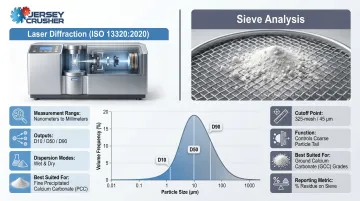
Laser diffraction, standardized under ISO 13320:2020, is the most widely used technique for measuring CaCO3 particle size distributions in both production QC and R&D. Modern instruments such as the Malvern Panalytical Mastersizer 3000, Sympatec HELOS, and HORIBA Partica LA-960V2 can measure from nanometers to millimeters in minutes.
Dispersion mode selection:
- Wet dispersion: Preferred for fine PCC grades to ensure complete de-agglomeration
- Dry dispersion: Practical for coarser GCC grades
Both modes should give consistent results for a well-dispersed sample. Detecting agglomerates vs. primary particles is a critical quality check.
For coarser GCC grades, sieve analysis provides a practical complement to laser diffraction. 325-mesh (45 µm) sieve analysis remains essential to control the coarse tail of the distribution. Manufacturers frequently specify maximum allowable residue — for example, Huber Engineered Materials reports 325-mesh residue as low as 0.005% for fine Hubercarb G Series grades.
Key Parameters and Specifications
Standard reporting parameters used throughout the CaCO3 industry include:
| Parameter | Definition |
|---|---|
| D10 | Fine end of distribution (10th percentile by volume) |
| D50 | Median particle size by volume |
| D90 | Coarse end of distribution (90th percentile by volume) |
Specifications frequently include percentage passing or retained at reference sieve sizes — for example, % below 45 µm for 325-mesh products.
BET specific surface area (ISO 9277:2022): Particle size distribution alone doesn't capture everything. For fine and ultra-fine PCC, nitrogen physisorption (BET) surface area measurement is often run alongside laser diffraction — as particle size decreases, specific surface area rises inversely. Commercial high-surface-area PCCs report values from 17 to 29 m²/g; ultrafine GCC mineral accelerators typically specify BET surface area above 5 m²/g.
Frequently Asked Questions
What is the typical particle size range for industrial calcium carbonate?
Industrial CaCO3 covers a wide spectrum: coarse construction and asphalt grades run 100–300+ microns, while mid-range rubber and plastics fillers land at 5–50 microns (D50). Fine PCC grades for paper coatings, food, and pharma fall below 3 microns, with ultra-fine pharmaceutical grades reaching as low as 0.7 microns.
What is the difference between GCC and PCC in terms of particle size control?
GCC relies on mechanical grinding and classification to achieve a target size range, typically producing broader distributions and coarser products. PCC uses chemical synthesis enabling much tighter control over particle size, shape, and crystal form, generally yielding finer and more uniform particles with D50 values below 3 microns.
How does calcium carbonate particle size affect performance in different applications?
Finer particles deliver greater surface area, improved reactivity, and stronger optical performance — benefits that matter most in paper coating, pharmaceutical, and food applications. Coarser grades suit structural fillers in construction and rubber, where bulk volume and cost efficiency take priority over surface area.
What process variables most influence calcium carbonate particle size during grinding?
Screen aperture sets the maximum output size. Beyond that, mill type and speed, feed material hardness, classification settings (open vs. closed circuit), and wet versus dry grinding are the primary determinants of final particle size distribution.
How is calcium carbonate particle size specified and measured in industry?
Laser diffraction (ISO 13320:2020) is the industry standard measurement method. Results are typically reported as D50 (median) and D90 (coarse cutoff), often supplemented by 325-mesh (45 µm) sieve analysis for coarser GCC grades to strictly control the coarse tail.
Can calcium carbonate particle size be increased or adjusted after initial production?
Further size reduction is achievable through additional grinding or classification. Increasing particle size, however, requires agglomeration or compaction — processes not standard in CaCO3 production — making it far more practical to hit the target size at the production stage.