Introduction
A particle grinding process system is a complete, integrated sequence of equipment and controls that reduces bulk materials to a specified particle size at production scale. For plant engineers, production managers, and procurement teams in chemical, food, pharmaceutical, fertilizer, and recycling industries, understanding the full system — not just a single machine — determines whether output quality, throughput, and uptime hold up in production.
Many operations face persistent challenges when particle size control falters: downstream bottlenecks multiply, quality checks fail, rework costs climb, and equipment wear accelerates throughout the processing line. According to research published in Processes, moisture content variations of just 1.5% can reduce grinding capacity by 15–30%, demonstrating how sensitive these systems are to material properties and feed consistency.
This guide gives you a working understanding of the full grinding system — so you can diagnose performance problems, evaluate equipment options, and make confident decisions before committing to a configuration. Specifically, it covers:
- What a particle grinding process system includes and how each stage functions
- What variables drive or degrade performance in real production environments
- When this approach fits your application — and when a different method may serve better
Key Takeaways
- Particle grinding process systems reduce solid materials through integrated feeding, size reduction, and classification
- Method selection depends on material hardness, moisture content, and target particle size
- Key performance drivers include feed rate consistency, screen aperture sizing, and bulk density variation
- Grinding (impact, shear, or attrition) handles fine reduction; crushing uses compression for coarse reduction — and choosing the wrong method for the stage wastes energy and increases wear
- Skipping material fit evaluation before selecting a grinding method leads to inconsistent output, energy waste, and premature equipment wear
What Is the Particle Grinding Process?
Particle grinding is a mechanical size reduction process that applies impact, shear, compression, or attrition forces to break solid materials into smaller, more uniform particles.
The intended outcome is a consistent, controlled particle size distribution suited to the next stage of processing — whether that's mixing, dissolution, packaging, or chemical reaction. Achieving this consistency requires careful matching of equipment type to material properties.
How Grinding Differs from Related Operations
Crushing targets coarse reduction of large feed material, typically using compression to break down rocks, ore, or large agglomerates. Milling implies finer, more controlled size reduction in the sub-millimeter to micron range. Grinding spans the range between these extremes, focused on achieving a defined particle size specification through one or more force mechanisms.
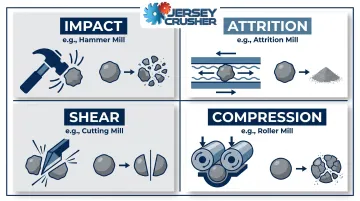
Each mechanism produces a different result depending on the material and the target particle size:
The four primary force mechanisms in grinding are:
- Impact: Instantaneous striking action (hammer mills, Particle-izers)
- Attrition: Rubbing or friction between surfaces (stirred media mills)
- Shear: Cutting or cleaving particles (dual-rotor lump breakers)
- Compression: Slow application of crushing force (roller mills, roll crushers)
Why Industrial Operations Rely on Particle Grinding Process Systems
Particle size directly impacts product performance. Finer particles increase surface area, improving reaction rates, solubility, flowability, and consistency in formulated products. Research published in PMC demonstrates that micronization (reducing particles to 1–1,000 µm) increases surface area for solvent interaction, which improves dissolution rates — a critical factor for pharmaceutical bioavailability.
Industry-Specific Demands
Pharmaceutical manufacturers require tight particle size tolerances because size directly affects API bioavailability. The FDA's Q7 Good Manufacturing Practice Guidance explicitly identifies "physical manipulation of particle size (e.g., milling, micronizing)" as a critical physical processing step for Active Pharmaceutical Ingredients.
Food processors need uniform grinding to preserve flavor, texture, and appearance. Equipment must adhere to sanitary design standards — the USDA relies on 3-A Sanitary Standards to verify compliance with the Food Safety Modernization Act (FSMA).
Chemical and fertilizer producers rely on consistent granule size for reliable dosing, dissolution rates, and even nutrient distribution. Variability in size creates formulation inconsistencies and downstream handling problems.
Recycling operations need efficient size reduction to recover usable material from glass bottles, construction debris, or electronic waste, facilitating easier transportation and downstream processing.
What Goes Wrong Without Proper System Design
Without a properly designed system, particle size variability cascades through the entire process:
- Downstream equipment experiences surges and starvation
- Product fails quality specifications requiring rework
- Mixing ratios become inconsistent
- Packaging systems jam or overfill
- Unplanned equipment wear accelerates across the processing line
The driver may be operational efficiency, formulation consistency, or regulatory compliance — but the requirement is the same. Particle grinding systems need to be engineered as integrated workflows, not standalone equipment purchases.
How a Particle Grinding Process System Works
Raw bulk material enters the system, passes through one or more size reduction stages using mechanical force, and exits as a classified particle stream meeting the target specification. Controls manage feed rate, screen selection, and recirculation at each stage — the three levers that keep output consistent from start to finish.
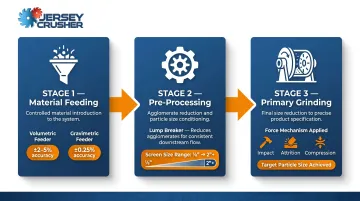
Step 1: Material Feeding and Pre-Processing
Consistent, controlled feeding is the foundation of stable grinding. Feed rate variation causes fluctuating particle output, which undermines all downstream quality control.
Volumetric feeders discharge a set volume of material per unit of time but do not detect bulk density changes. According to CCPS guidelines, volumetric feeders typically achieve ±2% to 5% accuracy, acceptable for applications with consistent material density.
Gravimetric (loss-in-weight) feeders rely on continuous weighing via load cells to adjust speed and deliver constant mass flow. These systems achieve ±0.25% accuracy and are essential when handling materials with fluctuating bulk densities or when strict quality control demands tighter tolerances.
Materials arriving as lumps or agglomerates require a pre-processing step before entering the primary grinder. Lump breakers equipped with counter-rotating dual rotors and integrated screens handle friable or caked materials, reducing oversized lumps to manageable pieces without generating excessive fines — and without the product degradation that heavy pounding causes. Jersey Crusher's LUMPBUSTER® uses exactly this shearing mechanism, with integrated screens customizable from ⅛" to 2"+ hole diameters to match the target feed size.
Step 2: Size Reduction
The core grinding action applies mechanical force — impact, shear, attrition, or compression — to break particles down toward the target size. Equipment type must match material properties:
- Soft, friable materials (sugar, salt, dehydrated foods) respond well to shear and impact
- Hard, abrasive materials (minerals, ore) require compression or attrition
- Heat-sensitive materials (APIs, polymers, spices) need controlled grinding to avoid thermal degradation
Particle-izers and grinders apply these forces within a chamber fitted with screens or breaker bars that control maximum particle size. Screen aperture size is the primary physical control over output particle size, with options typically ranging from fine (⅛") to coarse (2") depending on the application.
Step 3: Classification and Discharge
Post-grinding, material is classified — oversized particles are either returned to the grinding stage (closed-loop circuit) or discharged separately. Closed-circuit grinding eliminates over-grinding by removing fine undersize material early, preventing already-liberated particles from consuming unnecessary energy.
Conveying equipment moves the processed material downstream to packaging, blending, or further processing. In more complex systems, classification equipment ensures only on-spec material exits. Common classification and discharge configurations include:
- Closed-loop recirculation — oversized particles return to the grinding stage until they meet spec
- Open-circuit discharge — all output exits in a single stream, relying on screen aperture alone for control
- Staged classification — screens or separators positioned between grinding stages remove on-spec fines early, reducing load on downstream equipment
Key Factors That Affect Particle Grinding System Performance
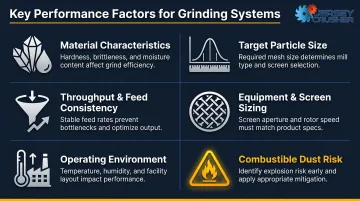
Material characteristics: Hardness, brittleness, moisture content, and abrasiveness all determine which grinding mechanism applies — the Bond Work Index (BWI) quantifies the specific energy (kWh/t) required and directly informs equipment selection and motor sizing.
Target particle size and distribution: The tighter the specification, the more precisely screens, gap settings, and recirculation loops must be configured. Broad distribution tolerance allows simpler systems; narrow distribution requires closer control.
Throughput and feed consistency: Volumetric feed rate, moisture content, and feed uniformity all affect output quality. Feed moisture above 2–3% causes clogging and throughput loss, while feed surges or starvation accelerate equipment wear.
Equipment selection and screen sizing: Lump breakers, particle-izers, hammer mills, roller mills, and ball mills each suit a specific material profile and particle size range — selecting the wrong type is the most common driver of poor system performance.
Operating environment and material sensitivity: Heat-sensitive materials (food, pharma) require low-impact grinding and stainless steel construction; facilities handling combustible dusts must also comply with NFPA 652's Dust Hazard Analysis requirements.
Explosion risk from combustible dusts: NFPA 652 mandates a formal Dust Hazard Analysis for any facility where combustible dust is generated — this directly affects enclosure design, ventilation, and equipment grounding specifications.
Common Misconceptions and When Particle Grinding May Not Be the Right Choice
Three beliefs cause more misapplied grinding decisions than any equipment limitation:
Equipment is interchangeable across materials. Material properties must match the force mechanism. Highly abrasive materials will rapidly destroy high-speed rotors in a hammer mill — these applications require compression-based equipment instead.
Finer particle size always means better output. Over-grinding wastes energy and generates ultrafine dust that hurts downstream recovery and handling. Comminution consumes approximately 4% to 5% of global electricity, and excessive grinding converts mechanical energy to heat — degrading heat-sensitive materials like spices, APIs, or polymers in the process.
A mill alone is a complete system. Effective size reduction requires integrated feeding, grinding, and classification working together. Without controlled feeding upstream and classification downstream, consistent output is not achievable.
These misconceptions point to a broader question: when is grinding the wrong tool entirely?
When Particle Grinding Is Unnecessary or Counterproductive
- Materials already at specification size — deploying grinding adds cost and complexity
- Materials that degrade under grinding forces — those that melt, smear, or oxidize under heat require gentler de-agglomeration rather than aggressive grinding
- Applications where coarse crushing alone achieves required output — unnecessary fine grinding wastes energy and creates handling challenges
Signals That Grinding Is Being Used by Default
- Persistent product variability despite equipment operation
- High energy draw with low throughput
- Frequent screen replacement or excessive equipment wear
- Material temperature rise during processing
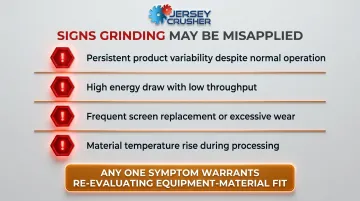
Any one of these symptoms warrants revisiting whether the equipment selected actually matches the material and the target output — not just whether the machine is running.
Conclusion
Particle grinding is an integrated system — controlled feeding, pre-processing, size reduction, classification, and discharge all function as a chain. Each stage depends on the one before it, and a weak link anywhere produces inconsistent, off-spec output.
Applying grinding by default — without matching the approach to the material and target specification — produces preventable inefficiency, product variability, and elevated operating cost. Effective system design starts with the material itself.
The four variables that determine whether a grinding system consistently hits spec:
- Feed consistency — controlled input rate and particle size entering the mill
- Force mechanism — compression, shear, or impact matched to material hardness and friability
- Screen sizing — aperture selection calibrated to discharge particle size targets
- Classification — separation of on-spec particles from oversize that requires reprocessing
Getting these right requires treating particle grinding as an engineered system, not a commodity step in the process. For operations handling friable bulk solids — whether chemical, food-grade, pharmaceutical, or agricultural — working with an equipment manufacturer that evaluates your specific material before specifying a solution is the most reliable path to consistent output.
Frequently Asked Questions
What's the difference between crushing and grinding?
Crushing handles primary, coarse size reduction of large lumps using compressive force in equipment like roll crushers. Grinding applies impact, shear, or attrition to achieve finer, more controlled particle sizes. They typically serve sequential stages in a processing system.
Is grinding the same as milling?
The terms are often used interchangeably, but milling typically refers to finer, more controlled size reduction (often in the sub-millimeter range). Grinding can describe a broader range of size reduction from coarse to fine depending on equipment and industry context.
How does a wet mill work?
A wet mill adds liquid (usually water) to the grinding chamber to reduce friction, control heat, and facilitate finer particle size reduction. Wet milling suits slurry-processed materials but is not appropriate for moisture-sensitive ones.
What are the four types of grinding machines?
The main categories are hammer mills (impact-based), roller mills (compression/shear), ball mills (media impact and attrition), and lump breakers or particle-izers (for de-agglomeration and coarse-to-mid grinding). Selection depends on material type and target particle size.
What particle size can industrial grinding systems achieve?
Achievable particle size ranges widely by equipment type — from several centimeters with lump breakers down to sub-millimeter or micron-scale with fine mills. Stirred media mills can achieve particles down to 200 nm, while lump breakers typically reduce material to ~2 mm.