
This guide covers the physical nature of chemical crushing, methods from manual to industrial scale, equipment selection criteria, and the safety protocols every facility handling chemical powders must have in place.
Key Takeaways
- Crushing chemicals into powder is a physical change — molecular identity stays the same, only particle size changes
- Methods range from mortar and pestle at lab scale to lump breakers, hammer mills, and ball mills at industrial scale
- Equipment choice depends on material hardness, target particle size, volume, and safety classification
- Industrial lump breakers are the preferred tool for friable chemical solids requiring controlled, gentle size reduction at scale
- Safety is non-negotiable: dust hazard analysis, PPE, ventilation, and enclosed equipment are required
Is Crushing a Chemical into Powder a Physical or Chemical Change?
Crushing is a physical change, not a chemical one. When you reduce a solid to powder, the molecular structure and chemical identity of the substance remain completely intact. Only the particle size and surface area change. No new compounds form, no bonds break, no reactions occur.
This distinction matters more than it might seem. Because the powdered output retains the same reactivity, solubility, and chemical properties as the original solid, particle size reduction is used specifically to enhance those properties — not to alter them.
Why Particle Size Matters in Practice
Smaller particles mean greater surface area, which directly accelerates dissolution and reaction rates. Research published in the International Journal of Nanomedicine demonstrated this clearly: 80 nm nanocrystals of coenzyme Q10 achieved 7.3-fold higher oral bioavailability compared to coarse suspensions. That's the same substance, same chemistry — just smaller particles.
This principle drives particle size reduction across industries:
- Pharmaceutical APIs require controlled particle size for predictable dissolution and dosage accuracy
- Fertilizers absorb faster and distribute more evenly when ground finer
- Food additives and pigments depend on consistent particle size for texture, color development, and blendability
- Chemical intermediates need uniform particles to support consistent downstream reaction stoichiometry
For many materials, achieving a specific particle size distribution is a core production requirement — not an afterthought.
Common Methods for Crushing Chemicals into Powder
Manual and Laboratory-Scale Methods
The mortar and pestle is the starting point for most lab-scale grinding work. For pharmacy compounding and sample preparation, it's reliable and low-cost. At any meaningful scale, though, limitations surface fast: inconsistent particle size, slow throughput, contamination risk, and operator fatigue.
Material selection matters for lab-scale grinding:
| Material | Best For |
|---|---|
| Agate (Mohs 6.5–7) | High-purity sample prep, abrasive materials |
| Alumina / Zirconia | Very hard samples, chemical-resistant environments |
| Porcelain | Pharmacy compounding, soft to moderately hard chemicals |
| Stainless Steel | General lab use, moderate hardness |
Agate is typically recommended when cross-contamination must be avoided. Porcelain is standard for pharmaceutical compounding under USP guidelines.
Lab-scale methods stop being practical the moment volume, consistency, or throughput targets enter the picture. For industrial chemical production, the real question shifts: which type of industrial equipment matches the material and the output spec?
Industrial-Scale Crushing Methods
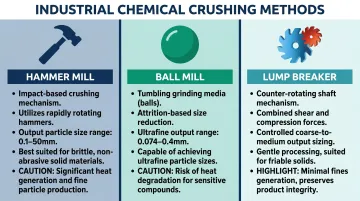
Hammer mills use rotating hammers to pulverize material through impact against chamber walls and particle-on-particle collision. A perforated discharge screen retains oversized material for further processing — screen size alone controls over 70% of finished particle size, with rotor speed and hammer configuration accounting for the rest. Hammer mills handle brittle, non-abrasive solids well and produce output in the 0.1–50 mm range.
Ball mills operate differently — a rotating drum partially filled with grinding media (steel, ceramic, or zirconia balls) uses impact and attrition (grinding by friction) to reduce material to very fine particles. Standard output falls in the 0.074–0.4 mm range, with specialized applications achieving particles as fine as 5 nm. Ball mills are preferred for pharmaceutical APIs requiring ultrafine grinding and for hard mineral processing, but heat generation during grinding can degrade heat-sensitive materials, and media wear adds ongoing maintenance costs.
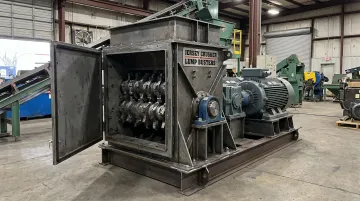
Lump breakers take a fundamentally different approach. Rather than pulverizing material with high energy, they use counter-rotating shafts with breaker bars working against sizing screens to fracture agglomerated or compacted solids down to a controlled particle size. The distinction matters: lump breakers restore material to its original grain size without creating excessive fines, heat, or dust. For friable chemical solids — dried cakes, agglomerated intermediates, compacted bulk chemicals — a lump breaker typically delivers the target particle size without the product degradation or fines overproduction that hammer and ball mills introduce.
Industrial Equipment for Large-Scale Chemical Powdering
How Lump Breakers Work and Where They Excel
A lump breaker's mechanical action combines shear and compression. Counter-rotating shafts with breaker bars fracture lumps between the rotors and against fixed combs or sizing grids. Once material reaches the target particle size, it passes through the discharge grate immediately — with no over-grinding or unnecessary heat buildup.
For temperature-sensitive chemical compounds, that matters. High-impact mills generate frictional heat that can degrade heat-sensitive APIs, alter moisture content in hygroscopic materials, or affect the reactivity of chemical intermediates. The lump breaker's gentler shearing mechanism avoids these problems.
Lump breakers are the preferred tool across several industrial contexts:
- Breaking agglomerated intermediates and chemical cake from filtration or drying (bulk chemical processing)
- De-lumping NPK, urea, and other granular fertilizers that cake in storage
- Reducing compacted API or excipient to uniform feed before fine milling (pharma pre-milling)
- Gently sizing food ingredients — sugar, spices, flour — without heat damage
- Coarse de-agglomeration of minerals upstream of finer milling stages
Jersey Crusher's Lump Busters® line — built over four decades of manufacturing experience in Wayne, NJ — is engineered specifically for this application space. The counter-rotating dual-rotor design with integrated sizing screens or breaker bars processes friable chemical substances without the heavy pounding of hammer mills, ball mills, or pin mills. Screen hole diameters are customizable from ⅛" to 2" and beyond, allowing precise targeting of particle size output to downstream process specifications.
Standard features on all Lump Busters® units include air purge shaft seals, which prevent process material from migrating into bearing assemblies — a critical feature in chemical processing where bearing contamination creates both equipment failure and cross-contamination risks.
Selecting Equipment Material and Configuration
Material selection in chemical processing is largely determined by regulatory requirements and chemical compatibility, not just cost.
| Material | Best For |
|---|---|
| 316 Stainless Steel | Pharmaceutical, food-grade, corrosive chemical intermediates — molybdenum content resists chloride pitting |
| 304 Stainless Steel | General chemical service with corrosion resistance requirements |
| Carbon Steel | Non-corrosive bulk chemical applications, painted with blue enamel |
| Abrasion-Resistant Alloys | Highly abrasive mineral and chemical materials |
316L stainless steel's 2–3% molybdenum content makes it the industry standard for pharmaceutical and food product-contact surfaces under FDA cGMP and ASME BPE requirements. Jersey Crusher offers 316 SS construction as standard for sanitary applications.
Optional interior finishes include food-grade white epoxy for pharmaceutical and food-contact surfaces, and high-temperature inorganic carbon/zinc primer for elevated-temperature or aggressive chemical environments.
Fully mobile design rounds out the package. All Lump Busters® models relocate between plant locations or production lines without permanent foundation installation — a practical advantage for multi-plant operators or facilities with shifting production schedules.
Key Factors for Choosing the Right Crushing Method
Getting this decision right starts with four variables. Each one narrows your equipment options — and skipping any of them leads to undersized, oversized, or outright unsafe equipment choices.
Material Hardness and Friability
Soft, friable solids — dried chemical cakes, fertilizer lumps, agglomerated intermediates — are ideal candidates for lump breakers. Harder minerals or dense compacted materials may require jaw crushers or ball mills upstream. Test with actual production samples before committing to equipment. Jersey Crusher's sample evaluation service lets you ship material directly to their engineering team for application analysis and equipment recommendation.
Required Particle Size and Distribution
Different equipment covers different size ranges:
- Lump breakers handle coarse-to-medium de-agglomeration
- Hammer mills cover mid-range grinding
- Ball mills achieve fine to ultrafine output
Operations requiring tight particle size distribution tolerances need equipment with integrated sizing screens rather than units without downstream sizing control. Pharmaceutical and specialty chemical manufacturers typically verify output with laser diffraction (ISO 13320), which covers 0.1 to 3,000 microns.
Production Volume and Throughput
Manual methods are impractical beyond bench scale. Industrial continuous-feed equipment — from compact models like the Lump Busters® 1515 to high-capacity units like the 6464 — is necessary for chemical processing operations. The right model size is determined by volumetric throughput requirements, not just material type.
Chemical Properties and Safety Classification
This factor must drive equipment specification before anything else. Reactive, toxic, or combustible dust chemicals require enclosed systems, appropriate motor configurations for the facility's hazardous location classification, and dust containment integration. Identify your material's safety classification first, then select equipment that meets those requirements.
Safety Guide: How to Crush Chemicals Safely
Dust Hazard Assessment
Many chemical powders generate combustible or toxic dust during crushing. The U.S. Chemical Safety Board documented 281 combustible dust incidents between 1980 and 2005, resulting in 119 deaths and 718 injuries. These aren't edge cases — they span chemicals, food products, pharmaceuticals, and metals.
Before selecting equipment or designing a workspace, facilities must conduct a Dust Hazard Analysis (DHA). NFPA 652 (now consolidated into NFPA 660, Standard for Combustible Dusts and Particulate Solids) requires DHAs for all facilities handling combustible dust, with 5-year revalidation cycles. OSHA enforces these requirements through Directive CPL 03-00-008, effective January 2023, covering chemicals, food, pharmaceuticals, and metals industries.
Personal Protective Equipment
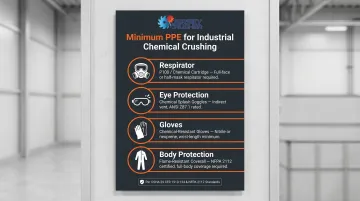
Minimum PPE for industrial chemical crushing:
- Respirators — P100 filters (99.97% efficiency, oil-proof) for dusty environments; chemical-specific cartridges for toxic vapor exposure
- Eye protection — chemical splash goggles, not just safety glasses
- Gloves — chemical-resistant, matched to the specific substance being processed
- Body protection — full-body coverage increases with toxicity and reactivity rating; flame-resistant clothing per NFPA 2112 for combustible dust environments
OSHA 29 CFR 1910.134 requires fit testing for all tight-fitting respirators and NIOSH-certified equipment throughout.
Ventilation and Dust Containment
Enclosed or hooded crushing equipment with integrated dust collection (bag filters or cyclones) is the industrial standard. Inadequate containment creates health hazards, product loss, and regulatory violations simultaneously.
For powder applications, venting and dust collection must be engineered into the system from the start. Key requirements:
- Integrate dust collection connections at the equipment design stage, not retrofitted afterward
- Select equipment with integral venting ports to simplify collection system tie-in
- Keep compressed air cleaning below 30 psi — OSHA 1910.94 enforces this limit
Equipment Cleaning and Cross-Contamination Prevention
In pharmaceutical and food chemical applications, cleanout between batches is a GMP requirement, not discretionary. Key considerations:
- Tool-free access panels for faster, more thorough cleaning
- 316 SS construction with polished interiors (120 grit, all welds ground smooth) for pharmaceutical-grade sanitation
- Air purge shaft seals preventing material migration into mechanical components between cleaning cycles
- Validation documentation (IQ/OQ protocols, material certifications) for regulated environments
Operational Training and LOTO
All personnel operating crushing equipment for chemical materials must be trained on:
- Specific hazards of the material being processed (SDS review)
- Lockout/tagout (LOTO) procedures per OSHA 29 CFR 1910.147 — written, machine-specific energy control procedures required
- Emergency response steps for dust ignition or chemical exposure events
LOTO procedures apply during all maintenance, cleaning, and unjamming operations — including unscheduled cleaning and unjamming operations.
Frequently Asked Questions
Is crushing a solid into a powder a chemical change?
No — crushing is a physical change. The chemical composition and molecular identity of the substance remain unchanged; only particle size is reduced, increasing surface area without altering what the substance fundamentally is.
Which apparatus is used to grind and crush solid substances into a powder?
At lab scale, a mortar and pestle. At industrial scale, the right tool depends on hardness and target particle size: lump breakers handle friable solids and de-agglomeration, hammer mills cover mid-range grinding, ball mills achieve fine and ultrafine output, and jaw crushers handle harder materials.
Can chemicals be in powder form?
Yes. Many chemicals are routinely processed into or stored in powder form — pharmaceutical APIs, fertilizers, pigments, food additives, and detergents among them. Powder form improves reactivity, solubility, and ease of blending or dosing.
What safety precautions should be taken when crushing chemicals into powder?
Conduct a dust hazard analysis before starting, wear appropriate PPE (including fit-tested respirators), ensure proper ventilation and dust containment, and use enclosed or appropriately rated equipment when working with reactive or combustible chemical powders.
What is the difference between a lump breaker and a ball mill?
Lump breakers break compacted or agglomerated solids to a controlled coarse-to-medium particle size using shear and compression — they work faster and more gently, preserving material integrity in the process. Ball mills grind material to very fine or ultrafine particles using tumbling media, making them better suited for applications requiring extremely fine output.
How do you control particle size when crushing chemicals?
Operators control particle size through integrated sizing screens or breaker bars set to specific opening dimensions. Customizable screen configurations — like the ⅛" to 2"+ options on industrial lump breakers — let operators target precise output specifications.