
Introduction
Think about the last time you stirred instant coffee into hot water, reached for a bottle of ground cumin, or opened a bag of uniformly cut frozen vegetables. Each of those products required at least one size reduction step — often several — before reaching its final form.
Size reduction (also called comminution) underpins every major branch of food manufacturing, from grain milling and spice grinding to chocolate refining and meat processing. Despite its prevalence, it remains one of the most misunderstood operations in food plant design.
Get it wrong and the consequences compound quickly:
- Excessive heat degrades volatile flavor compounds
- Inconsistent particle sizes cause blending failures
- Moisture-laden materials clog screens and blind mills
Each problem cascades downstream, affecting mixing, packaging, and final shelf life.
This guide covers the fundamental principles driving size reduction in food processing: the mechanical forces involved, the material factors that determine which approach works, and the direct link between particle size decisions and finished product quality.
Key Takeaways
- Size reduction (comminution) breaks solid food materials into smaller particles, increasing surface area to improve mixing, extraction, and texture consistency.
- Four forces — compression, impact, attrition, and cutting — govern all size reduction equipment, each suited to different materials and target particle sizes.
- Material properties (hardness, moisture content, heat sensitivity) determine which force delivers consistent, on-spec output.
- Particle size affects flowability, mouthfeel, shelf life, and pathogen kill during thermal processing.
- The wrong equipment generates excess heat, destroys flavor compounds, and creates uneven distributions that disrupt every downstream step.
What Is Size Reduction in Food Processing?
Size reduction is defined as the "mechanical process of breakdown of solids into smaller size particles without altering the state of aggregation of solids" (Sahu & Singh, 2018). In practical terms: you're applying force to break a solid food material into smaller pieces, creating new surface area in the process.
That new surface area is the whole point. It accelerates heat and mass transfer, improves extraction efficiency, enables more uniform mixing and hydration, and determines how consistently a product behaves batch to batch.
The Problem It Solves
Raw ingredients rarely arrive ready for direct processing. Common examples include:
- Whole grains and cocoa nibs with inconsistent particle sizes
- Caked sugar that has clumped during storage
- Dried spice clusters that won't blend or hydrate evenly
Each needs to reach a processable intermediate particle size before blending, cooking, or packaging can proceed predictably. Size reduction bridges that gap.
What It Is Not
Size reduction is frequently confused with size separation — screening, sieving, and air classification. These operations sort particles by size after reduction; they don't break them. The two often appear in sequence on a processing line, but they serve distinct functions. Specifying the wrong one is a common source of equipment selection errors when engineering new food processing lines.
Size reduction also spans a wide intensity range — from coarse lump breaking of agglomerated bulk solids down to ultra-fine milling at sub-50 micron levels. Coarse breaking typically uses breaker bars or screens sized to a specific discharge opening; fine milling demands tighter controls on feed rate, rotor speed, and particle dwell time. Getting the application wrong at the specification stage costs time and money downstream.
The Four Mechanical Principles of Size Reduction
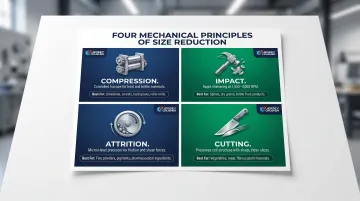
All size reduction equipment — regardless of manufacturer, configuration, or application — operates through one or more of four mechanical forces. The choice of force determines particle size range, product quality, energy consumption, and heat generation.
Compression
Compression applies slow, steady force between two surfaces until the material fractures along its natural weak points. Roller mills are the clearest example: counter-rotating rollers squeeze material as it passes through the gap, producing controlled fracture with relatively few fines.
Best suited for: Hard, brittle materials with defined fracture planes — grains, dried fruits, cocoa nibs, crystallized sugar. Roller mills used in wheat flour production can achieve a D90 below 160 µm with particle size coefficients of variation in the 10–20% range.
Soft or fibrous materials deform under compression rather than fracturing cleanly, making compression ineffective for fibrous or elastic materials.
Impact
Impact delivers rapid, high-energy strikes from rotating components — hammers, pins, or rotors — that shatter particles almost instantly. Industrial hammer mills operate at 1,550 to 4,000 RPM, with higher speeds (3,000–3,600 RPM) producing finer particles and lower speeds (1,500–1,800 RPM) yielding coarser output (Prater Industries).
Best suited for: Spices, dried vegetables, sugar, grains, and animal feed — materials that fracture under sudden force.
The critical trade-off: only approximately 1% of grinding energy creates new particle surface area; the remaining ~99% dissipates as heat (Sahu & Singh, 2018). In cumin milling, conventional impact grinding drives powder temperatures to 95°C — enough to volatilize essential oils and degrade the flavor profile significantly.
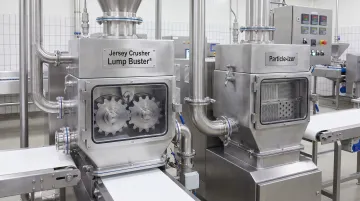
That heat problem is why equipment selection matters for temperature-sensitive ingredients. Jersey Crusher's Lump Busters® use counter-rotating dual rotor shafts to generate a shearing action rather than impact force, keeping temperatures lower throughout the reduction cycle. Material exits only once it reaches the target particle size via integrated screen apertures from ⅛" to 2" — a direct structural advantage for dried herbs, spice blends, and other volatile-rich ingredients.
Attrition
Attrition reduces particle size through friction between two rough surfaces or between particles themselves. Disc mills and ball mills are the standard equipment. Particle sizes near the micrometre level are achievable, making attrition the preferred method for smooth chocolate, fine spice blends, and instant beverage powders.
The efficiency gains from parameter optimization can be substantial. In chocolate ball milling, optimizing agitator speed to 58 RPM and reducing refining time from 55 to 38.5 minutes increased output from 109 kg/h to 156 kg/h (a 43% gain) while reducing energy consumption by approximately 25% (Alamprese et al., 2007, Journal of Food Engineering).
Attrition is inherently slower than impact or compression — a worthwhile exchange when particle size precision matters more than raw throughput.
Cutting
Cutting uses sharp blades or edges to slice through material cleanly, preserving cell structure and maintaining visual integrity. It's the right choice when piece uniformity, moisture retention, and appearance are the primary objectives — sliced vegetables for canning, diced onions for ready-to-eat products, portioned meat.
Blade condition directly controls output quality. Sharp knives require approximately 25 N of cutting force versus 75 N for blunt blades — and dull blades don't just cut poorly, they crush. That crushing action increases drip loss in meat products and produces inconsistent piece sizes that compound into yield losses and downstream rework.
Key Factors That Influence Size Reduction Outcomes
Selecting the right mechanical force is only the starting point. The material's own characteristics determine whether that force delivers consistent, on-spec particles efficiently — or leads to clogging, heat damage, and uneven output.
Hardness and Toughness
These two properties are distinct and affect equipment selection differently:
- Hardness (resistance to deformation): Hard, brittle materials like dried grains or crystallized sugar fracture predictably under compression or impact.
- Toughness (resistance to fracture): Tough, fibrous materials like dried coconut or celery resist crushing and require impact or cutting to achieve clean reduction.
Misidentifying which property dominates in a material leads to undersized equipment, excessive energy consumption, and off-spec particle distributions.
Moisture Content
Moisture is one of the most influential material variables in size reduction. Research consistently shows that higher moisture content produces larger average particle sizes and increases grinding energy requirements (Jung et al., 2018, Processes). Excess moisture can rapidly blind a mill screen or cause material to smear across blades rather than fracture cleanly.
The optimal moisture range varies by material — wheat is typically conditioned to 9–16% before milling, meat is chilled to approximately 0–1°C before grinding to maintain firmness. There is no single universal threshold; processors should determine moisture targets per ingredient through testing.
Heat Sensitivity
Size reduction generates heat through friction and impact, and heat-sensitive foods — spices, chocolate, fat-rich or sugar-rich products — lose flavor compounds or become sticky if temperatures aren't controlled. Cryogenic grinding at liquid nitrogen temperatures (-195.6°C) retains 62.56% more volatile oil in cumin compared to ambient grinding, with similar advantages documented for clove (129.5% more retention) and caraway seed (32% more).
Where cryogenic processing isn't warranted, water-jacketed mills and air cooling within the grinding chamber offer partial protection. Jersey Crusher's Lump Busters®, with their counter-rotating dual rotor design, are a practical option for heat-sensitive materials: the low-impact shearing action limits frictional heat generation without requiring cryogenic infrastructure.
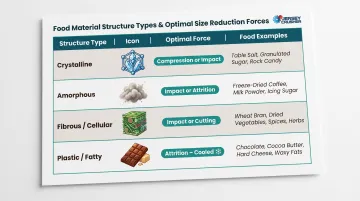
Material Structure
A food material's internal architecture determines how it responds to force:
| Structure Type | Examples | Best Force |
|---|---|---|
| Crystalline | Salt, sugar | Compression or impact |
| Amorphous | Freeze-dried powders | Impact or attrition |
| Fibrous/cellular | Dried coconut, celery | Impact or cutting |
| Plastic/fatty | Chocolate, cheese | Attrition (cooled) |
Matching force type to structure is what separates a well-specified mill from one that produces off-spec output — or fails entirely.
How Size Reduction Impacts Food Product Quality
Every size reduction decision is ultimately a quality decision. Particle size affects how a product performs at every stage of its life — in process, in storage, and in the consumer's hands.
Surface Area and Process Performance
When particles are reduced, new surface area is created. More surface area means faster and more uniform heat and mass transfer, better flavor and nutrient extraction, and more consistent hydration.
The difference between evenly hydrated flour in dough and lumpy, under-hydrated patches in a mixer is largely a particle size story. So is rapid dissolution in instant drink mixes versus the chalky residue left by coarsely ground powder.
This has a limit, though. Below certain thresholds, cohesive forces between ultra-fine particles increase and gaps decrease, forming a gel-like outer layer during rehydration that traps dry material inside — a well-documented problem in instant powder processing. The optimal particle size for dissolution is material-specific: green tea powder typically performs best at 100–180 µm, orange powder below 75 µm.
Texture, Flowability, and Stability
Three quality parameters food manufacturers track directly connect to particle size:
- Mouthfeel: The grittiness threshold in confectionery products falls at approximately 25–35 µm — particles above this range become perceptible and objectionable to consumers. Commercial dark chocolate is typically processed to a D90 of 19.2–31.1 µm to stay below this threshold.
- Flowability: Finer particles generally exhibit poorer flowability due to increased interparticle cohesion. Dairy powders, for example, show Carr Index values of 27–39 (poor to very poor flowability) — a direct consequence of their particle size and surface characteristics.
- Stability: Inconsistent particle size in powdered dairy or emulsified products increases caking risk and emulsion instability. Finer particles with more surface area absorb moisture faster, accelerating caking in storage.

Food Safety
Smaller, more uniform particles increase the surface-area-to-volume ratio, enabling more uniform heat penetration during cooking — critical in ground and processed meat formulations where processors must validate pathogen kill. Consistent grind size directly supports that validation by removing the cold spots that coarser, uneven particles create.
Where Size Reduction Equipment Fits in Food Processing Operations
Size reduction typically occurs after initial cleaning and sorting (to protect equipment from foreign material damage) and before mixing, blending, or thermal processing. Output quality shapes every downstream stage.
In some operations — particularly where bulk ingredients like salt, sugar, or spice blends cake during storage or transport — lump breaking also serves as a reconditioning step within the conveyance line itself. Jersey Crusher's Lump Busters® are commonly installed beneath silos and at bulk bag unloaders precisely for this purpose, restoring free flow before caked material reaches sensitive downstream equipment.
Matching Equipment to Operating Environment
Different size reduction principles suit different production contexts:
- Coarse impact reduction (lump breakers) — best for continuous bulk flow of grains, sugar, and spice blends; designed for high throughput in inline applications
- Precision attrition milling — suited to controlled batch environments with tight particle distribution requirements, such as chocolate refining or instant beverage powder production
- Cutting equipment — the right choice where piece uniformity and structural preservation matter most, such as frozen vegetable and ready-to-eat meal lines
For food-grade bulk processing integration, Jersey Crusher builds both the Lump Busters® and Particle-izers in 316 stainless steel (the sanitary grade preferred where contamination control is critical) and 304 stainless steel. Key configuration details:
- Screen apertures are customizable from ⅛" to 2"
- Particle-izers achieve particle sizes down to 100 mesh or finer
- Air purge shaft seals are standard on all units, preventing cross-contamination between product runs
Multi-Stage Processing
Modern food processing lines often combine multiple size reduction principles in sequence — coarse impact reduction to break large agglomerates, followed by attrition milling for fine finishing. This keeps each machine operating in its most efficient range and reduces total energy consumption per unit of product.
Wheat flour milling is the clearest example: grain passes through successive break rolls and reduction rolls with sieving between stages, each contributing targeted reduction rather than forcing a single machine to do all the work.
Frequently Asked Questions
What is size reduction in food processing?
Size reduction is the mechanical process of applying force to solid food materials to break them into smaller particles, increasing surface area for improved mixing, flavor extraction, dissolution, and texture uniformity. It applies across nearly every food category, from grain milling to chocolate refining to meat processing.
What are the principles of size reduction in food processing?
The four mechanical principles are compression, impact, attrition, and cutting. Each applies force differently, suits different food materials, and produces different particle size ranges and quality outcomes. Most industrial equipment uses one primary force, sometimes supplemented by a secondary one.
What factors affect size reduction in food processing?
The four primary material factors are hardness and toughness, moisture content, heat sensitivity, and internal material structure. These determine which principle and equipment will produce consistent, on-spec output without causing clogging, heat damage, or particle distribution problems.
How does size reduction affect food quality?
Size reduction affects flowability, stability, texture, shelf life, nutrient bioavailability, and food safety. Downstream steps — mixing, heating, packaging, and dissolution — all depend on consistent particle size coming out of the reduction stage.
What is the difference between size reduction and size separation?
Size reduction breaks particles into smaller pieces using mechanical force. Size separation (screening, sieving, air classification) sorts existing particles by size without breaking them. The two are often used in sequence on the same processing line.
What are examples of size reduction in food processing?
Common examples include roller milling of wheat into flour, hammer milling of dried spices, lump breaking of caked sugar or salt in storage lines, ball milling of cocoa for chocolate production, and rotary knife cutting of vegetables for frozen meal lines.