Introduction
Powder & Bulk Solids reports that 70% of everything manufactured or produced involves a powder or bulk solid at some point. For most industries, powder processing isn't a peripheral concern — it's baked into the core of production, yet rarely examined with the rigor it demands.
Industrial powder processing is the controlled transformation of raw bulk materials into powders with defined particle size, density, and flow characteristics. Getting those properties right determines whether a pharmaceutical tablet dissolves on schedule, whether a fertilizer granule releases nutrients evenly in soil, or whether a food ingredient blends consistently at production volume.
The challenge is that powders behave nothing like liquids or gases. Each material has its own flowability, moisture sensitivity, bulk density, and tendency to cake — and those properties shift with temperature, humidity, and storage time. Managing that complexity across a production line requires engineering judgment and the right equipment at every stage.
This article walks through the core stages of a powder processing workflow: size reduction and classification techniques, key equipment categories, the industries that rely on them, and the safety requirements that come with the territory.
Key Takeaways
- Industrial powder processing converts bulk materials into controlled-particle-size powders through feeding, size reduction, classification, blending, and drying.
- Particle size is the most critical variable — it directly affects flowability, reactivity, compressibility, and end-product quality.
- Lump breaking is the essential first-pass step that protects downstream equipment and ensures consistent output.
- Equipment selection must align with material properties, target particle size, and production environment.
- Combustible dust explosion risk and inhalation hazards are non-negotiable safety priorities in every powder processing facility.
Key Stages in the Industrial Powder Processing Workflow
A powder processing line is only as consistent as its weakest stage. Each step below feeds directly into the next — irregularities compound rather than cancel out.
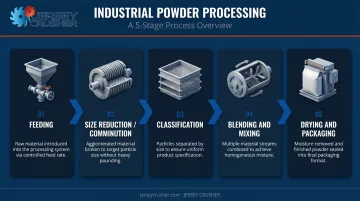
Stage 1: Feeding
Raw material enters the processing system at a controlled rate using volumetric or gravimetric (loss-in-weight) feeders. Feed rate consistency is foundational. Pharmaceutical Technology reports that in testing, powder-grade acetaminophen feedfactor dropped to 44% of its initial value at low hopper fill, a variation that propagates directly into downstream mixing errors and particle size inconsistency.
The choice of feeder type has direct process implications:
- Loss-in-weight feeders: The most commonly used continuous feeding method for pharmaceutical applications, providing real-time mass-flow feedback that volumetric feeders cannot match
- Volumetric feeders: A simpler, lower-cost option for less precision-critical materials where gravimetric control is not required
Stage 2: Size Reduction (Comminution)
Oversized lumps, agglomerated material, or raw bulk solids are reduced to a target particle size range. This stage determines the efficiency of every subsequent step. Skip or under-specify it, and the consequences are predictable: equipment jams, poor blend uniformity, and inconsistent throughput.
Lump breaking is typically the first-pass step here, reducing caked or compacted material before finer milling. Specific techniques are covered in the next section.
Stage 3: Classification
After size reduction, sieves, vibrating screens, or air classifiers separate the powder into fractions by particle size. The output is characterized by a particle size distribution (PSD): the spread of particle sizes present in a sample.
A narrow, controlled PSD is often a formal quality specification. USP <786> governs PSD estimation by analytical sieving for pharmaceutical powders, with mechanical sieving most suitable for particles above roughly 75 µm.
In food powder research, PSD is directly linked to flowability. Finer powders frequently show poorer flow behavior due to increased cohesive forces between particles.
Stage 4: Blending and Mixing
Individual powder components are combined to achieve a homogeneous mixture. FDA's 21 CFR 211.110 requires testing of in-process materials for adequacy of mixing to assure uniformity and homogeneity, a standard that illustrates how directly blend quality ties to regulatory compliance in pharmaceutical manufacturing.
Batch mixing processes one fixed charge at a time; continuous mixing integrates blending into an ongoing production flow. Both approaches require careful attention to particle size matching.
Research shows sifting segregation can occur in binary mixtures when the particle size ratio reaches just 1.3:1, pulling drug potency outside the acceptable 85–115% label-claim range.
Stage 5: Drying and Packaging
Moisture removal restores flowability, extends shelf life, and prevents caking during storage. Moisture content must be controlled within tight limits before packaging: excess moisture causes bridging and agglomeration that undo everything achieved upstream.
Packaging considerations are just as consequential. The chosen format (bags, bulk containers, silos) must suit the powder's flow characteristics to prevent settling, segregation, or compaction during transit.
Core Powder Processing Techniques
Size Reduction Techniques
Lump Breaking
Lump breaking is the critical first-pass step before any finer milling. Lump breakers mechanically break down caked, compacted, or agglomerated bulk material into manageable particle sizes — without the heavy impact forces of hammer mills. Preserved material integrity is often a requirement in food, pharmaceutical, and chemical applications where aggressive milling generates excessive fines or alters particle morphology.
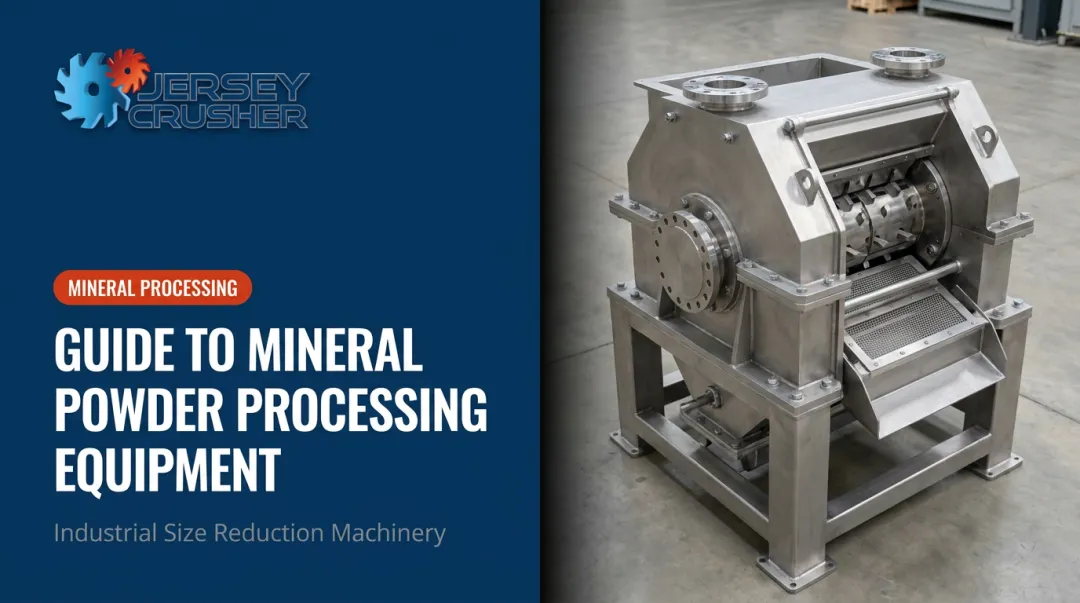
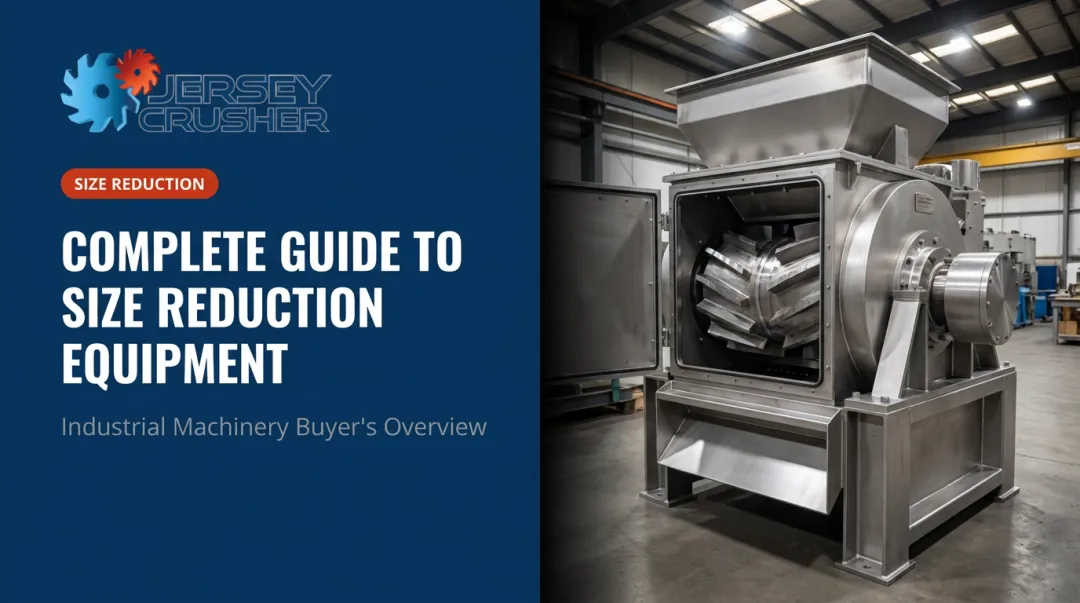
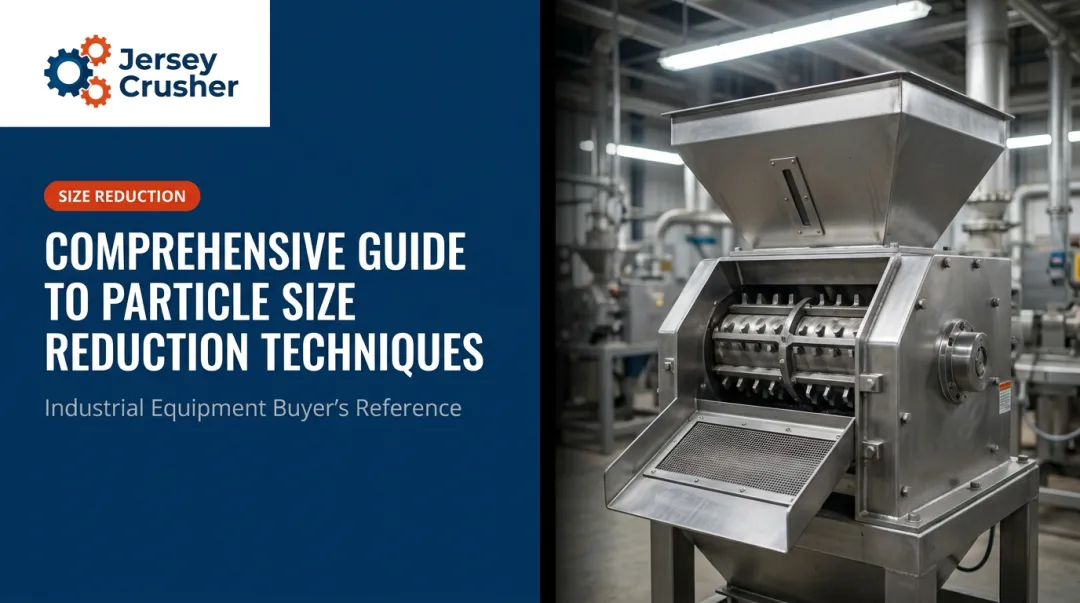
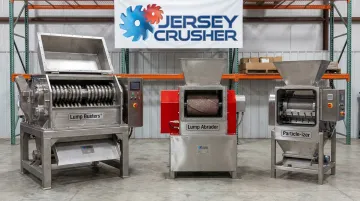
Jersey Crusher's Lump Busters® line uses a counter-rotating dual rotor system with specialized finger patterns. The two shafts rotate toward each other, pulling material inward and applying shearing force rather than impact. Integrated sizing screens or breaker bars regulate the output — screen hole diameters are customizable from ⅛" to 2" and beyond, giving process engineers direct control over the particle size leaving the equipment.
Where dust generation is a priority concern, the Lump Abrador line takes a different approach: a single large-diameter rotor with impacting fingers forces material against fixed combs, using abrasion rather than shearing. This preserves particle morphology and minimizes fines — particularly useful for mineral processing, pharmaceutical API liberation, and explosion-classified environments.
The Particle-izer line targets precision size reduction down to 100 mesh or smaller — appropriate for fertilizer granulation, pharmaceutical active ingredients, cosmetics, and cannabis processing where particle uniformity drives product performance.
Hammer Milling
Hammer mills use high-speed rotating hammers to impact particles against a screen or casing wall, producing particles from several millimeters down to tens of microns. They offer high throughput and broad material compatibility across chemical, food, grain, and mineral applications. Output particle size is controlled primarily by screen aperture and rotor speed. However, the aggressive impact forces make hammer mills unsuitable where material integrity, fine dust generation, or morphology preservation are process requirements — the cases where lump breakers or abrasion-based size reduction are the engineered alternative.
Jet Milling / Micronization
Jet mills use high-velocity particle-to-particle collisions from compressed air or steam to achieve particle sizes in the 1–10 µm range — with no mechanical contact and no heat generation. Micronization to 1–5 µm is widely used for pharmaceutical APIs to increase dissolution rates. The lack of heat input is critical: some APIs undergo amorphization or polymorph transformation during conventional milling, making jet milling the preferred approach despite higher operating costs.
Classification Techniques
Once material exits a size reduction stage, classification separates the output into target fractions and returns oversize material for reprocessing.
Mechanical Sieving and Vibrating Screens
Particles pass through mesh openings sized to the target specification. Screen selection must account for several variables:
- Mesh aperture — set to the target particle size specification
- Vibration frequency — affects throughput and blinding tendency
- Material characteristics — density, moisture content, and stickiness all affect screen performance
A screen correctly sized for a dry granulate may blind immediately with a hygroscopic powder. Material properties drive screen selection as much as the target cut point does.
Air Classification
Air classifiers separate particles using controlled airflow — centrifugal force and air drag act simultaneously, separating by both size and density. This makes air classification well-suited for fine or cohesive powders where mechanical screening is impractical.
Mechanical classification is standard above 100 µm. Finer distributions require the more controlled separation that air classification provides — Hosokawa's Alpine TTC classifier, as one example, achieves classifications down to D97 = 2 µm.
Blending and Mixing Techniques
Effective blending relies on three fundamental mechanisms:
- Convective mixing — bulk movement of material masses
- Diffusive mixing — particle-level randomization through random motion
- Shear mixing — breaking apart agglomerates within the blend
Mixer selection determines which mechanisms dominate. Ribbon blenders and paddle mixers generate strong convective and shear action. V-blenders and bin tumblers rely more heavily on diffusion. Match the wrong mechanism to the material, and the result is a segregated mix rather than a homogeneous blend — with direct consequences for dosing accuracy and downstream processing.
Key Equipment Used in Industrial Powder Processing
Feeding and Conveying Equipment
Volumetric feeders, screw conveyors, and gravimetric systems form the transport backbone of a powder line. Equipment must match powder bulk density, flowability, and abrasiveness — mismatched equipment causes bridging in hoppers, segregation during transfer, or premature wear on contact surfaces.
Screw conveyors are particularly suited for controlled, enclosed transfer of friable or dusty materials. Jersey Crusher's screw conveyors use enclosed tube construction to prevent dust escape and protect operators. Standard configurations include:
- Materials: 316 SS, 304 SS, and carbon steel
- Diameter range: 6" up to 12" for higher throughput
- Drive options: Variable speed drives for feed rate matching with upstream and downstream equipment, preventing surge or starvation at connected process stages
Jersey Crusher's volumetric feeder range covers a spectrum of industrial capacities. The choice between volumetric and gravimetric systems comes down to accuracy requirements. Volumetric feeders suit applications where density is stable and slight rate variation is acceptable; gravimetric systems are the right call when weight-based precision is required for product quality or regulatory compliance.
Size Reduction Equipment
| Equipment Type | Typical Output Range | Primary Application |
|---|---|---|
| Lump Breakers (Lump Busters®) | ⅛" to 2"+ (screen-controlled) | First-pass reduction of caked/agglomerated feed |
| Lump Abradors | Controlled de-agglomeration | Abrasion-based liberation, minimal fines |
| Particle-izers | Down to 100 mesh or finer | Fine, precision particle size reduction |
| Hammer Mills | Several mm to tens of µm | High-throughput intermediate milling |
| Jet Mills | 1–10 µm | Pharmaceutical/sensitive chemical micronization |
Material of construction must align with the process. Lump Busters® are available in 316 SS (sanitary applications), 304 SS (general industrial), carbon steel (non-corrosive bulk materials), and abrasion-resistant variants (hard or aggressive minerals). Optional interior finishes include food-grade white epoxy for regulated food and pharmaceutical applications; high-temperature inorganic carbon/zinc primer is available for elevated-temperature environments.
All Lump Busters® units include air purge shaft seals as standard — creating positive pressure at shaft penetrations to prevent powder migration into bearing assemblies and reduce fugitive dust emissions at a critical potential leak point.
Classification and Mixing Equipment
Vibrating screens and air classifiers handle particle size control after reduction. For facilities processing multiple powder types or requiring frequent product changeovers, equipment selection should prioritize:
- Cleanability: Tool-free disassembly and smooth internal surfaces reduce changeover time
- Contained design: Enclosed construction limits cross-contamination between batches
- Regulatory fit: Pharmaceutical and food applications require designs that meet sanitary standards
Industrial mixers (ribbon blenders, paddle mixers, bin tumblers) handle blending downstream of classification. Selecting the right mixer starts with understanding the particle size and flow characteristics coming out of upstream size reduction — which makes equipment compatibility at the feed point a key integration criterion.
Industries That Rely on Powder Processing
Powder processing equipment appears across nearly every manufacturing sector. The equipment categories are broadly similar; what varies are the material specifications, hygiene requirements, and regulatory standards applied in each.
Key industries and their specific drivers:
- Pharmaceuticals: Tablet pressing, capsule filling, and granulation governed by FDA cGMP and USP standards. The oral solid dosage CDMO market is forecast to reach $77.06B by 2033; 316 SS contact surfaces with documented cleanability are standard for GMP audits.
- Food and beverage: Spices, sugar, grain, and food rendering all require sanitary construction for food-contact surfaces. The seasoning and spices market alone is projected at $28.21B by 2031; stainless steel also addresses combustion risk in sugar and flour processing.
- Chemical processing: Pigments, powder coatings, and specialty chemicals — with the powder coatings market forecast at $17.94B by 2031. Carbon steel is often adequate; corrosive intermediates require stainless.
- Mineral processing: Aggregates and mining-adjacent processing, with an equipment market projected at $24.44B by 2031. Abrasion resistance is the primary material selection driver here, not hygiene.
- Recycling: Foam, cardboard, glass, and tissue — size reduction requirements vary by material type, and mobile equipment capability enables on-site processing without transporting materials to fixed facilities.
- Fertilizer and agriculture: Granulation and particle size uniformity directly affect nutrient release rates and soil absorption.
- Animal feed, cosmetics, and detergents: Each sector has distinct particle size targets and contamination control requirements driven by product performance specifications.
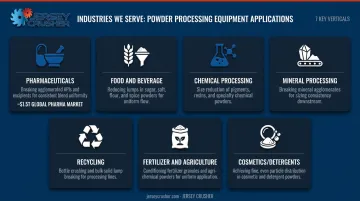
Jersey Crusher's equipment spans nearly all of these verticals — from food-grade 316 stainless steel lump breakers for pharmaceutical and food applications to abrasion-resistant configurations for mineral and recycling operations.
Safety Considerations in Industrial Powder Processing
Powder processing environments carry two primary hazards that demand engineered solutions, not just procedural controls.
Combustible Dust Explosion Risk
Fine airborne particles can form explosive clouds when concentrations reach the minimum explosible concentration (MEC). The U.S. Chemical Safety Board identified 281 combustible dust incidents between 1980 and 2005, resulting in 119 deaths and 718 injuries — numbers that make the hazard difficult to dismiss.
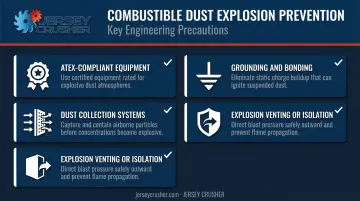
Common combustible powders include aluminum, magnesium, wood dust, flour, and sugar. NFPA 652 (active) and the consolidated NFPA 660 standard govern combustible dust risk management. Key precautions include:
- ATEX-compliant equipment selection (Directive 2014/34/EU for EU facilities)
- Proper grounding and bonding to prevent static discharge ignition
- Dust collection systems to keep airborne concentrations below MEC
- Explosion venting or isolation devices on process enclosures
Enclosed processing equipment addresses this risk at the source: material contained within sealed housings cannot disperse into the ambient air to form an ignitable cloud. Jersey Crusher's Lump Busters® and screw conveyors are designed with this principle in mind, with dust collection venting integration available for powder applications requiring additional containment.
Inhalation Hazards
Dust containment that prevents explosions also protects workers from inhalation exposure — the two hazards share a common engineering solution. OSHA sets the permissible exposure limit (PEL) for respirable crystalline silica at 50 µg/m³ (8-hour TWA), with an action level of 25 µg/m³. For general particulates not otherwise regulated, OSHA Table Z-1 limits the respirable fraction to 5 mg/m³.
Engineering controls are the first line of defense — enclosed processing equipment, local exhaust ventilation, and dust collection systems reduce exposure at the source before PPE is ever needed. Equipment with sealed conveyors, enclosed size reduction housings, and integrated dust venting reduces both explosion risk and worker respiratory exposure through the same design choices.
Frequently Asked Questions
What is industrial powder processing?
Industrial powder processing is the set of operations used to convert raw bulk materials into powders with controlled particle size, flowability, and composition. Pharmaceuticals, food, chemicals, and minerals all rely on the same core process steps — adapted to each sector's material specs and regulatory standards.
What are the main steps in a powder processing workflow?
The core sequence is: feeding, size reduction/comminution, classification, blending, drying, and packaging. Not every process uses all steps — the workflow is configured to the material properties and end-product requirements of each application.
Why is particle size so important in powder processing?
Particle size directly affects flowability, reactivity, compressibility, dissolution rate, and blend homogeneity. Get it wrong and the downstream consequences are immediate — a tablet that won't dissolve correctly, a food blend that won't stay uniform, a fertilizer that won't absorb at the right rate.
What is the difference between a lump breaker and a hammer mill?
Lump breakers use controlled shearing to gently reduce caked or agglomerated material, preserving product integrity and limiting fines. Hammer mills apply high-energy impact for fine and ultrafine particle sizes. In many workflows, lump breakers sit upstream of mills — delivering consistent feed and protecting the mill from oversized chunks.
What industries use industrial powder processing equipment?
Key industries include:
- Pharmaceuticals and food and beverage
- Chemical processing and fertilizer production
- Mineral processing and animal feed
- Cosmetics, detergents, and personal care
- Recycling, spice, and grain processing
Equipment categories are broadly similar across these sectors; material specifications, hygiene requirements, and regulatory standards vary considerably.
What are the main safety risks in powder processing facilities?
Combustible dust explosions and inhalation hazards are the primary concerns. Both are managed through enclosed equipment design, dust collection systems, proper grounding and bonding, and compliance with NFPA 652/660 and OSHA exposure limits for respirable dust and crystalline silica.