The cost compounds quickly. According to research by Ballantyne et al., crushing, grinding, and separation account for 35–50% of total mine operating costs — meaning inefficiency at any stage of the processing line has an outsized financial impact.
This guide covers the four core stages of mineral powder processing, the key equipment used at each stage — from lump breakers and crushers through grinding mills, classification systems, and material handling equipment — and a practical framework for matching the right machinery to your specific mineral and output requirements.
Key Takeaways
- Lump breakers and crushers condition raw mineral feed to consistent size before any grinding begins — skipping this step causes downstream wear and uneven output
- Mill selection drives final fineness: match equipment to mineral hardness, target mesh/micron range, and throughput before specifying anything else
- Screens, hydrocyclones, and air classifiers enforce particle size distribution specs — oversize loops back for regrinding until it passes
- Feeders and screw conveyors prevent surge loading and protect mill components; system integration determines whether throughput targets hold under real production conditions
The Four Stages of Mineral Powder Processing
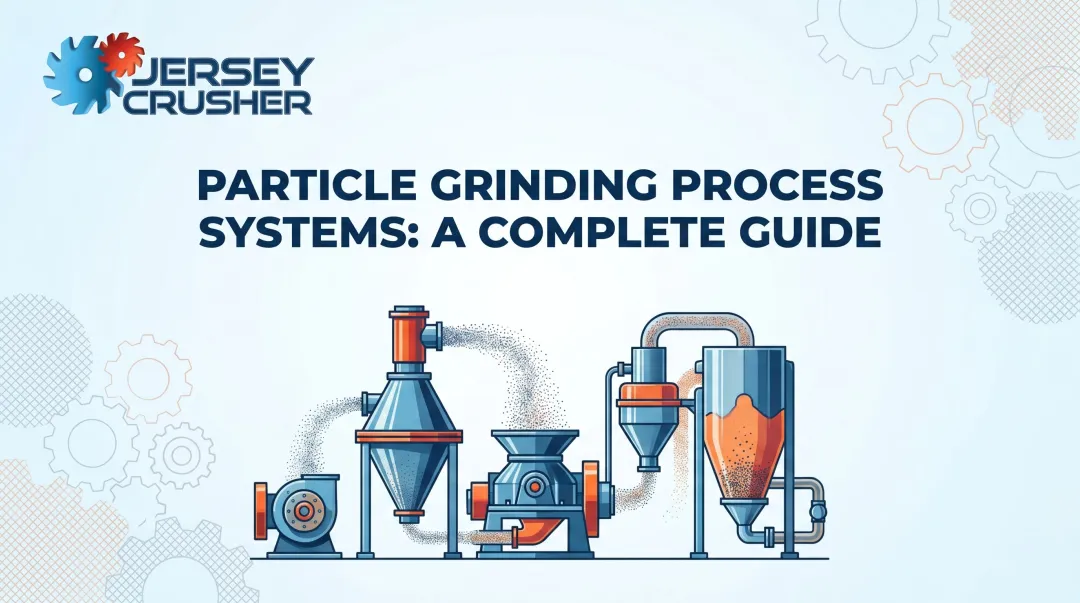
Most non-metallic mineral powder plants — processing limestone, calcite, barite, kaolin, silica sand, or similar materials — move material through four sequential stages:
| Stage | Function | Output |
|---|---|---|
| Stage 1: Comminution | Primary and secondary size reduction of raw ore | Manageable feed size for grinding |
| Stage 2: Grinding | Fine powder production to target mesh or micron spec | Powder at target fineness |
| Stage 3: Classification | Particle size separation; oversize returned for regrinding | On-spec powder; recycled oversize |
| Stage 4: Concentration/Separation | Impurity removal (iron, titanium, density-based separation) | Purified mineral product |
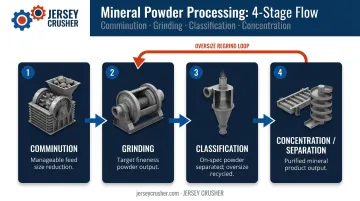
The output quality of each stage directly determines the next stage's efficiency. Feed material entering a ball mill with inconsistent particle sizes increases energy consumption, reduces throughput uniformity, and forces more regrinding cycles — all avoidable costs that trace back to inadequate primary crushing.
Size Reduction Equipment: Lump Breakers, Crushers, and Pre-Processing Tools
Raw mined minerals arrive as large chunks, caked masses, or agglomerated material that must be reduced to a consistent feed size before grinding can occur. This first stage is where many processing lines lose efficiency — oversized or irregular feed causes grinding equipment to work harder, wear faster, and produce uneven output.
Crushers vs. Lump Breakers: Choosing the Right First Stage
For hard rock circuits — granite, quartzite, iron ore, hard silicates — conventional crushers apply heavy compressive force and are suited for primary size reduction of dense ore. They are not the right tool for friable, agglomerated, or caked non-metallic minerals. On softer, more delicate mineral materials, that compressive force generates excessive fines and over-reduces product before it ever reaches the grinding stage.
Lump Breakers: Pre-Processing for Friable Minerals
For friable, agglomerated, or caked mineral materials — calcite, barite, limestone, potash, gypsum — lump breakers are the right first stage. They break material without the heavy pounding that generates unnecessary fines and degrades product quality.
Jersey Crusher's Lump Busters® use counter-rotating dual rotors that shear material between them rather than pound it. The finger-pattern rotor geometry fractures agglomerated material along natural fault lines, delivering consistent output without the dust generation associated with hammer mills, ball mills, or pin mills.
Key design features that prevent over-reduction:
- Integrated size control screens with customizable hole diameters from ⅛" to 2" — material exits only after reaching the specified size
- Adjustable rotor speeds (300–1800 RPM) for precise, material-specific processing
- Air purge shaft seals on all units, protecting bearings from high particulate loading in dusty mineral environments
- Abrasion-resistant construction variants for aggressive minerals like limestone, which Jersey Crusher specifically identifies as requiring wear-resistant components
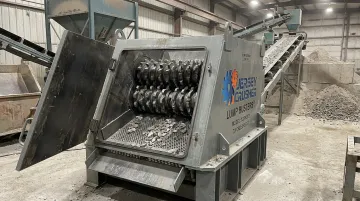
For limestone specifically, Jersey Crusher notes that pre-conditioning material with a lump breaker before it enters crushers or grinding mills protects downstream equipment and stabilizes feed rates. The Lump Busters® line includes eight model sizes — from Model 1515 through the heavy-duty Model 6464 — covering operations from small-batch processing to high-volume industrial mineral lines. Customers can ship material samples to Jersey Crusher's Wayne, NJ facility for engineering evaluation before specifying a model.
Particle-izers: Intermediate Size Reduction
Jersey Crusher's Particle-izers handle intermediate size reduction — where a Lump Buster® brings material down to roughly ¼ inch, Particle-izers continue reduction down to 100 mesh or smaller. That makes them a practical step between coarse lump breaking and a ball mill or Raymond mill.
Documented mineral applications include:
- Gypsum
- Limestone
- Calcite
- Dolomite
- Marble
- Phosphorite
Available in 10" to 48" sizes with adjustable screens, Particle-izers produce consistent, evenly-sized particles. For operations running high-volume mineral lines, pairing a Lump Buster® with a Particle-izer upstream of the primary grinding mill is a straightforward way to stabilize feed quality and reduce mill wear.
Grinding Equipment for Fine Mineral Powder
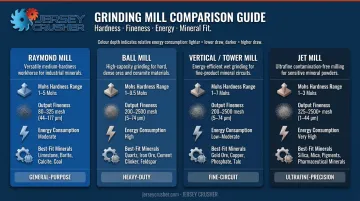
Grinding reduces pre-conditioned material to the target powder fineness, expressed in mesh (e.g., 200 mesh = 75 microns, 325 mesh = 45 microns) or D50/D97 values. Mill selection depends on four factors: mineral hardness (Mohs scale), target fineness, required throughput, and whether wet or dry processing is used.
Mill selection depends on four factors: mineral hardness (Mohs scale), target fineness, required throughput, and whether wet or dry processing is used. The equipment described below represents downstream fine-grinding stages — typically receiving pre-conditioned feed from upstream lump breakers and particle size reducers.
Raymond Mills
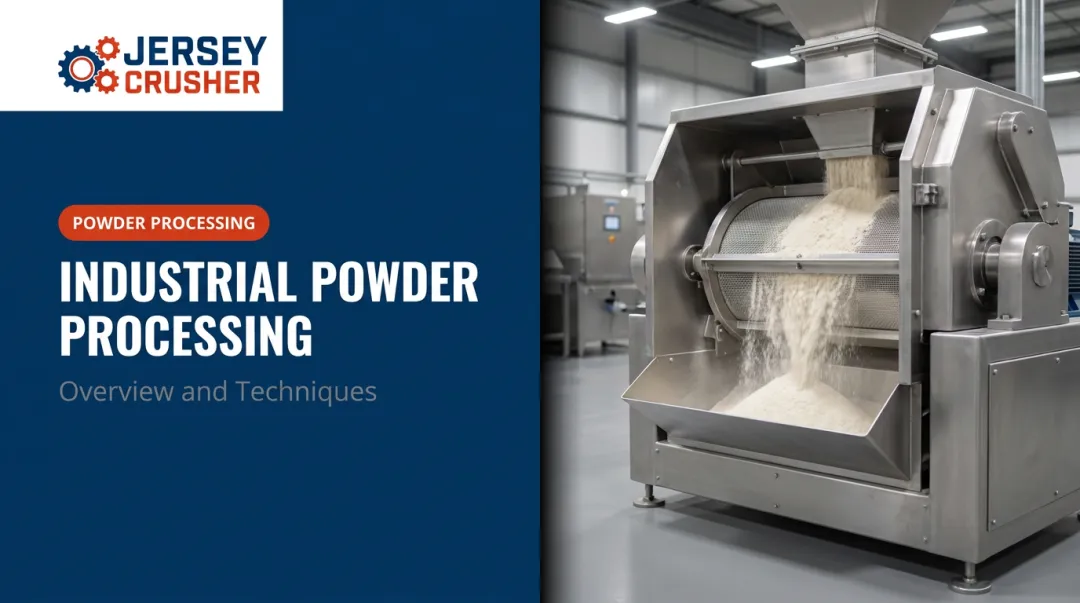
Raymond mills (roller mills) are well-suited for soft to medium-hard non-metallic minerals. Typical operating parameters include:
- Hardness: Mohs below 7
- Moisture: below 6%
- Output fineness: 80–400 mesh
- Typical minerals: limestone, calcite, barite, talc, bentonite
Their integrated grinding-and-classification design produces powder in a single pass, and their relatively compact footprint makes them practical for medium-scale operations. Raymond roller mills generally accept feed around 10–50 mm — making upstream lump breakers and Particle-izers a natural fit for preparing feed to this specification.
Ball Mills
Ball mills use steel ball-liner impact grinding and handle mineral types that exceed Raymond mill hardness limits: iron ore, lithium ore, copper ore, and other hard minerals. They operate in wet or dry modes and suit a wide range of circuit designs.
Key operating characteristics:
- Circuit requirement: Closed-circuit with a hydrocyclone or air classifier to hit target fineness
- Optimum circulating load: ~250% in closed-circuit ball mill-cyclone systems
- Primary trade-off: High energy draw relative to other mill types
According to CEEC's 2021 mining energy analysis, comminution accounts for roughly half of mine-site energy consumption. That makes mill selection as much an operating cost decision as a capital one.
Vertical Mills and Ultrafine Mills
For large-scale operations where energy efficiency is a priority, vertical fine grinding mills offer a documented advantage. FLS reports that its vertical Tower Mill reduces energy consumption by 25–50% versus traditional horizontal ball mills at equivalent feed and product sizes , a meaningful difference at industrial throughput.
Ultrafine mills extend the fineness range further, producing powders in the 325–2500 mesh range for high-value-added minerals like kaolin, heavy calcium carbonate, and talc where particle size directly determines product value.
Jet Mills
Jet mills occupy the premium end of the fineness spectrum. They grind by particle-on-particle collisions in a high-velocity gas stream with no mechanical grinding media contacting the product, which eliminates contamination risk. Hosokawa Alpine reports fineness down to d97 = 1 micron; NETZSCH's CGS fluidized bed jet mill achieves d97 = 2–70 microns.
Jet mills are best suited for:
- Ultra-high purity applications (pharmaceutical, electronics, specialty minerals)
- Low-volume, high-value products where tight particle size distribution justifies higher capital and operating cost
- Any application where grinding media contamination is unacceptable
Classification and Separation Equipment
Classification equipment controls which particles advance and which return for regrinding. On-spec powder moves to packaging or downstream use; oversize recirculates until it meets the target cut-point. That closed-loop mechanism is what delivers consistent particle size distribution across a mineral powder line.
Screening Equipment
Vibrating screens sort crushed and ground particles by size at multiple circuit stages. Trommel screens — which use tumbling and lifting action — are preferred for high-moisture or high-clay-content ores where standard wire screens blind or clog.
Screen selection must match the target cut-point and circuit throughput. Screens at the lump breaking stage handle coarser cuts; those downstream of grinding handle finer separations. For sub-100-micron work, mechanical screens give way to fluid or air-based classification.
Hydrocyclones and Air Classifiers
These two technologies handle fine classification in closed grinding circuits:
- Hydrocyclones use centrifugal force in wet circuits with no moving parts, keeping maintenance low. FLS KREBS units are widely used for fine particle separation in mineral classification circuits.
- Air classifiers are the dry-circuit equivalent: controlled airflow separates fine powder from coarser particles. Hosokawa covers d97 = 2–200 microns; NETZSCH turbo-classifiers reach cut points below d98 = 3.5 microns at throughputs exceeding 50 t/h.
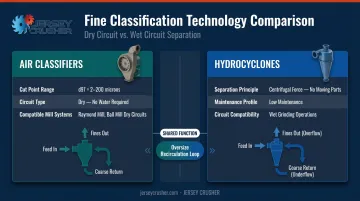
Air classifiers are the standard pairing for dry Raymond mill or ball mill circuits. Hydrocyclones serve wet grinding operations.
Magnetic and Gravity Separation Equipment
Impurity removal determines whether a non-metallic mineral powder meets purity specifications for glass, ceramics, paper, or pharmaceutical fillers:
- Magnetic separators (wet and dry types) remove iron and titanium-bearing minerals. Eriez DHIMS units cover silica sand, calcium carbonate, feldspar, and bauxite; SLon separators target iron/titanium removal specifically in kaolin processing.
- Gravity separation equipment uses spiral concentrators and shaking tables to separate minerals by specific gravity — no chemicals required, which eliminates process effluent and keeps operating costs down for heavy mineral concentration.
Material Handling and Auxiliary Equipment
Feeders, conveyors, and system integration equipment determine whether a mineral powder processing line runs smoothly or lurches from one bottleneck to the next.
Volumetric feeders meter material at a consistent, controlled rate into each processing stage, preventing the feed surges that cause equipment overload or output variation. Jersey Crusher's volumetric feeders integrate directly with their Lump Busters®, Particle-izers, and screw conveyors, and are available in stainless steel configurations for mineral applications.
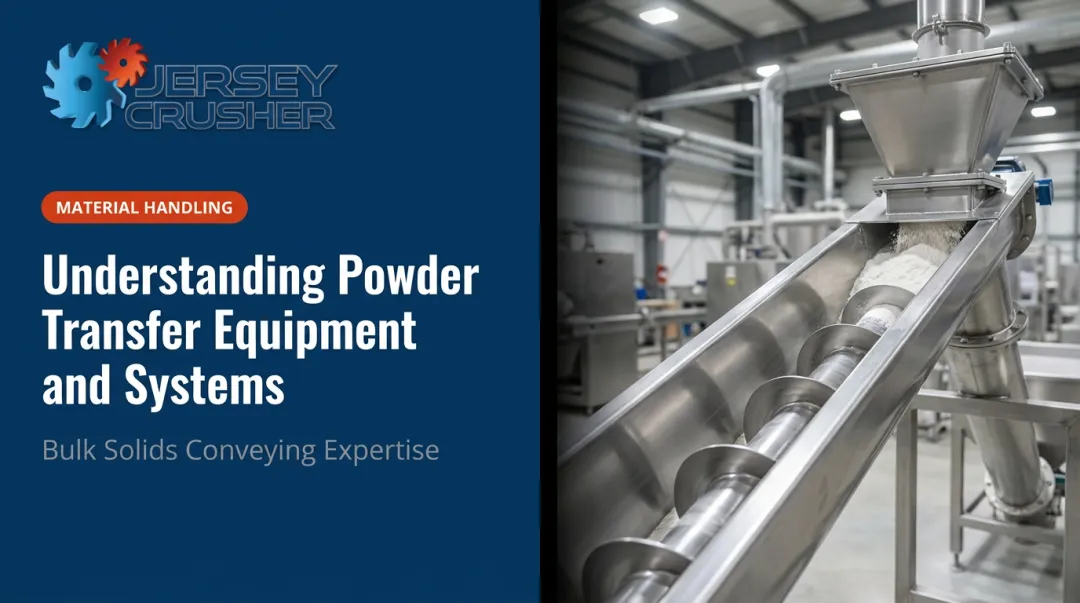
Screw conveyors are the preferred enclosed transport method for fine mineral powders between stages. Jersey Crusher offers screw conveyors in multiple material configurations to match the demands of mineral processing:
- Carbon steel (painted with blue enamel for durability)
- 304 SS and 316 SS for corrosion-sensitive environments
- Abrasion-resistant variants designed for aggressive mineral materials
Standard configurations include 6-inch diameter units in horizontal, inclined, and portable arrangements; custom geometry is available to match existing plant layouts.
When wet processing is used upstream, moisture content in mineral concentrates must be addressed before material enters size reduction or conveying stages. Jersey Crusher's engineers account for these upstream conditions when specifying integration points.
For system integration, Jersey Crusher's engineering team evaluates existing conveyor systems, rotary valve assemblies, and discharge points to ensure new equipment fits cleanly into an existing line. This includes specifying flange alignment, hopper geometry, and handoff to downstream automated systems.
How to Choose the Right Mineral Powder Processing Equipment
Start with Material Characterization
Equipment selection begins with knowing your material. The key parameters:
- Mohs hardness — talc (1), kaolin (2–2.5), calcite (3), barite (3–3.5), quartz/silica (7)
- Moisture content — dry, free-flowing material suits lump breakers and Particle-izers directly; sticky or high-moisture material may cake in hoppers and requires pre-drying or wet circuit considerations before dry size reduction
- Abrasiveness — determines construction material: carbon steel, 304/316 SS, or abrasion-resistant variants
- Target particle size — expressed in mesh or D50/D97; 200 mesh = 75 microns, 325 mesh = 45 microns
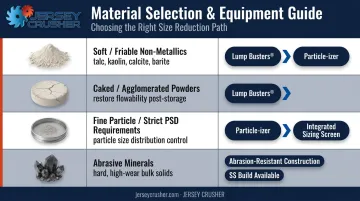
A quick reference framework:
| Material Type | Recommended Approach |
|---|---|
| Soft/friable non-metallics (talc, kaolin, calcite, barite) | Lump Busters® or Lump Abradors for lump/agglomerate breakdown → Particle-izer for fine, uniform particle production |
| Caked or agglomerated mineral powders in storage or post-production | Lump Busters® to restore flowability before downstream processing |
| Fine particle requirements with strict size distribution | Particle-izer with integrated sizing screen (hole diameters ⅛" to 2"+, customizable) |
| Abrasive minerals requiring durable construction | Jersey Crusher equipment configured in abrasion-resistant or 304/316 SS construction |
Balance Capital Cost Against Operating Cost
Upfront equipment price is only part of the cost picture. For mineral powder processing, the operating cost factors that accumulate over equipment life include:
- Energy draw relative to throughput — oversized equipment running at partial capacity wastes power
- Wear part replacement frequency — abrasive minerals accelerate liner and screen wear; construction material selection directly affects maintenance spend
- Downtime cost — spare parts availability matters as much as initial build quality; Jersey Crusher maintains spare parts for its full Lump Busters®, Particle-izers, and Screw Conveyor lines
Engineered-to-order equipment sized correctly for your actual throughput rate typically delivers lower total cost of ownership than off-the-shelf units selected on price alone.
Non-Negotiable Selection Criteria
Beyond material fit and economics, every equipment decision should address:
- Throughput capacity matched to the circuit's design rate
- Maintenance access and spare parts availability — Jersey Crusher maintains spare parts for their full Lump Busters®, Particle-izers, and screw conveyor lines
- Environmental and safety compliance — dust containment, noise levels, and enclosure requirements
- Customization for your specific material — Jersey Crusher's free sample evaluation service lets prospects ship material to the Wayne, NJ facility for engineering analysis before committing to a configuration
Frequently Asked Questions
What equipment is used in mineral processing?
Mineral powder processing lines typically include size reduction equipment (lump breakers, crushers, particle-izers), classification systems (screens, air classifiers), separation equipment, and auxiliary handling equipment such as volumetric feeders and screw conveyors. The right combination depends on your mineral type, target particle size, and throughput requirements.
What grinding machine is used in mineral processing?
Selection depends on hardness, moisture content, and target fineness. For friable, non-metallic minerals, lump breakers and particle-izers deliver controlled size reduction without the over-grinding risks associated with heavy-impact mills. Hard, abrasive ores may require more aggressive crushing stages upstream before fine grinding. Always match the reduction method to the material's physical properties — the wrong approach wastes energy and degrades product quality.
What is the difference between a lump breaker and a crusher in mineral powder processing?
Crushers apply heavy compressive force for hard rock size reduction — appropriate for granite, quartzite, and hard ores. Lump breakers use controlled shear action to gently break up friable, caked, or agglomerated materials without over-reducing, making them the preferred first-stage solution for non-metallic and chemical minerals where fines generation must be minimized.
What is particle size distribution and why does it matter?
Particle size distribution (PSD) describes the range of particle sizes present in a powder batch. HORIBA defines D50 as the size at which half the distribution is smaller and half is larger. Tight, consistent PSD is critical because downstream industries — ceramics, pharmaceuticals, paper, fillers — specify narrow size ranges, and inconsistent PSD leads to product rejection and processing inefficiency.
How do I know which size reduction equipment is right for my mineral?
Start with Mohs hardness, moisture content, target output size, and required capacity, then match those characteristics to the appropriate equipment type as outlined in the selection framework above. For non-standard materials, submitting a sample for engineering evaluation — a service Jersey Crusher provides — confirms equipment fit before you commit to a configuration.
Can mineral powder processing equipment handle highly abrasive materials?
Yes. Equipment is available in carbon steel, 304 SS, 316 SS, and abrasion-resistant construction specifically engineered for aggressive minerals. Jersey Crusher's Lump Busters®, for instance, are built for hard mineral applications — and specifying the correct screen material and wear-part grade is what separates a machine that lasts from one that fails early.