Key Takeaways
- Particle size directly controls bioavailability and blend homogeneity in nutraceutical powders
- Raw materials almost always arrive with lumps or agglomerates that need breaking before milling or blending
- Processing follows a fixed sequence: lump breaking → fine milling → screening and classification
- Material fragility, heat sensitivity, and moisture sensitivity determine which equipment is right for each ingredient
- Wrong equipment selection degrades potency and produces inconsistent batches
What Is Nutraceutical Powder Size Reduction?
Size reduction is the controlled mechanical breakdown of solid nutraceutical materials into a uniform powder within a target particle size range. Raw inputs — vitamins, herbal extracts, proteins, probiotics, mineral compounds — arrive in bulk or agglomerated form and must be processed to specification before they're usable.
The goal isn't just smaller particles. It's a consistent, specification-ready particle size distribution that supports:
- Reliable dissolution and bioavailability of active ingredients
- Accurate blending without segregation
- Predictable flow through filling and compression equipment
- Batch-to-batch repeatability for GMP compliance
Three distinct processes are often conflated under the term "size reduction" — and treating them as interchangeable creates problems:
| Process | Purpose | Stage |
|---|---|---|
| Lump breaking | Break coarse agglomerates and caked material | First |
| Milling | Reduce particles to target specification range | Second |
| Screening/classification | Verify size distribution, remove oversize material | Third |
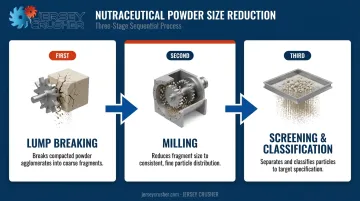
Each stage depends on the one before it. Running caked material directly into a fine mill bypasses lump breaking entirely — the result is uneven particle size, accelerated mill wear, and blend segregation that shows up at the tablet press or filling line.
Why Particle Size Matters in Nutraceutical Manufacturing
The Bioavailability Connection
Particle size directly determines whether a supplement works as intended. A 2024 study published in PMC demonstrated this clearly with curcumin: nanocrystal formulations achieved 80% dissolution in under 2 minutes, with a 1.68x higher Cmax compared to unprocessed curcumin. Curcumin metabolite AUC was 4.07x higher in the nanocrystal group.
Smaller isn't universally better. A calcium carbonate RCT comparing 13.5 µm and 18 µm particles found no absorption advantage for the finer size in adolescent girls. Particle size targets must be defined by the formulation — not minimized by default.
Lump Formation Is Routine, Not Exceptional
Many nutraceutical raw materials are hygroscopic, absorbing moisture during storage and shipping and bonding into cakes, lumps, and agglomerates. Research on sodium ascorbate powders found that relative humidity and anticaking-agent type significantly affected physical stability across conditions from 23% to 98% RH.
The problem isn't limited to vitamins. High-protein milk concentrate powders showed glass transition temperatures dropping to just 16°C at 44% RH, meaning standard warehouse conditions can push protein powders past their physical stability threshold.
What Goes Wrong Without Size Reduction
A 2021 review of tablet powder segregation confirmed that particle size differences are a primary driver of blend segregation — a blend that looks uniform in one vessel can partially unmix by the time it reaches the next step. Research on ergocalciferol (vitamin D2) blends showed that homogeneity depends on particle size, size distribution, and density together, not any single variable alone.
The downstream consequences of skipping size reduction include:
- Inconsistent capsule fill weights and tablet compression
- Poor flow through feeders and filling equipment
- Segregation by density and size during transfer
- Batch failures during QC particle size distribution testing
How Nutraceutical Powder Size Reduction Works
Step 1: Lump Breaking
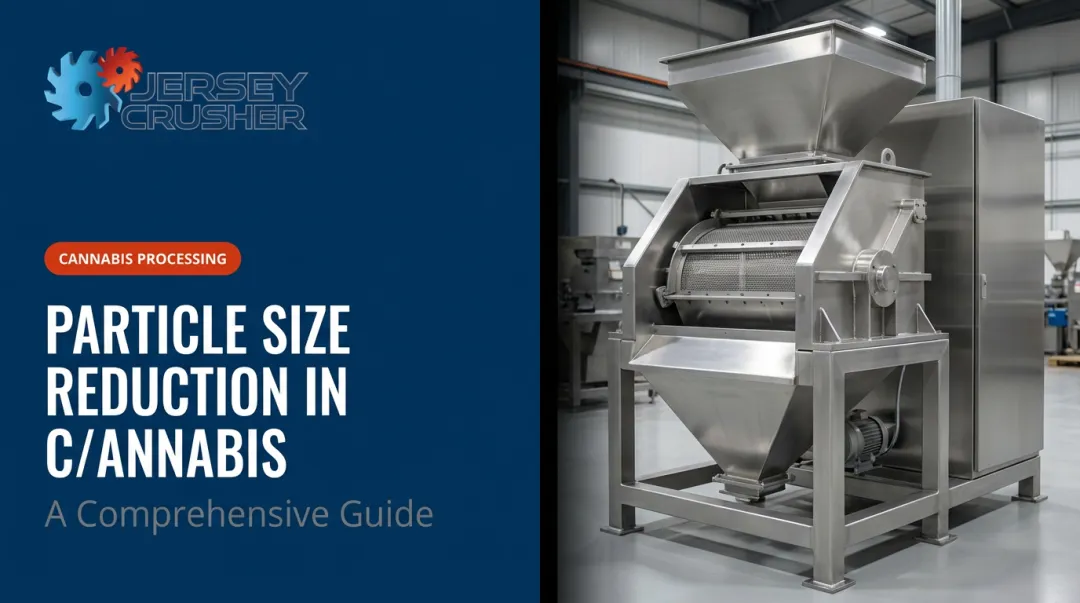
Lump breaking is the entry point and the most commonly skipped step. It handles coarse agglomerates and caked bulk material before fine milling equipment ever sees the product.
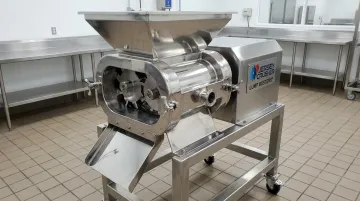
Lump breakers use counter-rotating dual rotor shafts to shear material between them, fracturing lumps through compression and controlled shear rather than high-impact force. For nutraceutical actives, that difference is critical: heavy pounding generates heat and mechanical stress that can degrade heat-sensitive ingredients before they ever reach the mill.
Jersey Crusher's Lump Busters® are engineered specifically for this kind of friable material processing, breaking material without the heavy pounding of hammers, balls, or pin mills. Integrated size reduction screens with customizable hole diameters from ⅛" to 2"+" control the output particle size range, so material leaving the lump breaker is sized to specification before moving downstream.
For nutraceutical applications, units are available in 316 stainless steel (the sanitary-grade choice for GMP environments) with optional food-grade white epoxy interior finishes for non-contact surfaces.
Standard on every unit: air purge shaft seals that prevent process material from migrating into bearing assemblies — critical for preventing cross-contamination between product changeovers in regulated facilities.
Step 2: Fine Milling
Once coarse material has been pre-broken, fine milling reduces particles to the target specification range. Common approaches include:
- Conical milling — gentle, controlled particle size reduction suitable for friable materials with tight distribution requirements
- Hammer milling — higher throughput but generates more heat and impact force; not suited for heat-sensitive actives
- Jet milling — ultra-fine particle reduction using compressed air; appropriate for very fine specifications but energy-intensive
For heat-sensitive nutraceuticals, temperature during milling is a real constraint. Probiotic viability can be negatively affected by temperatures above 45°C during processing, and probiotic dry matrix water activity above 0.25 affects cell viability as a separate risk. Cryogenic milling chills material before and during reduction, which works for extremely temperature-sensitive actives — though it adds process complexity and cost.
Jersey Crusher's Particle-izer line handles fine particle reduction beyond what lump breakers are designed for, producing evenly-sized particles down to 100 mesh or smaller in 316 SS construction for sanitary applications.
Step 3: Screening and Classification
Screening follows milling to verify particle size distribution and catch oversize material before it reaches blending or filling. Per USP <811>, powders are classified by median particle size:
| Classification | x50 Range |
|---|---|
| Coarse | >355 µm |
| Moderately Fine | 180–355 µm |
| Fine | 125–180 µm |
| Very Fine | ≤125 µm |
Analytical sieving is most suitable when most particles exceed ~75 µm. Oversize material identified during screening is returned for re-milling.
Screening also serves as a contamination check — 21 CFR 111.365(i) requires effective measures including filters, strainers, or magnets to protect against foreign material during processing.
Key Factors That Affect Size Reduction Outcomes
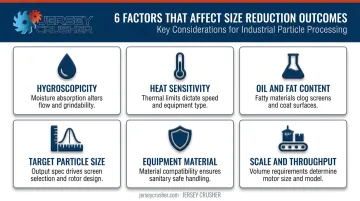
These variables directly affect whether size reduction hits spec — or damages the ingredient before it ever reaches blending:
- Hygroscopicity — moisture-absorbing ingredients re-cake quickly if exposed to ambient humidity during processing; environmental humidity control is as critical as equipment selection
- Heat sensitivity — probiotics, certain vitamins, and encapsulated actives require low-friction, low-temperature milling configurations; the wrong equipment causes potency loss before the product is even blended
- Oil and fat content — high-fat materials (some botanical extracts, certain proteins) can smear rather than fracture during milling; pre-chilling before reduction is often necessary
- Target particle size and distribution — a tight particle size distribution matters more for blending homogeneity than hitting a specific average; select equipment and screens for consistent distribution, not just mean particle size
- Equipment material of construction — food-contact surfaces must meet GMP hygiene standards; 316 SS is standard for sanitary nutraceutical applications, with 304 SS acceptable for less critical environments
- Scale and throughput — particle size behavior changes between lab scale and production scale; equipment must be validated at the intended production throughput
Common Misconceptions
Smaller particles are always better. The curcumin nanocrystal data supports particle size reduction for poorly soluble botanicals. The calcium carbonate data doesn't. For some materials, overly fine particles worsen flowability, increase dust generation and static charge, and can cause re-agglomeration. Target particle size should come from downstream formulation requirements, not from minimizing mean size.
Lump breaking is optional. It isn't — for any material that has caked in storage. Feeding agglomerated material directly into a fine mill overloads the equipment, produces inconsistent output, and risks damage or unplanned downtime. Lump breaking is a prerequisite, not a shortcut.
Fine milling is fine milling. Method matters. A hammer mill on a probiotic powder can exceed the 45°C thermal threshold that degrades cell viability. A conical mill on heavily caked herbal extract may stall without pre-breaking.Before specifying any mill, confirm your material's thermal sensitivity, moisture content, and agglomeration behavior — then match equipment to those constraints, not the other way around.
Combustible dust is someone else's problem. Equipment selection decisions directly create safety risk. Particles smaller than 420 µm — those passing a U.S. No. 40 sieve — meet the combustible-dust particle-size criterion under OSHA guidance. Grinding, sifting, and screening all generate this hazard. Dust collection and explosion prevention belong in the process design from the start. NFPA 660 and NFPA 61 set the governing requirements for food and agricultural processing facilities.
Frequently Asked Questions
What is nutraceutical powder?
Nutraceutical powder is a bioactive ingredient or blend — vitamins, minerals, herbal extracts, proteins, or probiotics — processed into fine powder form to improve bioavailability, enable accurate dosing, and allow incorporation into capsules, tablets, sachets, or drink mixes.
What are common nutraceutical powder processing methods?
The four primary methods are:
- Lump breaking — coarse size reduction of agglomerated material before downstream processing
- Fine milling — conical, hammer, or jet milling to reach target particle size
- Blending — achieving uniform distribution across all ingredients
- Screening/classification — verifying particle size and removing oversize material or contaminants
What are examples of nutraceutical products?
Common products relying on powder processing include protein powders (whey, pea, rice), green superfood blends, pre-workout and recovery formulas, vitamin and mineral supplements, collagen peptides, probiotic powders, and herbal extract supplements.
Why do nutraceutical powders form lumps during storage?
Most nutraceutical ingredients are hygroscopic — they absorb moisture from ambient air, causing particles to bond into lumps or cakes. High-fat or high-sugar ingredients, temperature fluctuations, and compression during packaging accelerate this process, making lump breaking a routine first step before blending or milling.
What particle size is ideal for nutraceutical powders?
Target particle size depends on your formulation and delivery format. Finer particles improve dissolution and bioavailability, but overly fine powders reduce flowability and increase dusting and clumping risks. USP <811> provides the standard classification framework, and your target should always be validated against downstream requirements.
How do I know which size reduction equipment is right for my material?
The most reliable method is to test your actual production material. Jersey Crusher offers a free sample evaluation service — ship a freight-prepaid sample to the Wayne, NJ engineering team and receive a custom equipment recommendation based on your material's physical properties and particle size targets. Contact Jersey Crusher at 973-686-5999 to arrange sample shipping.