How does a rotary crusher work?
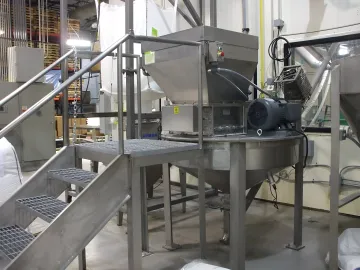
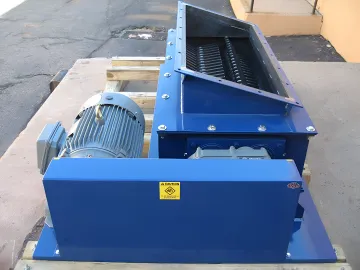
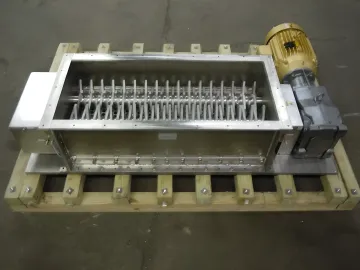
A rotary crusher uses one or more high-speed rotating rotors fitted with blades, fingers, or hammers to impact, shear, or abrade material fed into the crushing chamber. As material contacts the spinning rotor, it is broken against fixed breaker bars or screen grids until particles are small enough to pass through the screen apertures, delivering controlled, consistent particle size output.
What crusher is best for hard rock?
For hard and abrasive bulk solids such as ore, coal, clay, lime, and mineral feedstock, Jersey Crusher's Lump Busters® are best suited. They use counter-rotating dual rotors that shear material between them, making them ideal for heavy-duty size reduction of dense agglomerates. Abrasion-resistant material construction variants are also available for aggressive bulk solids applications in mining and minerals processing.
What is the difference between a Lump Buster® and a Lump Abrador?
Lump Busters® use counter-rotating dual rotors that shear material between them — ideal for heavy-duty size reduction of dense agglomerates. Lump Abradors use a single large-diameter rotor with impacting fingers that gently abrade material, preserving particle morphology. Choose Lump Abradors when downstream processes require intact particle shape, such as pharmaceutical API liberation or spice de-agglomeration.
What particle sizes can Jersey Crusher rotary crushers achieve?
Jersey Crusher's rotary crusher range covers coarse reduction (up to 2 inches), fine reduction (down to ¼ inch), and ultra-fine particle production down to 100 mesh or smaller. Screen hole diameters are customizable from ⅛ inch to 2 inches and beyond, with Particle-izers designed specifically for 100 mesh and finer applications in pharmaceutical, cosmetic, and food industries.
What industries use rotary crushers?
Rotary crushers are widely used in food and beverage processing (sugar, spices, chocolate), pharmaceutical manufacturing, chemical processing, fertilizer production, mining and minerals, agriculture and animal feed, cosmetics manufacturing, cannabis processing, recycling, and foundry operations. Jersey Crusher's product line is engineered to serve all these industries with material-appropriate construction options.
Are Jersey Crusher rotary crushers suitable for food and pharmaceutical applications?
Yes. All three rotary crusher lines are available in 316 Sanitary Stainless Steel construction with food-grade white epoxy interior finish options, air purge shaft seals to prevent cross-contamination, and tool-free screen changes on sanitary units. These features align with FDA-adjacent food processing, GMP pharmaceutical manufacturing, and cosmetics industry cleanliness requirements.
When should I use a Particle-izer instead of a Lump Buster® or Lump Abrador?
A Particle-izer is the right choice when your application requires ultra-fine, evenly-sized particle production down to 100 mesh or smaller. It is specifically engineered for industries with strict particle uniformity demands, including pharmaceutical, cosmetic, cannabis, fertilizer, and food manufacturing. If your target particle size is coarser than 100 mesh, a Lump Buster® or Lump Abrador will typically be more appropriate.
Can I test my material before purchasing a rotary crusher?
Yes. Jersey Crusher offers a free product sample test and evaluation service. Ship your material sample freight-prepaid to Jersey Crusher's Wayne, NJ facility, and their engineering team will analyze the product, determine the optimal machine configuration, and provide a tailored equipment recommendation. Call 862-356-6112 for sample shipping details.